Key Takeaways
- Definition: Operational excellence is a strategic framework for executing business strategy more consistently and reliably than the competition. It focuses on creating more value for the customer by eliminating waste and continuously improving processes.
- Modern Approach: In the B2B context, this means leveraging AI and automation to scale revenue without a proportional increase in costs or operational complexity.
- Core Methodologies: Key toolkits include Lean (eliminating waste), Six Sigma (reducing defects and variation), and the Theory of Constraints (TOC) (fixing the single biggest bottleneck).
- ROI Focus: Success is measured through ROI-centric KPIs like Customer Acquisition Cost (CAC), Sales Cycle Length, and Administrative Debt Reduction, which translates saved time into direct cost savings.
- Action Plan: Implementation follows a structured 30-60-90 day plan: diagnose the primary bottleneck, launch a targeted pilot project to solve it, and then use the data to prove ROI and justify a wider rollout.
At its core, operational excellence is a strategic framework for creating more value for the customer with less waste. For B2B leaders, this translates into a system for scaling revenue without scaling headcount or operational complexity at the same rate. The primary goal is to build a resilient, efficient organization by continuously improving processes, empowering teams, and leveraging technology to eliminate non-value-added activities.
This guide provides a B2B-focused roadmap for implementing operational excellence. We will move past academic theory to focus on how AI-driven automation is a critical enabler, automating workflows, reducing administrative debt, and delivering the data-driven insights necessary for a competitive advantage.

From here, we will lay out a clear framework for putting these principles into practice, with a sharp focus on ROI-centric KPIs to measure what matters and justify the investment. It’s all about turning process improvement into tangible business results.
Core Pillars Of Modern Operational Excellence
Operational excellence is built on four interdependent pillars that create a foundation for continuous improvement and sustainable growth. The answer-first approach requires establishing a culture of continuous improvement, aligning all activities with customer-centric value, empowering teams to solve problems, and leveraging AI-driven automation to eliminate low-value work. Together, these pillars transform operations from a cost center into a strategic value engine.
This approach represents a mindset shift—from reactively fighting fires to proactively engineering a system of continuous improvement, fueled by data and powered by intelligent technology. The table below outlines the key components that define operational excellence in a modern B2B environment.
| Pillar | Description | Actionable B2B Workflow |
|---|---|---|
| Continuous Improvement | A cultural commitment to making small, consistent enhancements to processes, products, and services to cut out waste and boost value. | Conduct a quarterly win/loss analysis to refine the sales qualification process, thereby improving lead conversion rates. |
| Customer-Centric Value | Defining value entirely from the customer's perspective and aligning every operational activity to deliver on that promise. | Map the entire customer onboarding journey to identify and eliminate friction points, directly reducing time-to-value. |
| Empowered Teams | Providing front-line employees with the authority, tools, and problem-solving skills to identify and resolve issues autonomously. | Authorize customer support teams to issue service credits up to a defined threshold without requiring managerial approval. |
| AI-Driven Automation | Using artificial intelligence to handle repetitive, low-value tasks, thereby freeing human capital for strategic, high-impact work. | Deploy an AI tool to automatically score and route inbound marketing leads to the most appropriate sales representative. |
These pillars are not abstract concepts; they are active principles that, when combined, create a powerful engine for scalable growth and enhanced profitability.
Defining Operational Excellence In The AI Era
Operational excellence is a state of execution where every employee can see, deliver, and improve the flow of value to the customer. For a B2B organization, this means implementing a framework for efficient scaling—growing revenue without a proportional increase in costs or complexity. It moves the organization away from isolated process fixes and toward a culture of sustained high performance.
Consider the contrast between a skilled artisan and a high-performance system. A talented mechanic can tune a single engine to perfection. An F1 team, however, practices operational excellence. They systematically refine every component of the racing operation—from pit crew choreography (people) and engine telemetry (data) to the car's aerodynamics (processes)—to achieve measurable improvements. This holistic, system-wide optimization is the essence of modern operational excellence.
Shifting From Cost Centre To Value Engine
The primary shift in modern operational excellence is reframing the operations function from a cost center to a strategic value engine that directly drives bottom-line results. This is now achievable because AI and automation have evolved from simple efficiency tools into foundational technologies that redefine an organization's capabilities. They connect previously siloed activities, providing a unified, intelligent view of the entire revenue lifecycle.
This strategic pivot delivers ROI-focused outcomes, including lower customer acquisition costs, shorter sales cycles, and higher revenue per employee.
- Reducing Administrative Debt: AI automates repetitive, low-value work such as data entry, report generation, and lead routing. This frees human capital to focus on strategic initiatives.
- Sharpening Revenue Operations (RevOps): By analyzing large datasets, AI can predict which leads are most likely to convert, identify bottlenecks in the sales funnel, and suggest optimizations for go-to-market strategies.
- Connecting Actions to ROI: Intelligent analytics enable leaders to draw a direct line from operational improvements to financial outcomes, such as measuring how automating lead qualification impacts sales cycle length and quarterly revenue.
The Tangible Impact On Productivity And Growth
This AI-driven approach delivers concrete business results. In the UK, operational excellence has been a key driver behind recent gains in labor productivity, particularly within the Information Technology sector.
Recent analysis shows that output per hour worked rose by 1.5% and output per worker by 1.1% compared to pre-pandemic levels. This was fueled by a 5.1% increase in gross value added (GVA) achieved with only 3.5% more hours worked. You can discover more insights from the TPI Productivity Lab about how these efficiency leaps are helping IT firms achieve scalable growth without a proportional rise in headcount.
Operational excellence is not a one-time project but a cultural commitment. It’s the relentless pursuit of perfection, knowing it can never be fully achieved, but that the journey itself creates a resilient, competitive, and highly profitable organisation.
Ultimately, defining operational excellence today means embracing a system where technology and human talent work in concert. It’s about building an organization that is not just efficient, but also agile, intelligent, and relentlessly focused on delivering superior customer value.
Choosing Your Toolkit: Lean, Six Sigma, and TOC Explained
Selecting the right methodology is the first step in implementing an operational excellence strategy. The three primary frameworks—Lean, Six Sigma, and the Theory of Constraints (TOC)—each provide a specialized toolkit for improving business performance. The optimal choice depends entirely on the specific problem you aim to solve.
For example, Lean is best suited for eliminating waste in a sales funnel, Six Sigma is designed to ensure flawless execution in a customer onboarding process, and TOC is laser-focused on resolving the single biggest bottleneck impeding the entire system, such as a delay in the lead-to-cash cycle. Understanding their distinct strengths allows B2B leaders to apply the right solution to the right problem for measurable results.
Lean: Eliminating Waste in the Value Stream
The primary solution offered by the Lean methodology is to deliver maximum customer value by systematically eliminating waste. In a B2B context, "waste" is defined as any activity that consumes resources but adds no value from the client's perspective. This includes redundant administrative tasks in a sales process or software features that customers do not use.
Lean methodology encourages viewing the entire operation as a value stream—the end-to-end journey of delivering a product or service. The objective is to make this journey as efficient as possible by removing roadblocks and non-value-added activities. For instance, a Lean analysis of a content marketing funnel might reveal that 30% of marketing's time is spent creating assets for a lead stage with a near-zero conversion rate. Reallocating that effort to a higher-performing stage is a classic Lean improvement that directly boosts ROI.
Six Sigma: Nailing Consistency and Slashing Defects
The core purpose of Six Sigma is to achieve precision, consistency, and quality by eliminating variation in a process until defects are virtually non-existent (no more than 3.4 defects per million opportunities). While originating in manufacturing, this principle is highly effective for B2B services.
For a customer support function, significant variation in response times (e.g., one client waits ten minutes, another ten hours) damages trust and degrades the customer experience. A Six Sigma project would analyze this workflow, identify the root causes of delays, and implement standardized processes to ensure every customer receives a consistent, high-quality service level.
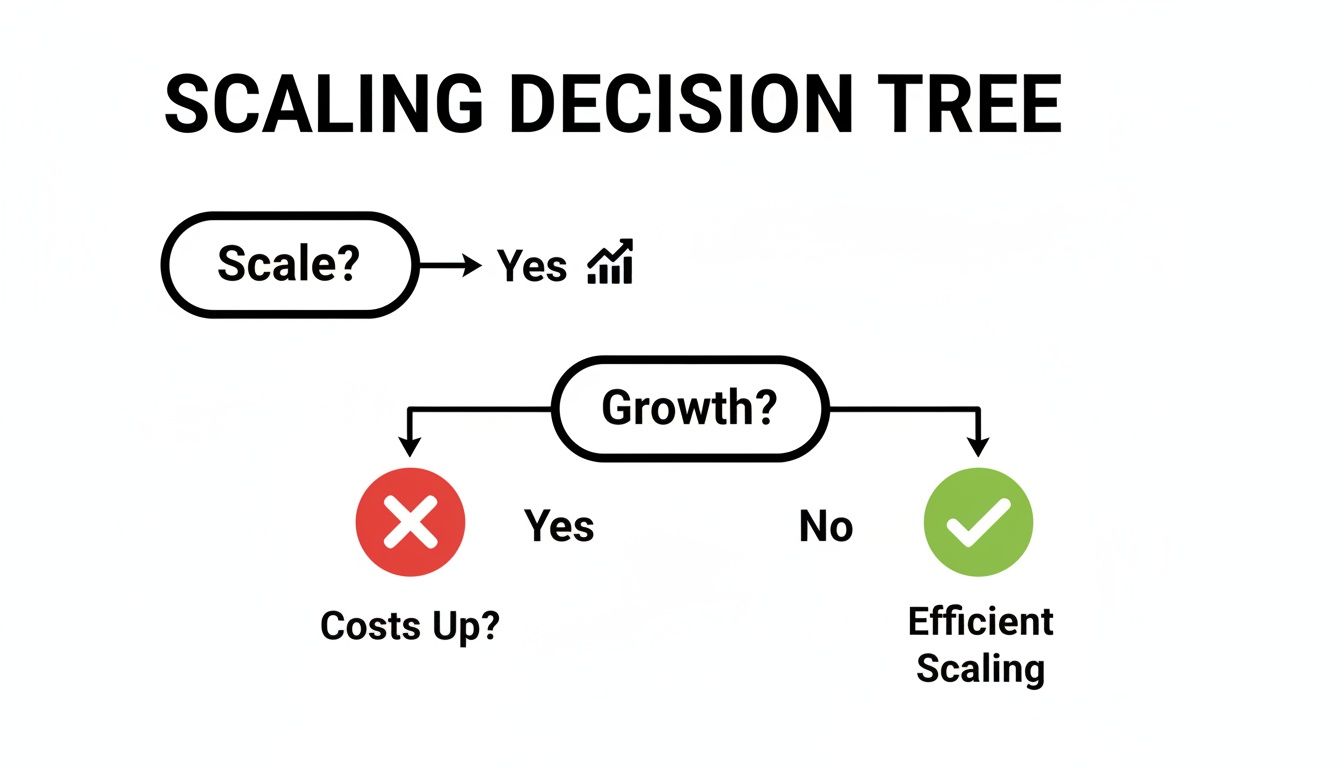
As the diagram illustrates, true operational excellence enables revenue growth without a corresponding increase in costs. This is a direct outcome of controlling process variation.
Theory of Constraints (TOC): Unblocking Your Biggest Bottleneck
The Theory of Constraints (TOC) operates on the principle that any complex system is limited by at least one constraint. This single bottleneck dictates the throughput of the entire operation. TOC's methodology is to identify this limiting factor and concentrate all improvement efforts on elevating its performance.
Consider a B2B revenue pipeline as a chain; its strength is determined by its weakest link. If a sales team can generate 100 qualified leads per week, but the legal team can only review 20 contracts in the same period, the legal department is the bottleneck. According to TOC, any effort to improve sales efficiency is wasted until the contract review constraint is resolved.
"The goal is not to improve one part of the system in isolation, but to elevate the performance of the entire system by focusing on its single biggest limiting factor."
The following table provides a technical comparison to guide your selection.
| Framework | Core Principle | Primary Goal | Best For (B2B Workflow) | Key Performance Indicator |
|---|---|---|---|---|
| Lean | Eliminate waste and maximize customer value. | Increase process speed and efficiency. | Streamlining complex workflows like sales funnels or product development. | Sales Cycle Length |
| Six Sigma | Reduce process variation and eliminate defects. | Improve quality and consistency. | Standardizing critical processes like customer onboarding or service delivery. | Customer Satisfaction (CSAT) Score |
| TOC | Identify and elevate the system's primary constraint. | Increase system throughput. | Fixing a single, major bottleneck holding back the entire revenue process. | Lead-to-Cash Time |
Ultimately, choosing the right framework is the first step. The real value is generated when its principles are applied to solve a specific business problem that is impeding growth.
How AI Powers Operational Excellence In B2B Growth
Artificial intelligence is the primary engine for modern operational excellence, enabling B2B growth functions to transition from reactive cost centers to proactive, data-driven revenue generators. The core solution AI provides is the automation of workflows and the delivery of predictive insights, which directly addresses the foundational goals of eliminating waste and creating customer value. This allows organizations to scale their impact without a proportional increase in headcount or resources, freeing human capital for strategic work.

Here, we examine high-impact, real-world applications within a Revenue Operations (RevOps) team. We will demonstrate the clear "before-and-after" impact of AI implementation, showing how intelligent systems deliver tangible results like shorter sales cycles, higher conversion rates, and reclaimed executive time.
Predictive Lead Scoring To Focus Sales Efforts
The primary solution offered by AI in sales is predictive lead scoring, which resolves the inefficiency of treating all inbound inquiries with equal urgency. This technology uses machine learning to analyze historical data, identify the attributes of ideal customers, and automatically prioritize new leads, ensuring sales teams always engage the highest-potential accounts first.
Before AI, a sales team might process leads chronologically, wasting valuable time on prospects with a low probability of conversion. This is an inefficient, low-ROI workflow. With AI, each new lead is automatically scored based on hundreds of data points (e.g., firmographics, technographics, online behavior). This creates a prioritized queue for the sales team.
- Before AI: Sales development representatives (SDRs) spend up to 40% of their time on manual lead research and qualification, with inconsistent outcomes.
- After AI: SDRs receive a continuously updated, ranked list of prospects. This allows them to focus on relationship-building and closing, which can lead to an increase in qualified lead conversion rates of up to 50%.
This is not merely an efficiency gain; it is an effectiveness multiplier that directly impacts revenue by shortening the sales cycle.
Automated Lead Nurturing And Management
AI-powered automation provides the solution for engaging prospects at scale without sacrificing personalization. It executes complex nurturing sequences that are impossible to manage manually, ensuring no lead is neglected and that communication remains consistent and relevant.
Consider a prospect who downloads a whitepaper. Without AI, they might receive a single, generic follow-up and then be forgotten. With an AI-driven workflow, that same prospect is automatically enrolled in a tailored nurturing sequence. The AI sends personalized emails based on their industry and job title, suggests relevant content, and alerts a sales representative when the prospect's engagement level indicates they are sales-ready.
By automating these critical touchpoints, AI ensures no lead ever falls through the cracks. It maintains consistent engagement, building trust and keeping your brand top-of-mind until the prospect is truly sales-ready.
This systematic workflow delivers a level of scale and precision unattainable through manual processes, allowing a small team to manage thousands of prospect relationships effectively.
Eliminating Executive Administrative Debt
One of the most significant hidden costs in any organization is "administrative debt"—low-value, repetitive tasks that consume the time of highly skilled leaders. AI-powered business intelligence (BI) and analytics platforms provide the solution by automating data aggregation, analysis, and reporting.
Instead of executives spending hours manually compiling reports or consolidating data from disparate systems, intelligent platforms can perform these tasks in seconds.
| Task | Before AI (Manual Workflow) | After AI (Automated Workflow) |
|---|---|---|
| Weekly Sales Reporting | A sales manager spends 3-4 hours every Monday exporting CRM data, cleaning it in Excel, and building charts for a slide deck. | An AI-powered dashboard updates in real-time. The manager receives an automated summary with key insights and anomalies already flagged. |
| Quarterly Business Review | An operations director spends a full week consolidating data from sales, marketing, and finance to analyze performance against targets. | The director uses a natural language query, "Show me our sales pipeline conversion rates by region for Q3," and the report is generated instantly. |
By automating data analysis, AI returns dozens of hours of high-value leadership time each month. This allows executives to shift their focus from backward-looking reporting to forward-looking strategy. This is the essence of what is operational excellence: creating systems that empower your best people to perform their most valuable work.
Your Implementation Roadmap for Enterprise B2B
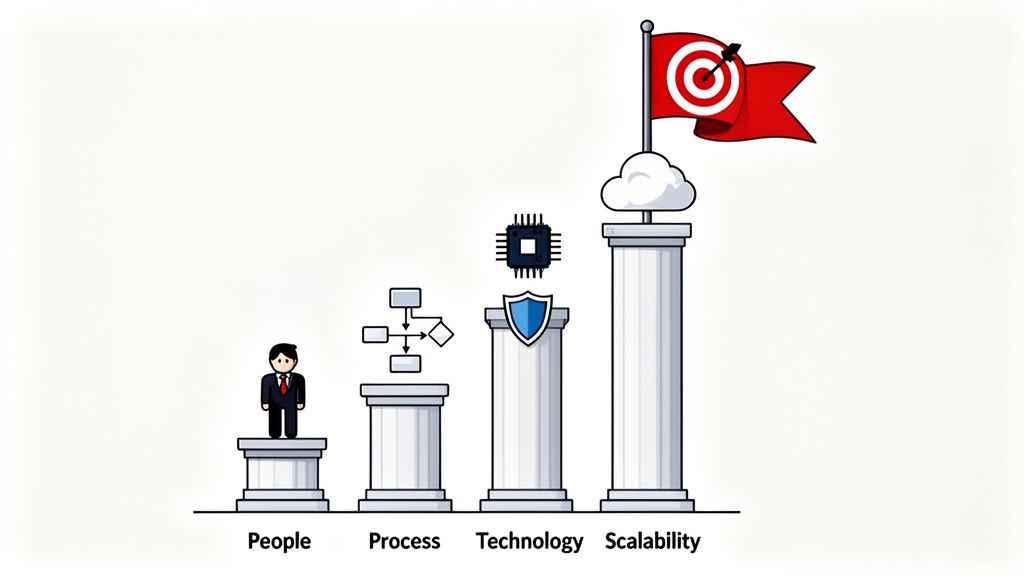
The primary solution for translating operational excellence theory into practice is a structured implementation roadmap. This strategic plan is built on five critical pillars: People, Process, Technology, Security, and Scalability. By addressing each component systematically, you can embed operational excellence into your organization’s DNA, drive efficiency, foster a culture of continuous improvement, and deliver a measurable return on investment. This framework is designed not as a one-time project, but as a commitment to building a system for delivering superior customer value.
Pillar 1: People and Culture
The success of any operational excellence initiative is contingent on its people. The first step is to cultivate a culture of continuous improvement, driven by executive leadership and empowered employees. Without genuine buy-in, even the most advanced processes and technologies will fail.
- Secure Executive Sponsorship: Identify a senior leader to champion the initiative, secure resources, and communicate its strategic importance.
- Establish Cross-Functional Teams: Break down silos by creating dedicated improvement teams with representatives from sales, marketing, operations, and customer success.
- Invest in Training: Equip employees with problem-solving methodologies like Lean or Six Sigma to enable them to identify and address inefficiencies.
- Incentivize Improvement: Recognize and reward teams and individuals who contribute to successful process improvements, linking their efforts to tangible business outcomes.
Pillar 2: Process Mapping and Optimisation
With the right culture in place, the next step is to gain a clear and objective understanding of current workflows. The primary action is process mapping: visually documenting end-to-end operations (e.g., from lead generation to customer renewal) to uncover bottlenecks, redundancies, and waste.
The goal here is to make the invisible visible. You can't improve what you don't fully understand. Mapping the flow of value is the first, essential step toward optimising it.
Prioritize a single, high-impact process, such as the lead-to-cash cycle. Conduct collaborative workshops with stakeholders to document every step, decision, and handoff. This detailed map provides the necessary baseline for targeted improvements.
Pillar 3: Technology Evaluation and Integration
Technology, particularly AI, is a critical accelerator for operational excellence. The key is a strategic approach: select tools that solve specific, identified problems and integrate seamlessly with your existing technology stack. For a deeper dive into making the right technology choices, you can learn more about building a scalable operational framework with expert advisory support.
A structured vetting process is non-negotiable.
| Evaluation Criterion | Key Question |
|---|---|
| Workflow Integration | Does this tool offer native API connections to our CRM and marketing automation platforms, or will it require costly custom development? |
| Data Requirements | What quality and volume of historical data are required for the AI model to be effective, and do we possess it? |
| User Adoption | Is the user interface intuitive for non-technical team members, or will it necessitate extensive training that hinders adoption? |
| Vendor Support | What level of implementation support, technical assistance, and strategic guidance does the vendor provide post-contract? |
Pillar 4: Security and Data Governance
As you integrate new technology and refine processes, data security and governance must be paramount. The immediate action is to establish a robust framework that ensures efficiency gains do not introduce new risks to the business or its customers.
Implement clear data handling policies that define who can access, modify, and share sensitive information. Ensure any new AI tool is compliant with GDPR and other relevant regulations, and conduct thorough security audits prior to full-scale implementation.
Pillar 5: Scalability and Future-Proofing
Finally, your operational excellence framework must be designed for long-term viability. The core principle of scalability is to design processes and select technologies that can accommodate business growth without requiring complete overhauls.
Select platforms with flexible architecture capable of handling increased data volumes and user loads. Meticulously document all new processes and configurations to simplify future adjustments and ensure the system can evolve with your business strategy. This foresight is what transforms short-term improvements into long-term strategic assets.
Measuring Success with ROI-Focused KPIs
The primary solution for validating an operational excellence initiative is to measure its impact through ROI-focused Key Performance Indicators (KPIs). To secure executive buy-in and justify continued investment, you must move beyond vanity metrics and connect operational improvements directly to financial outcomes. These KPIs provide a quantitative assessment of how process enhancements are impacting business performance.
By tracking these core metrics, RevOps leaders can build a data-backed business case that demonstrates how operational excellence is a strategic investment with a clear and compelling return.
Core Financial and Performance KPIs
The most effective measurement framework is built around metrics that directly reflect financial health and sales velocity. These KPIs provide an unambiguous view of how process improvements impact the bottom line.
- Customer Acquisition Cost (CAC): The total sales and marketing cost required to acquire a new customer. A decreasing CAC is a direct indicator of improved go-to-market efficiency.
- Customer Lifetime Value (LTV): The total revenue projected from a single customer relationship. An increasing LTV-to-CAC ratio signifies profitable, sustainable growth.
- Sales Cycle Length: The average time from first contact to a signed contract. Shortening this cycle accelerates revenue recognition and improves cash flow.
- Lead Conversion Rate: The percentage of leads that convert into paying customers. An increasing conversion rate validates the effectiveness of qualification and nurturing processes.
Introducing Administrative Debt Reduction
A powerful, often overlooked metric is Administrative Debt Reduction. This KPI quantifies the time and associated cost savings realized by eliminating low-value, repetitive tasks through automation and process optimization. It provides a direct monetary value for efficiency gains.
By putting a number on the hours reclaimed through automation and smarter processes, you can attach a direct monetary value to efficiency. This turns the "soft" benefit of "saving time" into a hard, quantifiable ROI figure that CFOs love to see.
For example, implementing an AI tool that automates a reporting task previously requiring four hours per week from a sales manager reclaims 208 hours annually. At a loaded salary rate of £50 per hour, this translates to a direct cost saving of £10,400 from a single process improvement.
This focus on productivity is essential for growth. The UK's public sector provides a compelling case study: the NHS achieved 2.4% acute productivity growth in early 2024/25, driven by a 6.3% increase in output with only a 3.9% rise in inputs. B2B leaders can apply the same principles, using AI to aggressively reduce administrative debt and scale impact. You can read the full report on UK public sector productivity for detailed findings.
Tracking these ROI-focused KPIs is not a reporting exercise; it is the mechanism for proving the strategic value of operational excellence in the language of the business: financial performance.
Executive Action Plan
This 30-60-90 day plan provides an actionable framework for B2B leaders to gain immediate traction and demonstrate tangible results from an operational excellence initiative. The primary solution for successful implementation is to secure early wins, which build organizational momentum, secure stakeholder buy-in, and establish a foundation for long-term, systemic change. This approach avoids large, slow-moving projects in favor of targeted, high-impact sprints.
The First 30 Days: Identify the Primary Bottleneck
Objective: Diagnose and precisely define the single biggest constraint in the revenue operations process.
The first month is dedicated to diagnosis. Rather than attempting to fix multiple issues, the goal is to identify the one bottleneck that, once resolved, will have the greatest positive impact on the entire system.
Actionable Workflow:
- Process Audit: Map the end-to-end lead-to-cash process through workshops with sales, marketing, and customer success teams. Identify points of friction, delays, and major time sinks.
- Data Analysis: Analyze CRM and analytics data to pinpoint where deals stall, where funnel drop-offs are highest, and which activities consume the most resources for the lowest return.
- Constraint Definition: Based on qualitative and quantitative data, define the primary bottleneck with precision (e.g., "manual lead routing delays initial sales contact by an average of 48 hours").
A well-defined problem is halfway solved. This month is about achieving clarity, not implementing solutions.
The Next 60 Days: Launch a Targeted Pilot Project
Objective: Execute a small-scale pilot project to solve the identified bottleneck.
With the primary constraint defined, the next 60 days are focused on action. This involves launching a controlled experiment with a specific AI tool or process redesign to test a proposed solution, minimize risk, and gather performance data.
Actionable Workflow:
- Solution Selection: Choose a single technology or process change specifically designed to address the bottleneck (e.g., an automated lead routing tool).
- Success Metrics: Define clear, measurable KPIs for the pilot (e.g., "Reduce average lead response time by 50%" or "Increase qualified lead conversion by 15% for the pilot group").
- Execution and Monitoring: Deploy the solution with a limited team. Closely monitor performance against the defined KPIs and gather continuous feedback from users.
The Final 90 Days: Measure ROI and Scale
Objective: Analyze pilot results, calculate ROI, and build a business case for a broader rollout.
The final 30-day phase is about analysis and strategic planning. The data from the pilot is used to build an undeniable, data-driven case for expanding the successful solution across the organization.
Actionable Workflow:
- ROI Calculation: Quantify the pilot's impact. Calculate time saved, increases in conversion rates, and any associated cost reductions. Translate these operational wins into financial terms.
- Expansion Roadmap: Document all learnings from the pilot and create a phased plan for rolling out the solution to other teams or departments.
- Stakeholder Presentation: Present the pilot's results and calculated ROI to executive leadership. Use the hard data to secure sponsorship for the next phase of the initiative.
This structured plan deconstructs the concept of what is operational excellence into a series of achievable, high-impact steps, positioning the organization for a journey of continuous, data-driven improvement.
At Vantage Advisory, we provide the strategic intelligence B2B leaders need to integrate AI and achieve operational excellence. Our platform offers the roadmap for scaling your impact without scaling your headcount. Explore how Vantage Advisory can guide your AI implementation.