
Key Takeaways
- Focus on Revenue-Centric KPIs: Shift measurement from activity metrics (e.g., call volume) to outcome-focused KPIs like Lead-to-Opportunity Rate, Sales Cycle Length, and Customer Acquisition Cost (CAC) to accurately gauge productivity.
- Eliminate Administrative Debt: The most immediate productivity gains come from automating high-frequency, low-value administrative tasks. Focus on automating lead routing, activity logging, and meeting summaries to give sellers more customer-facing time.
- Deploy AI for Lead Prioritisation: Transition from static, rule-based lead scoring to dynamic, AI-powered predictive models. This ensures sales efforts are consistently focused on prospects with the highest probability of conversion, improving pipeline quality and velocity.
- Establish Continuous Optimisation: Sales productivity is not a one-time project. Implement a continuous cycle of measurement, refinement, and adaptation, using RevOps dashboards to correlate seller activities directly with revenue outcomes.
Boosting sales productivity requires a strategic shift from manual, time-consuming workflows toward an integrated, AI-driven operational framework. This guide provides a practical roadmap for B2B leaders to define revenue-centric KPIs, streamline processes with intelligent automation, and leverage AI for predictive lead management. The objective is to drive measurable ROI by increasing seller effectiveness and accelerating revenue growth.
We will begin by examining the current state of UK business productivity, which underscores the urgent need to move beyond outdated sales methodologies.
The State of UK Sales Productivity
For B2B leaders, the most effective way to address productivity challenges is through strategic technology adoption. Recent economic data reveals a concerning trend for UK businesses: a stagnation in labour productivity that directly impacts sales effectiveness and overall profitability.
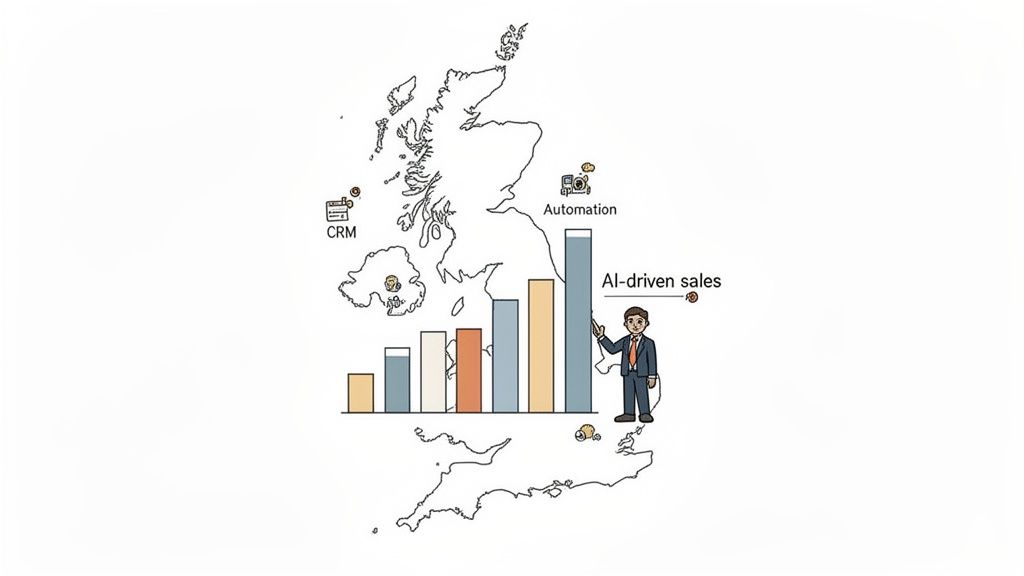
In Q2 2025, UK labour productivity analysis showed that output per hour fell by 0.8% year-on-year, even as total hours worked increased by 2%. Gross value added (GVA) grew by only 1.1% during this period. This data indicates that teams are working more but producing less value, a clear signal of operational inefficiency. You can review these UK productivity trends from The Productivity Institute for further context.
This productivity gap highlights a critical divergence in strategy. Sectors like Information Technology have advanced by integrating AI and cloud platforms, while others, including wholesale and retail, lag. For mid-market B2B companies aiming to scale efficiently, the path forward is to embed AI within revenue operations, mirroring the approach of high-growth sectors.
The Four Pillars of an AI-Driven Sales Productivity Framework
An effective strategy for improving sales productivity is built on a modern, data-first foundation. This involves re-engineering core sales workflows to maximise seller time on high-value activities. The following framework outlines four pillars for transforming a sales organisation into a high-performance engine.
| Pillar | Objective | Key Action | Expected ROI |
|---|---|---|---|
| Baseline & KPIs | Establish a data-backed starting point for all productivity initiatives. | Audit the sales cycle to define revenue-centric KPIs like Lead-to-Opportunity Rate. | Objective measurement of performance improvements and validation of technology investments. |
| Automation | Eradicate low-value administrative tasks consuming seller time. | Implement CRM automation rules for lead routing and activity logging. | 15-20% increase in customer-facing time per rep, leading to higher pipeline generation. |
| AI Lead Management | Focus sales efforts on prospects with the highest conversion probability. | Deploy a predictive lead scoring model that analyses intent data and historical win rates. | Higher conversion rates, shorter sales cycles, and improved forecast accuracy. |
| Optimisation | Create a resilient sales engine that adapts and improves over time. | Build RevOps dashboards that correlate seller activity with revenue outcomes. | Sustained, long-term growth in team performance and revenue per head. |
The primary objective is to minimise time spent on non-selling activities and maximise the velocity of high-quality customer engagements. This requires a systematic approach, blending process optimisation with intelligent automation to ensure the team operates with maximum efficiency.
Executive Action Plan
The first step is to conduct a thorough audit of your current sales processes to identify the most significant administrative bottlenecks. Survey your sales representatives to quantify this "admin debt" by determining the percentage of their time consumed by non-selling tasks such as manual data entry, follow-ups, and internal reporting. Use this data to build a business case for targeted automation, prioritising high-impact, low-effort changes first. This pragmatic approach establishes the foundation for more advanced AI strategies, ensuring every investment addresses a tangible productivity problem and delivers a clear ROI.
Setting the Stage: Your Productivity Baseline and KPIs
The foundational step to improving sales productivity is establishing an objective, data-backed baseline of your team's current performance. This requires moving beyond vanity metrics like call volume and focusing on Key Performance Indicators (KPIs) that directly correlate with revenue generation. A comprehensive audit of the entire sales cycle, from lead acquisition to contract closing, is necessary to create this baseline. Without it, you cannot accurately measure the ROI of new technologies or process improvements.
Shifting Focus from Activity to Actual Outcomes
A common mistake is conflating activity with productivity. A sales representative making 100 calls per day may appear productive, but if those calls do not convert into qualified opportunities, the effort yields no business value. The primary goal is to analyse how your team's time is allocated between high-value, client-facing activities and low-value administrative tasks.
A fundamental mindset shift is required: stop rewarding sheer volume of activity and start measuring tangible progress through the sales funnel. The most productive sales teams are not necessarily the busiest; they are the most effective at converting effort into revenue.
This analysis is crucial for Revenue Operations (RevOps) leaders. By examining CRM data, you can identify process bottlenecks, such as delays in quote approvals or excessive time spent on manual data entry. Addressing these inefficiencies is the first step toward improving team effectiveness.
Defining the KPIs That Truly Matter
After mapping your current workflows, you must define a concise set of core KPIs that are specific, measurable, and directly linked to sales effectiveness. These indicators will reveal the health and velocity of your sales engine.
- Time-to-First-Contact: Measures the duration between lead assignment and the first meaningful engagement. Delays often indicate inefficient lead routing or resource allocation.
- Lead-to-Opportunity Conversion Rate: The percentage of leads that are qualified as legitimate sales opportunities. This is a primary indicator of both lead quality and initial outreach effectiveness.
- Average Sales Cycle Length: The average time required to close a deal from the opportunity creation stage. An increasing cycle length can signal friction in the sales process or challenges in demonstrating value.
- Customer Acquisition Cost (CAC): The total sales and marketing cost required to acquire a new customer. All productivity enhancements should ultimately contribute to reducing this metric.
These KPIs provide a robust framework for identifying areas with the greatest potential for impact.
Building Your Performance Dashboard
With your core KPIs defined, the next step is to centralise this data from your CRM and other sales tools into a performance dashboard. This dashboard serves as a diagnostic tool to investigate the root causes of inefficiencies identified during your audit. For example, if Time-to-First-Contact is high, the dashboard should help determine whether the cause is a technology issue, a resource constraint, or flawed lead assignment rules. A well-constructed dashboard transforms raw data into actionable insights, providing the objective foundation needed before introducing AI or automation.
Executive Action Plan
Your immediate task is to convene a workshop with sales leaders and key representatives to map your current sales process from lead creation to close. Identify every manual step and system handoff. From this map, select three to five core productivity KPIs that directly influence revenue velocity and cost efficiency, such as your lead-to-opportunity rate and sales cycle length. Direct your operations team to build a baseline dashboard in your CRM to track these specific KPIs before implementing any new technology. This creates the data-driven foundation required to justify future investments and accurately measure their impact.
Get Rid of Admin Debt with Smart Automation
The most direct way to improve sales productivity is by eliminating administrative debt—the cumulative burden of low-value, repetitive tasks that detract from selling time. The solution is to implement targeted automation rules within your CRM and sales engagement platforms. This liberates sellers from manual data entry and process management, allowing them to redirect their focus toward building relationships and closing deals.
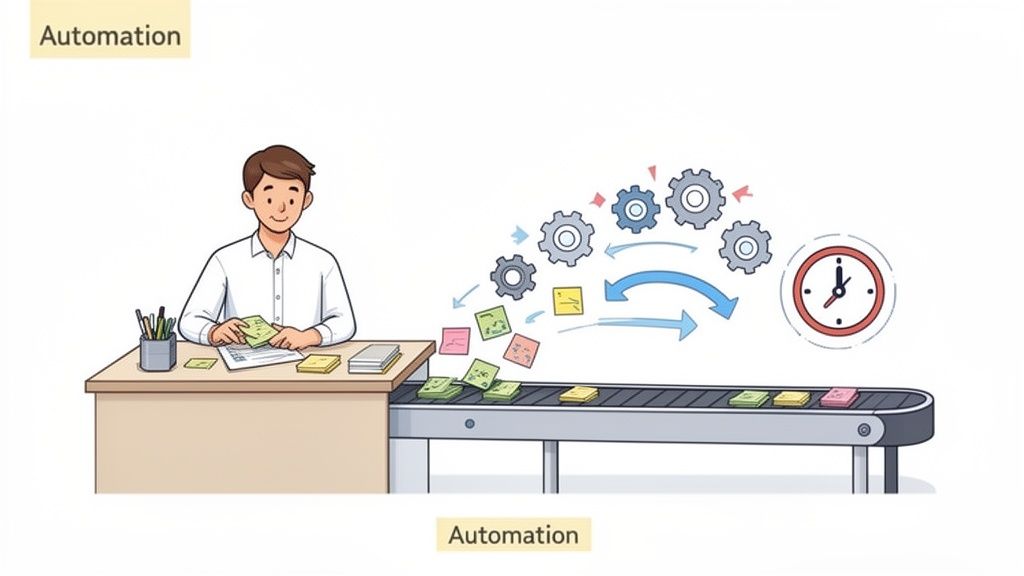
This represents a fundamental operational shift. Top-performing sales teams consistently spend more time on revenue-generating activities, a direct result of effective automation.
Find the Quick Wins for Automation
To begin, identify tasks that are frequent, rule-based, and inefficient. These represent the "quick wins" that will deliver the fastest ROI. Shadowing a sales representative for a day or conducting a survey can quickly reveal these friction points.
Focus on these high-impact areas for initial automation:
- Lead Routing and Assignment: Implement automated rules to assign new leads based on criteria like territory, industry, or company size. This eliminates manual distribution by a sales manager and ensures rapid follow-up, which is critical for conversion.
- Activity Logging: Configure your sales platforms to automatically log calls, emails, and meetings in your CRM. This maintains data integrity without requiring manual input from your team, saving significant time.
- Meeting Summaries and Follow-ups: Utilise AI-powered tools that can transcribe and summarise sales calls, identify action items, and draft follow-up emails. This single automation can save each representative several hours per week.
Automating these foundational processes creates a more efficient operational backbone for your sales organisation. For a deeper analysis, refer to our guide on strategic business process automation.
The objective of automation is not merely to accelerate a task but to remove it entirely from a seller's workload. Every minute reclaimed from administrative duties is a minute that can be invested in prospect engagement.
Connect Your Systems for Maximum Impact
After automating individual tasks, the next level of efficiency is achieved by integrating your core business systems. Information silos force manual data transfer, which introduces errors and slows the sales cycle. According to recent 2025 UK sales trends from Salesforce, 89% of UK sales teams now collaborate with partners, and 84% report that these partnerships have a greater impact on their revenue than in the previous year. Automating data flow between your CRM and partner systems is essential for scaling these relationships effectively. When a partner identifies a new lead, that information should be automatically ingested into your system for immediate action, creating a single source of truth and eliminating communication delays.
Executive Action Plan
Direct your RevOps team to identify the top three most time-consuming administrative tasks performed by your sales representatives, using data from your sales engagement platform or direct feedback. Launch a pilot program with a small group of sellers to automate these specific workflows using your existing CRM's capabilities, starting with a single process like lead routing or activity logging. Track the time saved per representative over a two-week period. This will provide a clear, data-backed ROI to justify a full-scale rollout across the organisation.
Getting Smarter with AI for Lead Management
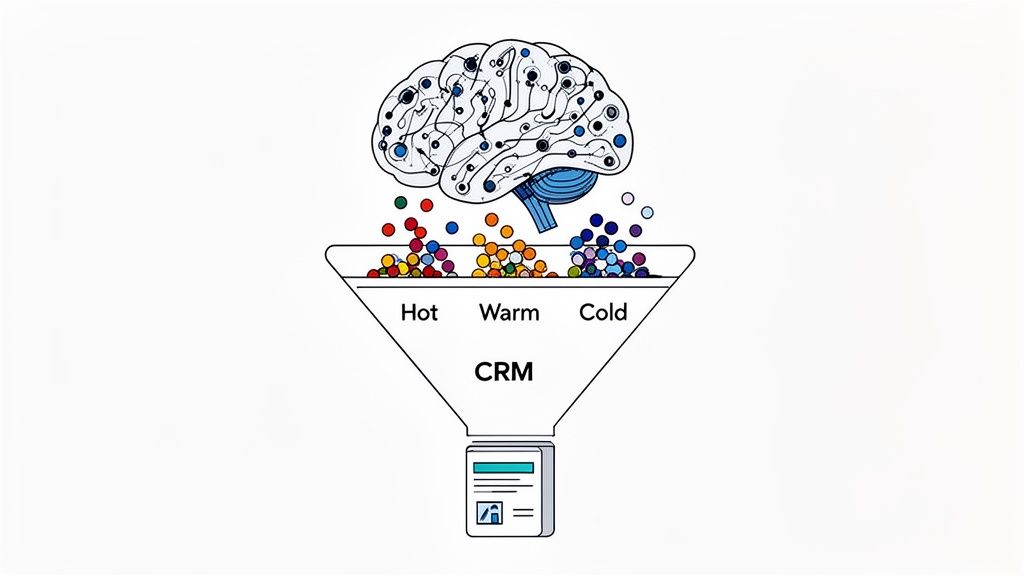
The most effective way to improve sales productivity after automating administrative tasks is to ensure your team engages with the right prospects at the right time. This is achieved by implementing an AI-driven lead management system that replaces static scoring rules with dynamic, predictive models. These systems analyse thousands of data points—from firmographics and technographics to real-time buyer intent signals—to identify leads with the highest probability of conversion.
This approach transitions sales from intuition-based prioritisation to data-driven intelligence. ONS data highlights the growing gap created by technology adoption; by 2023, workers at the most productive UK firms generated 3.5 times more output than those at average firms. This demonstrates that scalable technology is a key driver of significant productivity gains. You can explore these UK business productivity trends from the ONS for more detail.
Moving from Static Rules to Predictive Insights
Traditional lead scoring relies on a rigid, manually defined set of rules (e.g., job title = +5 points, pricing page visit = +10 points). While better than no system at all, this method is a blunt instrument that cannot adapt to market changes or learn from historical win/loss data.
AI-powered predictive scoring is fundamentally different. It builds a dynamic model of your ideal customer profile based on your actual sales history and continuously refines its algorithm. This enables it to identify subtle, non-obvious patterns that predict conversion far more accurately than a human-defined ruleset.
Comparison of Lead Scoring Methodologies
| Feature | Manual Rule-Based Scoring | AI-Powered Predictive Scoring |
|---|---|---|
| Data Sources | Limited to explicit CRM data (job title, industry). | Analyses thousands of data points including intent signals, technographics, and engagement history. |
| Adaptability | Static. Rules must be manually updated by an administrator. | Dynamic. The model learns and self-optimises based on new sales outcomes. |
| Accuracy | Prone to human bias and simplistic assumptions. | High accuracy by identifying complex, non-obvious correlations that predict conversion. |
| Maintenance | Requires constant manual review and tweaking to remain relevant. | Low manual maintenance once the initial model is trained and integrated. |
The AI approach is engineered for the complexity of modern B2B sales, delivering continuous improvement with minimal manual intervention.
Laying the Groundwork: Preparing Your Data
To realise the benefits of any AI tool, your underlying data must be clean, structured, and reliable. Before integrating a predictive model with your CRM, such as Salesforce or HubSpot, a data hygiene initiative is essential. This includes standardising fields, deduplicating records, and enriching existing contact data.
An AI model is only as intelligent as the data it learns from. Investing time in cleaning your CRM database is not an optional step; it is the foundational requirement for achieving a meaningful ROI from your AI initiatives.
Begin by auditing critical data fields like job titles, industry classifications, and lead sources. Implement validation rules to ensure the proper formatting of all new data entries. This preparatory work ensures the AI model learns from high-quality information, leading to more accurate and trustworthy predictions. You can learn more about how to implement AI in business in our related articles.
Scaling Personalisation with Generative AI
Beyond lead scoring, generative AI can significantly enhance outbound prospecting efficiency. Instead of composing every email from scratch, these tools can analyse a prospect’s professional profile, recent company news, and industry trends to draft highly personalised outreach messages in seconds. This allows a single salesperson to engage a larger pool of prospects with relevant, tailored messaging, accelerating pipeline generation without sacrificing interaction quality.
Executive Action Plan
First, audit your existing lead scoring system, if applicable. Analyse its historical correlation with closed-won deals over the past six months to build a business case for upgrading to a predictive model. Next, direct your RevOps team to identify and pilot a predictive scoring tool that integrates with your CRM. Conduct a controlled A/B test for one quarter: assign one group of representatives to the existing scoring method and a pilot group to the new AI-driven scores. Compare the lead-to-opportunity conversion rates between the two groups to quantify the impact on pipeline quality and sales productivity.
Measuring Impact and Driving Continuous Optimisation
The most effective way to sustain sales productivity gains is to establish a continuous cycle of measurement, refinement, and adaptation. Implementing new sales technology and processes is a starting point, not a final destination. The true test is the ability to consistently measure performance against the baseline KPIs established at the outset and make data-driven adjustments. This requires dynamic RevOps dashboards that correlate operational changes directly with revenue outcomes, such as shorter sales cycles and improved win rates.
However, technology alone is insufficient. A robust change management strategy is critical to ensure team adoption and realise the full ROI of your investment. The ultimate goal is to build a resilient, adaptable sales engine capable of consistently outperforming the market.
Building Dashboards That Connect Actions to Revenue
Your measurement framework must move beyond activity tracking to demonstrate how process improvements directly impact financial results. An effective RevOps dashboard should prove how increased efficiency—such as automated data entry or faster lead response times—translates to improved pipeline velocity and larger deal sizes.
Your dashboards must provide clear answers to key leadership questions:
- How much time are we actually saving? Quantify the efficiency gains from automation by comparing time-tracking data before and after implementation.
- Are deals closing faster? Track the average sales cycle length on a monthly basis to identify trends following the introduction of AI-powered lead scoring.
- Are we converting more? Monitor lead-to-opportunity and opportunity-to-close rates as the ultimate validation of your new lead management strategy.
Focusing on these outcome-driven metrics creates a powerful narrative that proves the value of your initiatives and justifies continued investment.
The best dashboards are not static reports; they are diagnostic tools. They should empower leaders to drill down into the data, identify high-performing teams, and pinpoint areas requiring additional coaching or process refinement.
Driving Adoption Through Effective Change Management
Technology adoption is a significant challenge, often more difficult than the technical implementation itself. A structured change management plan is essential for embedding new workflows into your team's daily habits. Research confirms that organisations with mature sales enablement programs achieve a 49% higher win rate, a success driven by continuous reinforcement rather than a single launch event.
A practical approach to change management includes:
- Run a Pilot Programme: Begin with a small group of enthusiastic, tech-forward users. Their success stories and feedback serve as powerful internal case studies to win over more hesitant team members.
- Deliver Role-Specific Training: Avoid a one-size-fits-all training approach. Tailor content to the specific daily workflows of each role, such as SDR, Account Executive, and Sales Manager.
- Create a Feedback Loop: Establish a dedicated communication channel (e.g., in Slack or Teams) for users to ask questions, share best practices, and report issues. This facilitates rapid problem-solving and fosters a sense of shared ownership.
This commitment to ongoing support is a cornerstone of achieving what is operational excellence.
Creating a Cycle of Continuous Refinement
The market is dynamic; customer needs evolve, and competitors adapt. Your sales process must be equally agile. The final component is establishing a regular cadence for reviewing performance data and refining your AI models and automation rules. This should be a cross-functional effort involving sales, marketing, and operations in quarterly reviews to analyse what is working and what requires adjustment. This proactive, continuous refinement ensures your sales engine remains finely tuned and continues to deliver long-term productivity gains.
Your Executive Action Plan for Sales Productivity
To achieve a systematic uplift in sales productivity, the primary action is to implement an AI-driven framework focused on four key principles: establishing a data-driven baseline with revenue-centric KPIs, aggressively reducing administrative debt through automation, deploying AI for intelligent lead prioritisation, and fostering a culture of continuous measurement and optimisation. This plan provides a strategic checklist for building a resilient, high-output sales engine.
A Phased Implementation Roadmap
To ensure successful adoption and demonstrate early ROI, a phased implementation is critical. A "big bang" approach often introduces unnecessary risk and resistance. Instead, sequence the rollout to manage change effectively and build momentum with quick wins. A successful program is built on a continuous cycle: measure performance, refine tools, and optimise strategy.
This iterative flow is central to improving sales productivity. You progress from establishing a baseline to continuously fine-tuning the operational machine. Each phase is designed to deliver a specific business outcome, such as increasing seller time with customers or accelerating deal velocity.
Here is a practical breakdown:
Quarter 1 Foundation: Initiate a comprehensive audit of your current sales process to identify the top three administrative bottlenecks. Concurrently, define and build a dashboard for your core, revenue-focused KPIs. This phase establishes the data-driven foundation for all subsequent actions.
Quarter 2 Automation & AI Pilot: Implement targeted automation to address the identified bottlenecks, such as intelligent lead routing or automated activity logging. Simultaneously, launch a pilot program for an AI lead-scoring tool with a select group of representatives to gather performance data and validate the business case before a full-scale deployment.
By focusing on sophisticated, scalable AI strategies, you build a more productive and resilient B2B enterprise. This isn't about small gains; it's a strategic overhaul designed to create a durable competitive advantage.
Common Questions About Boosting Sales Productivity
As leaders explore how to improve sales productivity, several key questions consistently arise regarding measurement, common pitfalls, and expected ROI. Here are direct, advisory answers based on our experience with B2B enterprises.
How Do You Actually Measure Sales Productivity?
The most effective way to measure sales productivity is to focus on output-based KPIs that are directly tied to revenue, rather than activity metrics. Key indicators include revenue generated per representative, sales velocity (the time required to move a lead from contact to close), and the ratio of Customer Lifetime Value (CLV) to Customer Acquisition Cost (CAC). These metrics provide a clear commercial view of performance. For instance, an increase in sales velocity without a corresponding decrease in average deal size is a definitive indicator of improved efficiency. Measuring against these bottom-line outcomes is the only reliable way to validate that your strategic changes are delivering tangible business value.
What’s the Biggest Mistake Companies Make?
The single most common mistake is investing in new technology before addressing the underlying inefficiencies in the sales process. Many leaders purchase advanced AI or automation platforms expecting a turnkey solution, only to implement them on top of flawed or inconsistent workflows. This approach rarely delivers the promised ROI.
The fundamental rule is that process must precede technology. You must first map, critique, and streamline your existing sales workflows. Otherwise, you are merely automating a broken process, which only enables you to execute the wrong activities faster.
How Long Does It Take to See an ROI from AI in Sales?
The ROI from implementing AI in sales typically materialises in two distinct phases. The first wave consists of immediate efficiency gains, which should become apparent within the first quarter. These "quick wins" include measurable time saved from the automation of administrative tasks like data entry and lead routing, which helps build team buy-in.
The second, more substantial wave of strategic impact on revenue generally takes six to nine months to fully realise. This is the time required for AI models to learn from your unique sales data, refine their predictive accuracy, and deliver significant improvements in win rates and forecast reliability.
At Vantage Advisory, we help you build the strategic roadmap for bringing AI into your revenue operations to drive real growth and efficiency. Discover how we help B2B leaders build more productive, resilient enterprises.