Key Takeaways:
- AI is Non-Negotiable: Artificial intelligence has moved from a competitive advantage to a foundational requirement for scaling demand generation without linearly increasing headcount. Key applications include predictive lead scoring, intent data analysis, and personalised content creation.
- RevOps is the Foundation: A successful strategy depends on a robust Revenue Operations framework that automates workflows, ensures data integrity across the tech stack, and provides a single source of truth for performance measurement.
- Personalisation at Scale is Achievable: Modern tools allow for deep, account-level personalisation across multiple channels, moving beyond simple name tokens to deliver contextually relevant messaging that significantly improves engagement and conversion rates.
- Focus on the Full Lifecycle: True demand generation encompasses the entire customer journey, from initial awareness to expansion and advocacy. Strategies must include proactive churn prevention and identifying upsell opportunities within the existing customer base, as retaining and expanding accounts is more cost-effective than acquiring new ones.
1. AI-Powered Lead Scoring and Predictive Analytics
AI-powered lead scoring transforms B2B demand generation by replacing simplistic, points-based systems with dynamic, predictive models. The primary solution involves using machine learning to analyse historical customer data, engagement signals, and firmographics to identify which prospects are most likely to convert. This data-driven approach allows revenue teams to prioritise their efforts with precision, focusing exclusively on accounts exhibiting a high propensity to buy and thereby increasing conversion rates and shortening sales cycles.
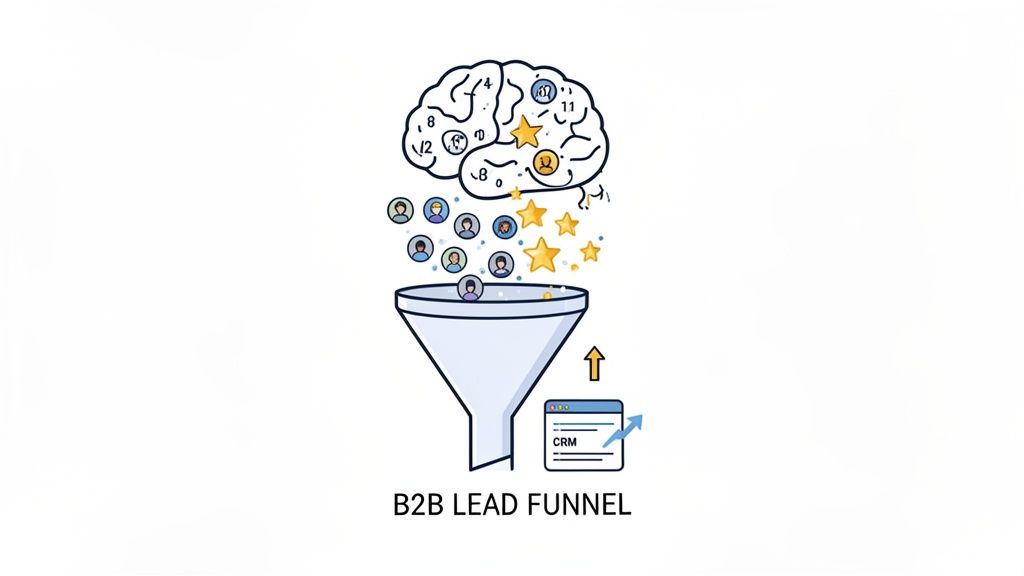
Unlike traditional scoring that assigns static values (e.g., +10 points for a CEO title), predictive analytics continuously learns and adapts. The models identify subtle patterns that indicate genuine purchase intent, ensuring that the leads passed to sales are not just active, but sales-ready. This directly improves conversion rates and aligns marketing and sales efforts around a single source of truth.
Why This Strategy Is Essential
For enterprises, predictive analytics provides a scalable solution to sift through high-volume inbound and outbound channels. It answers the critical question: "Which 100 accounts out of 10,000 should my sales team call today?" This focus maximises resource efficiency, boosts sales morale by reducing time spent on unqualified leads, and provides a clear, defensible ROI on marketing spend. The successful integration of these systems is a core component of effective B2B lead nurturing best practices, ensuring high-potential leads receive the right attention at the right time.
Implementation Blueprint
- Analyse Historical Data: Start by feeding the AI model with at least 12-24 months of "won" and "lost" opportunity data from your CRM. The model learns what attributes and behaviours correlate with successful conversions.
- Establish Feedback Loops: Create a formal process for the sales team to provide feedback on lead quality directly within the CRM. This data is crucial for retraining and refining the model's accuracy.
- Prioritise Dynamic Signals: Configure the model to heavily weight recent and accelerating engagement (e.g., multiple website visits in a week) over cumulative but outdated interactions.
- Integrate and Automate: Use platforms like Salesforce Einstein, 6sense, or HubSpot's Predictive Lead Scoring to automate the ranking and routing of high-intent leads to the appropriate sales queues, triggering instant notifications.
2. Account-Based Marketing (ABM) with AI Targeting
Account-Based Marketing (ABM) with AI targeting concentrates marketing and sales resources on a predefined set of high-value accounts. The core workflow involves integrating AI to predictively identify which accounts match your Ideal Customer Profile (ICP), detect real-time buying intent signals, and orchestrate targeted, personalised outreach at scale. This hyper-focused approach aligns revenue teams to engage specific buying committees with relevant messaging, maximising ROI by eliminating wasted ad spend on irrelevant audiences.
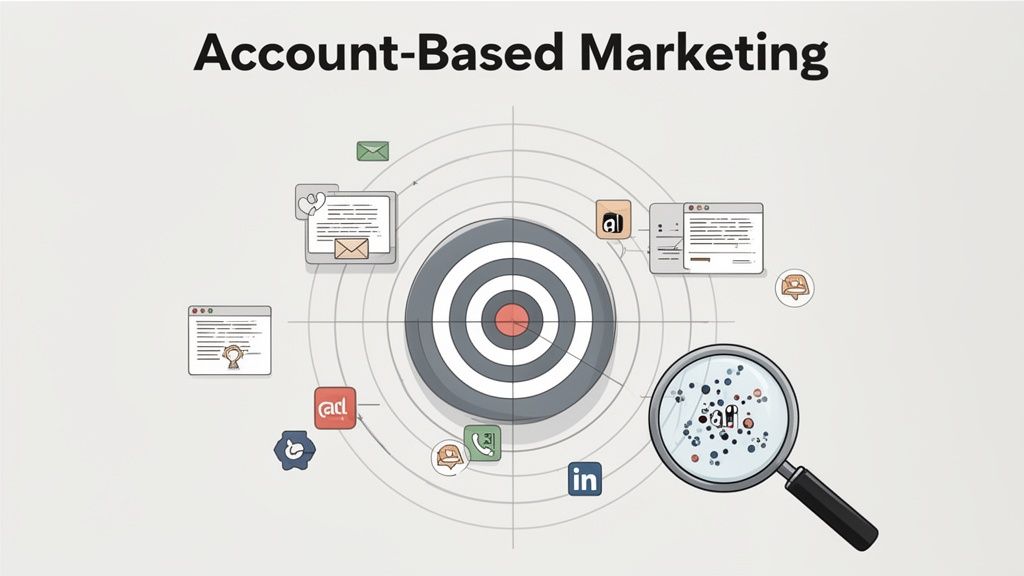
AI supercharges traditional ABM by automating the identification of "in-market" accounts that are actively researching solutions like yours. Platforms like 6sense or Demandbase analyse billions of third-party data signals to score accounts on their likelihood to purchase. This allows teams to shift from a static target list to a dynamic one, prioritising accounts that demonstrate clear intent and ensuring sales efforts are timely and relevant.
Why This Strategy Is Essential
For B2B organisations with high-value deals and complex buying cycles, ABM with AI is one of the most efficient B2B demand generation strategies. It focuses investment where it will yield the highest return. By treating each target account as a "market of one," it enables deep personalisation that resonates with senior decision-makers, fostering stronger relationships and significantly increasing deal velocity and size. This targeted precision is critical for penetrating mid-market and enterprise segments effectively.
Implementation Blueprint
- Define a Data-Driven ICP: Move beyond basic firmographics. Analyse your most profitable and successful customers to build an ICP based on technographics, growth rates, and operational maturity.
- Segment Accounts into Tiers: Not all target accounts are equal. Create tiers (e.g., Tier 1: Strategic, Tier 2: High-Priority, Tier 3: Scaled) to allocate budget and personalisation efforts appropriately. Tier 1 receives bespoke, one-to-one engagement, while Tier 3 might receive industry-specific digital campaigns.
- Deploy AI-Powered Intent Monitoring: Integrate an intent data platform to monitor anonymous web activity, content consumption, and keyword searches from target accounts. Use these signals to trigger timely and relevant outbound sequences from sales or personalised ad campaigns.
- Create Unified Account Dashboards: Build a central dashboard in your CRM or ABM platform that aggregates engagement data from all touchpoints, including ads, website visits, email opens, and sales calls. This provides a holistic view of account-level engagement for both marketing and sales teams.
3. Conversational AI and Chatbot Lead Qualification
Conversational AI and chatbots automate real-time visitor engagement and lead qualification on your website. The primary workflow involves deploying intelligent tools that use natural language processing (NLP) to interact with prospects, ask targeted qualifying questions, and seamlessly route high-value leads directly to the appropriate sales representative's calendar. Instead of forcing visitors to fill out a static form, this strategy guides them through a dynamic conversation, capturing critical intent data and reducing friction in the buyer's journey.
This approach significantly improves lead capture rates and shortens the sales cycle. By handling initial discovery and scheduling, these AI-powered assistants free up sales teams from administrative tasks, allowing them to focus entirely on high-impact selling conversations. The immediate, 24/7 engagement ensures no lead is missed, regardless of time zone.
Why This Strategy Is Essential
For B2B organisations, conversational AI solves the critical challenge of engaging anonymous but high-intent website traffic. It provides a scalable way to qualify visitors in real-time, ensuring sales conversations are reserved for those who meet ideal customer profile (ICP) criteria. Platforms like Drift and Qualified.com have demonstrated this model can increase demo bookings and pipeline generation by instantly connecting qualified buyers with live sales agents, creating a superior customer experience from the first touchpoint.
Implementation Blueprint
- Map Key Qualification Paths: Before building, script the conversation flows for your primary buyer personas. Define the essential questions needed to qualify a lead (e.g., company size, role, primary challenge) and create corresponding conversational branches.
- Train with Real Data: Use transcripts from past sales calls and customer support chats to train your chatbot. This helps it understand common industry jargon, customer pain points, and objections, making interactions feel more natural and effective.
- Integrate with Your CRM and Calendar: Connect your chatbot directly to your CRM (e.g., Salesforce, HubSpot) and sales team's calendars. This allows for automated lead creation, data enrichment, and seamless meeting booking without manual intervention.
- Always Provide a Human Handoff: Ensure every conversation flow includes a clear and easy option to connect with a live human agent. Trapping a high-intent prospect in a frustrating bot loop is a fast way to lose a potential deal.
4. Intelligent Email Sequencing and Cadence Optimisation
Intelligent email sequencing automates and optimises outbound prospecting through an AI-driven, data-informed system. The core solution involves leveraging AI to dynamically time, personalise, and adapt multi-touch email campaigns based on recipient behaviour and engagement signals. Instead of broadcasting a static series of messages, these platforms learn which sequences resonate with specific buyer personas, adjust messaging in real-time, and can even pause a cadence automatically when a prospect shows buying intent on another channel.
This AI-driven approach ensures that outreach is not only persistent but also contextually relevant. By analysing historical open rates, reply times, and content engagement, the system optimises send times and follow-up intervals for each individual contact. For example, platforms like Outreach have demonstrated the ability to improve reply rates by precisely timing emails based on a recipient's known activity patterns, transforming a cold outreach into a well-timed, relevant touchpoint.
Why This Strategy Is Essential
For B2B organisations with long sales cycles, maintaining top-of-mind awareness without fatiguing prospects is a critical balancing act. Intelligent sequencing automates this persistence with precision, freeing up sales development representatives (SDRs) to focus on high-value conversations rather than manual follow-ups. It answers the question: "How do we scale personalised outreach without sacrificing quality?" This strategic automation directly increases meeting booking rates, improves pipeline velocity, and ensures a consistent brand voice across all outbound communications.
Implementation Blueprint
- Segment Lists and Customise Sequences: Start by segmenting your prospect lists by buyer persona, industry, or pain point. Create a distinct 3-5 touch sequence for each segment, ensuring the messaging and value proposition are highly relevant.
- Utilise AI for Optimisation, Not Creation: Use AI-powered tools to A/B test subject lines, calls-to-action, and send times. However, have a human sales leader review and approve the final copy to ensure it aligns with brand voice and strategy.
- Establish Cross-Channel Triggers: Integrate your sequencing tool with your CRM and other engagement platforms. Configure rules to automatically pause a sequence if a contact visits the pricing page, downloads a case study, or engages with a sales representative on LinkedIn.
- Monitor and Prune Underperforming Cadences: Review sequence performance metrics (open, click, and reply rates) on a weekly basis. Immediately pause or rework any sequence that fails to meet a minimum reply rate threshold (e.g., below 2%) to avoid damaging your domain reputation.
5. Predictive Customer Success and Churn Prevention
Predictive Customer Success shifts demand generation from a new-logo-only focus to a continuous revenue cycle. The primary solution is to use AI to analyse customer behaviour, product usage, and support data to identify accounts at risk of churning or ripe for expansion well before they signal their intent. This strategy allows Customer Success (CS) teams to proactively intervene, secure renewals, and uncover upsell opportunities, turning the existing customer base into a predictable, ROI-focused revenue engine.
This approach fundamentally redefines demand generation by recognising that retention and expansion are its most profitable forms. Instead of relying on lagging indicators like support tickets, predictive models from platforms like Gainsight or Totango identify subtle, leading indicators of account health. This proactive stance ensures that CS teams are not just saving at-risk accounts but are actively cultivating advocates and identifying expansion signals, directly contributing to net revenue retention (NRR).
Why This Strategy Is Essential
For B2B enterprises, particularly in SaaS, retaining a customer is five to 25 times cheaper than acquiring a new one. Predictive analytics provide the mechanism to protect and grow this vital revenue stream at scale. It answers the critical question: "Which of our 1,000 customers need a strategic intervention this month to ensure renewal?" This focus maximises CS efficiency, prevents revenue leakage, and directly links post-sales activity to financial growth, a core principle of modern B2B demand generation strategies.
Implementation Blueprint
- Prioritise Leading Indicators: Configure your model to focus heavily on product usage and feature adoption data. These objective signals are far more predictive of long-term health than subjective sentiment or past support ticket volume.
- Develop Tiered Playbooks: Create distinct, actionable playbooks for different risk levels identified by the model. A 'high-risk' account may trigger an executive business review, while a 'moderate-risk' account might receive a targeted training webinar.
- Establish CS Feedback Loops: Implement a formal process for the CS team to validate or correct the AI-driven health scores within your platform. This human-in-the-loop feedback continuously refines the model's accuracy.
- Integrate and Automate: Connect your CS platform (e.g., Gainsight) with your CRM and product analytics tools. Automate alerts that notify account managers of significant changes in health scores, enabling immediate, data-informed outreach.
6. Dynamic Content Personalization and Website Optimization
Dynamic content personalization transforms a static website into an intelligent, adaptive experience for each B2B visitor. The primary solution involves using firmographic data, behavioural signals, and traffic sources to deliver customised messaging, offers, and imagery in real-time. By tailoring the user journey based on visitor attributes, businesses can present the most relevant value proposition for each specific account or persona, dramatically increasing engagement and conversion rates.
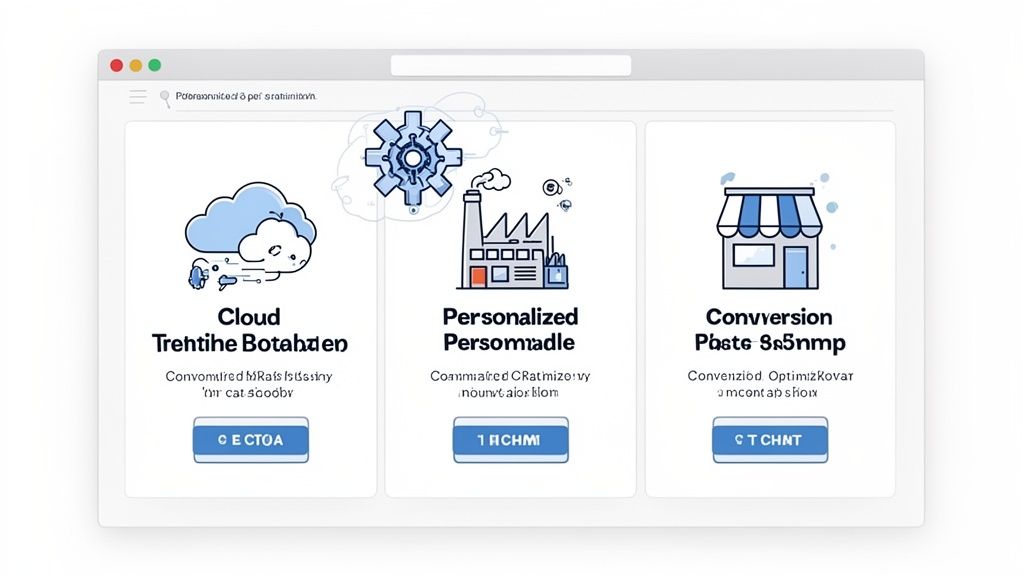
Unlike generic websites that present a one-size-fits-all message, personalization engines like Demandbase or Optimizely can modify homepage copy for a visitor from the financial services sector versus one from manufacturing. Similarly, HubSpot’s Smart CTAs can show a “Request a Demo” button to a high-intent visitor while offering an introductory e-book to a new prospect. This level of relevance is a cornerstone of modern B2B demand generation strategies.
Why This Strategy Is Essential
For enterprises targeting multiple distinct verticals or company sizes, personalization is non-negotiable. It ensures that a visitor from a Fortune 500 company sees enterprise-grade case studies and security information, while a startup visitor is shown self-service options and pricing plans. This prevents message mismatch, reduces bounce rates, and accelerates the buyer's journey by immediately validating that your solution is tailored to their specific business context. It directly addresses buyer intent and makes marketing feel like a helpful, one-to-one conversation.
Implementation Blueprint
- Start with High-Impact Segments: Begin by personalising headlines and Calls-to-Action (CTAs) for your highest-traffic visitor segments (e.g., by industry or company size) to prove ROI before expanding.
- Integrate First-Party Data: Connect your CRM and marketing automation platform to your personalization engine. Use data like lifecycle stage or past purchases to create highly relevant on-site experiences.
- Combine Firmographic and Behavioural Signals: Use firmographic data (company industry, revenue) to set the initial context, and then layer on behavioural data (pages visited, content downloaded) to refine the messaging dynamically during the session.
- Establish A/B Testing Guardrails: Continuously test personalised variants against a control version to validate performance. This prevents "personalization drift," where well-intentioned changes accidentally harm conversion rates.
7. Intent Data Integration and Buyer Journey Orchestration
Integrating third-party intent data into your demand generation workflow shifts your strategy from reactive to proactive. The core solution is to identify target accounts that are actively researching solutions like yours across the web—even before they visit your site. By combining external intent signals (like competitor keyword searches or content consumption) with your own first-party data (website visits, email clicks), you can pinpoint in-market buyers and orchestrate a timely, coordinated response from both marketing and sales.
This fusion of data provides a clear, prioritised view of which accounts are demonstrating active purchase intent right now. Rather than marketing to a static list, revenue teams can dynamically focus resources on accounts within a critical buying window. For instance, platforms like 6sense or Demandbase can detect when multiple stakeholders from a target account start researching "revenue operations tools," triggering an immediate, multi-channel campaign to engage the entire buying committee.
Why This Strategy Is Essential
For B2B organisations with long sales cycles, intent data provides the ultimate competitive advantage: timing. It reveals the "invisible" 95% of the buyer's journey that happens before a prospect ever fills out a form. This insight allows you to engage potential buyers with relevant content and outreach when your solution is top-of-mind, dramatically increasing the likelihood of securing a discovery call. It transforms marketing from a broad awareness function into a precise, revenue-focused operation.
Implementation Blueprint
- Combine Multiple Intent Sources: Rely on a blended model of first-party (your website, CRM) and third-party (G2, Bombora, TrustRadius) data. No single source provides a complete picture, so aggregation is key to accuracy.
- Establish Intent-to-Action Workflows: Configure automated alerts in your CRM or sales engagement platform that trigger a specific sequence when an account’s intent score crosses a predefined threshold. This ensures a rapid, coordinated response within 24 hours.
- Filter Against Existing Pipeline: Integrate intent signals with your CRM to de-prioritise accounts already in an active sales cycle. This prevents redundant outreach and ensures sales teams focus their efforts on net-new, high-intent opportunities.
- Monitor Intent Decay: Recognise that high intent is fleeting. Build your plays to capitalise on intent signals within the first two weeks. If an account shows intent but does not engage, move it to a longer-term nurturing track rather than pursuing it aggressively.
8. AI-Powered Content Creation and Topic Clustering
AI-powered content creation accelerates B2B demand generation by enabling marketing teams to produce high-quality, SEO-optimised content at scale. The core workflow involves using advanced language models to generate first drafts, refine headlines, and analyse competitor content, allowing teams to move faster from ideation to publication. By automating the more laborious aspects of writing, marketers can focus on high-value strategic tasks like narrative development and ensuring factual accuracy, thus boosting content velocity without sacrificing quality.
This technology extends beyond simple text generation. Modern AI platforms can perform sophisticated topic cluster analysis, identifying gaps in your content library by mapping out what your target audience is searching for. This ensures every piece of content created serves a specific purpose in addressing buyer questions throughout their journey. For example, HubSpot's Content Hub uses AI to suggest blog post outlines that have been shown to reduce writing time by 50%, enabling teams to build authority across core business themes more efficiently.
Why This Strategy Is Essential
For enterprises, content scale is a significant competitive advantage. AI-driven content creation provides the engine to dominate search engine results pages for critical keywords and establish comprehensive thought leadership. It directly addresses the challenge of resource constraints, empowering a small team to produce the output of a much larger one. This approach allows organisations to systematically cover every facet of a buyer's pain points, building a content moat that is difficult for competitors to replicate and is central to modern B2B demand generation strategies.
Implementation Blueprint
- Define Your Prompts with Precision: Develop detailed content briefs and prompts for the AI. Include target audience personas, desired tone of voice, key terminologies, and specific points to cover to guide the AI toward a high-quality first draft.
- Prioritise Human Oversight: Implement a strict "human-in-the-loop" workflow. Use AI to generate the initial structure, research summaries, and draft copy, but ensure a human editor always refines, fact-checks, and adds unique brand perspective before publication.
- Leverage AI for Repurposing: Use AI tools to atomise long-form content. Turn a single white paper or webinar into a dozen social media posts, a multi-part email nurture sequence, and a script for a short-form video to maximise the ROI of each core asset.
- Integrate Topic Clustering Tools: Use platforms like Jasper.ai, Copy.ai, or integrated hub solutions to analyse competitor content and search queries. This identifies content gaps and opportunities to build topic authority, ensuring your efforts are strategically aligned with user intent.
9. Revenue Operations (RevOps) Automation and Workflow Integration
Revenue Operations (RevOps) automation provides the framework to dismantle operational silos by integrating CRM, marketing automation, and sales engagement platforms into a cohesive system. The primary workflow involves using automated processes to handle administrative tasks like data entry, lead routing, and opportunity management. This strategic integration eliminates manual handoffs, ensures pristine data flows between teams, and frees up revenue professionals to focus exclusively on ROI-generating activities.
By connecting disparate systems, RevOps automation ensures that when a lead's status changes in one platform, corresponding tasks and data updates are triggered automatically across the entire tech stack. For example, a HubSpot workflow can update a lead's lifecycle stage, which then triggers a Salesforce Flow to assign the lead to the correct account executive and enrol them in a Salesloft cadence. This creates a seamless and efficient demand generation engine.
Why This Strategy Is Essential
For growing B2B organisations, RevOps automation is the key to scaling efficiently without proportionally increasing headcount. It eradicates the "admin debt" that slows down revenue teams and leads to poor data quality, inaccurate forecasting, and a disjointed customer experience. By automating the operational backbone of the demand generation funnel, companies ensure speed, consistency, and accuracy from initial touchpoint to final close. This operational excellence is a cornerstone of modern business process automation, directly impacting productivity and profitability.
Implementation Blueprint
- Map the End-to-End Funnel: Before building any automation, meticulously document every manual step, handoff, and data transfer in your current demand generation process to identify high-impact automation opportunities.
- Start with Low-Risk Workflows: Begin by automating high-frequency, simple tasks such as data field updates or internal task creation. This builds momentum and allows your team to learn before tackling more complex, multi-system workflows.
- Build in Error Handling: Design your automations with failure in mind. Implement notification systems that alert the RevOps team immediately if a workflow breaks, preventing silent failures that corrupt data.
- Establish a Governance Cadence: Create a formal 'RevOps audit' process. Conduct monthly or quarterly reviews to identify and fix broken automations, clean up data inconsistencies, and optimise existing workflows for better performance.
10. Lookalike Account Expansion and Generative AI Outreach
Lookalike account expansion systematically uncovers and engages high-potential growth opportunities. The core workflow combines predictive analytics to identify your highest-value customers and build an ideal profile, then uses that model to surface similar existing customers and net-new prospects. Generative AI is then leveraged to create hyper-personalised outreach at scale for these high-potential accounts, turning customer success and sales into proactive, ROI-focused revenue engines.
This dual approach turns your customer success and sales teams into a proactive revenue engine. Instead of waiting for upsell requests, the system intelligently recommends which accounts are primed for additional products, seat licenses, or premium tiers. Simultaneously, it equips your sales development representatives with context-aware messaging for new lookalike accounts, dramatically increasing the relevance and effectiveness of outbound campaigns.
Why This Strategy Is Essential
For enterprise B2B organisations, customer acquisition costs are rising, making retention and expansion paramount. This strategy directly addresses that by maximising lifetime value (LTV) from current clients and improving the efficiency of new client acquisition. It moves beyond generic cross-selling to a data-driven model that identifies expansion propensity before the customer even realises the need. By automating the "who" and "how" of outreach, it allows revenue teams to focus on strategic conversations, significantly improving net revenue retention and creating a powerful engine for compound growth.
Implementation Blueprint
- Define Expansion Triggers: Build your lookalike model from customers with the highest LTV and successful expansion histories, not just the largest initial contract value. Analyse product usage data to pinpoint behaviours that precede an upgrade.
- Segment for Precision: Create distinct lookalike models and outreach playbooks for different expansion types. A playbook for encouraging adoption of a new feature should be different from one designed to add more user seats.
- Arm Revenue Teams with AI: Integrate generative AI tools like those in Salesloft or Apollo.io directly into your sales and customer success workflows. Train the AI on your specific value propositions and successful outreach templates to ensure brand consistency.
- Establish Feedback Loops: Track expansion and new business close rates by lookalike segment. Use this performance data to continuously refine the predictive models and prompt engineering, ensuring your targeting and messaging become increasingly accurate over time.
B2B Demand Gen: 10-Strategy Comparison
| Strategy | Implementation Complexity | Resource Requirements | Expected ROI Timeline | Ideal Use Case | Key Advantages |
|---|---|---|---|---|---|
| AI-Powered Lead Scoring | Medium | Clean CRM data, ML model, RevOps support | 60–120 days | High-volume lead environments needing prioritization. | Dynamic lead priority, scalable management. |
| ABM with AI Targeting | High | ABM platform, intent data, dedicated team | 4–6 months | High ACV pursuits with defined ICPs. | Personalized engagement, reduced wasted spend. |
| Conversational AI | Low–Medium | Chatbot platform, CRM & calendar integration | 30–60 days | Websites with steady traffic needing lead capture. | Immediate 24/7 lead capture, reduced admin. |
| Intelligent Email Sequencing | Low–Medium | Sales engagement tools, clean contact data | 30–45 days | Outbound SDR teams for multi-touch prospecting. | Optimized timing, scalable personalization. |
| Predictive Customer Success | Medium–High | Product usage data, CS tooling, playbooks | 120–180 days | Subscription/SaaS businesses with churn risk. | Early risk detection, proactive retention. |
| Dynamic Content Personalization | Medium | Personalization engine, sufficient site traffic | 60–90 days | High-traffic sites and ABM landing pages. | Real-time relevance, consistent messaging. |
| Intent Data Integration | High | Intent data feeds, rapid-response workflows | 90–120 days | Teams running ABM that can act on signals quickly. | Engages accounts at peak intent. |
| AI-Powered Content Creation | Low | AI writing tools, SEO tools, human editors | Immediate | Content teams needing scale and SEO production. | Rapid draft generation, topic gap analysis. |
| RevOps Automation | High | Technical RevOps talent, automation platforms | 90–180 days | Orgs with complex stacks needing data reliability. | Eliminates manual handoffs, scales operations. |
| Lookalike Expansion & GenAI | Medium | Clean customer data, generative AI tools | 60–120 days | Companies aiming to grow existing accounts. | Identifies expansion accounts, scales outreach. |
Executive Action Plan
Adopting these advanced B2B demand generation strategies represents a fundamental shift towards an intelligent, automated, and customer-centric revenue engine. The journey from disconnected tactics to an orchestrated system requires a clear roadmap, starting with an honest assessment of your current state. The core theme is moving from reactive to proactive engagement. Instead of waiting for prospects to raise their hands, these methodologies empower teams to identify and engage in-market buyers with precision. This transition minimises wasted effort, shortens sales cycles, and aligns the entire revenue organisation.
To move from theory to tangible results, this 90-day action plan prioritises implementation to secure early victories and build momentum.
First 30 Days: Foundational Audit and Quick Wins.
- Action: Conduct a comprehensive audit of your existing demand generation process, from lead capture to close. Meticulously map every manual handoff and data transfer to identify critical bottlenecks.
- Technology: Implement a conversational AI chatbot on your highest-traffic website pages (e.g., homepage, pricing). This provides an immediate, low-effort way to improve lead capture efficiency.
- Metric to Watch: Monitor the change in website conversion rate and the number of sales-qualified meetings booked via the chatbot.
Days 31-60: Implement Predictive Intelligence.
- Action: Begin integrating an AI-powered lead scoring model using historical CRM data. Establish a structured feedback loop with sales to continuously refine the scoring criteria based on real-world outcomes.
- Technology: Activate native predictive lead scoring features in your CRM (e.g., Salesforce Einstein) and pilot an intelligent email sequencing tool (e.g., Outreach, Salesloft) with a segment of your SDR team.
- Metric to Watch: Track the lead-to-opportunity conversion rate for AI-scored leads versus non-scored leads and measure the impact on SDR email reply rates.
Days 61-90: Scale with Orchestration and RevOps.
- Action: Define your Tier 1 Account-Based Marketing (ABM) target list. Launch a pilot campaign integrating third-party intent data with personalised outreach cadences. Concurrently, automate the lead routing and data enrichment processes identified as pain points in your audit.
- Technology: Integrate an intent data provider (e.g., 6sense, Demandbase) with your CRM and marketing automation platform. Build initial RevOps automation workflows using tools like Salesforce Flow or HubSpot Workflows.
- Metric to Watch: Measure pipeline velocity (time from opportunity creation to close) for target accounts. Calculate the reduction in administrative time per sales representative from new automations.
By following this structured plan, you transform a complex list of strategies into a manageable project that delivers compounding value. The key is to start now, learn quickly, and relentlessly optimise your revenue engine.
Navigating this technological and strategic shift requires expert guidance to avoid costly missteps. Vantage Advisory provides the strategic intelligence and implementation support B2B leaders need to select the right technologies and build ROI-focused demand generation workflows. Partner with us to accelerate your journey from strategy to execution by visiting Vantage Advisory.