Key Takeaways
A Customer Relationship Management (CRM) system serves as the central operational hub for revenue-focused B2B organizations, unifying sales, marketing, and service functions to provide a single, authoritative view of all customer interactions. The primary benefits of implementing a CRM are a demonstrable Return on Investment (ROI) through increased sales and efficiency, the automation of manual workflows to free up strategic resources, and the application of AI-driven analytics for predictive insights. For executive leaders, a well-executed CRM strategy is the foundational technology for achieving scalable growth and a competitive advantage.
- Measurable ROI: Directly attribute revenue gains to specific activities by tracking metrics like sales cycle length, conversion rates, and customer lifetime value (CLV).
- Workflow Automation: Eliminate redundant administrative tasks, such as manual data entry and lead routing, allowing teams to focus on high-value, revenue-generating activities.
- AI-Driven Insights: Leverage predictive lead scoring and next-best-action recommendations to prioritize sales efforts and enhance decision-making accuracy.
- Unified Customer View: Consolidate all touchpoints into a single record, enabling hyper-personalized customer journeys and consistent cross-departmental communication.
Why a CRM Is the Backbone of Modern Revenue Operations
A modern Customer Relationship Management (CRM) system acts as the foundational technology for an effective Revenue Operations (RevOps) strategy by dismantling data silos between sales, marketing, and customer service. Its primary function is to create a single source of truth for all customer intelligence, enabling an organization to shift from reactive problem-solving to proactive, data-driven decision-making. By centralizing this information, a CRM facilitates the automation and predictive analytics required to manage the entire customer lifecycle cohesively, ensuring all departments operate from a unified playbook to drive growth.
This unified approach is the antidote to common operational drag, such as inefficient lead management, inconsistent customer experiences, and excessive administrative overhead. When customer intelligence is centralized, automation and predictive analytics can be effectively deployed to guide strategic decisions.
The flowchart below illustrates how a CRM-powered RevOps strategy directly connects to core business outcomes.
This demonstrates that a unified operational view is the critical launchpad for realizing tangible benefits in revenue generation, process automation, and customer personalization.
Unifying Disparate Business Functions
The core operational benefit of a CRM is its ability to transform disparate departmental data into a cohesive customer narrative, aligning all business functions around a holistic and profitable view of the customer. Without a central system, departments operate in isolation, leading to process inefficiencies and a disjointed customer journey. A CRM integrates these functions, creating a seamless feedback loop where insights from one department directly inform the actions of another, optimizing workflows for maximum revenue impact.
A CRM transforms disparate data points into a cohesive customer narrative. This allows RevOps leaders to accurately map the entire customer lifecycle, identify friction points, and optimise workflows for maximum efficiency and revenue impact.
This strategic alignment creates a powerful feedback loop for continuous improvement.
For instance:
- Sales insights on common objections can be used by marketing to refine campaign messaging.
- Marketing campaign engagement data helps sales teams prioritize their outreach efforts on the most qualified leads.
- Customer service interaction history provides context that can identify upsell or cross-sell opportunities for the sales team.
By connecting these workflows, a CRM becomes the operational core that powers all revenue-generating activities, ensuring every effort is synchronized and focused on delivering measurable growth.
What Are the Real-World Benefits of a CRM?
The most immediate and significant benefit of a CRM system is the establishment of a single, unified command center for all customer data, which eliminates redundant administrative tasks and breaks down internal data silos. By centralizing every interaction, purchase history, and service ticket, a CRM frees Revenue Operations (RevOps) teams from manual data entry, enabling them to focus on high-value strategic work. This centralized intelligence serves as the foundation for all subsequent benefits, including more effective lead nurturing, accelerated sales cycles, and a clear return on investment.
Drive Productivity and Accelerate Sales
A CRM's primary function is to organize customer information and make it actionable, thereby increasing productivity and accelerating sales cycles. It achieves this by replacing scattered data sources—such as spreadsheets, email threads, and personal notes—with a single source of truth that is accessible to the entire organization. This unified view allows a sales representative to instantly access a prospect's complete history, from marketing engagement to past support interactions, enabling them to prioritize leads effectively and tailor conversations for maximum impact.
This operational efficiency is why the UK CRM market has expanded to USD 4,128.6 million. With 92% of organizations viewing CRM as critical to achieving revenue targets and 87% opting for cloud-based platforms, the technology is a cornerstone of modern business strategy. You can explore more data on the UK CRM market from Grand View Research.
The diagram below outlines the customer lifecycle stages that a CRM is designed to manage and optimize.
This visual underscores that a CRM is not a departmental tool but an enterprise platform supporting the entire customer journey.
Connect and Streamline Your Revenue Operations
A CRM's key benefit for RevOps is its ability to automate and connect cross-functional workflows, transforming it from a static database into a dynamic engine for operational excellence. By linking previously disconnected functions like marketing automation, sales pipelines, and customer service desks, a CRM builds a cohesive revenue engine. This automation ensures that no opportunities are missed and provides leadership with an end-to-end view of the customer journey, enabling more strategic oversight.
By linking previously separate functions—like your marketing automation platform, sales pipeline, and customer service desk—a CRM builds a cohesive revenue engine. This alignment doesn't just create a smoother customer experience; it gives leadership a clear, end-to-end view of what’s really going on.
The table below provides a technical comparison of key business operations with and without a centralized CRM.
| Operational Area | Without CRM (Decentralized) | With CRM (Centralized) |
|---|---|---|
| Lead Management | Manual entry from multiple sources; inconsistent follow-up; leads are often lost or neglected. | Automated lead capture, routing, and scoring; standardised follow-up sequences; full visibility. |
| Sales Forecasting | Based on anecdotal evidence and disjointed spreadsheets; often inaccurate and unreliable. | Data-driven forecasting based on real-time pipeline data and historical conversion rates. |
| Customer Service | Agents lack context on past interactions; customers have to repeat information; slow resolution times. | Agents get a complete customer history; enabling proactive support and faster, personalised resolutions. |
| Reporting & Analytics | Time-consuming manual report generation; siloed data gives you an incomplete picture. | Automated dashboards with unified data; provides a single source of truth for strategic decisions. |
A CRM does not merely add a layer of technology; it fundamentally restructures how teams collaborate, making them more informed, efficient, and aligned toward common revenue goals.
How to Measure the ROI of Your CRM Investment
The most effective way to measure the ROI of a CRM is to establish quantitative performance baselines before implementation and then track specific Key Performance Indicators (KPIs) within the system after launch. This data-driven approach allows you to directly correlate the technology investment with financial outcomes, such as increased sales revenue, improved conversion rates, and reduced operational costs. By focusing on these hard metrics, the benefits of a CRM are translated from abstract concepts into a clear, justifiable business case.
This methodical approach is how organizations achieve significant returns, with studies showing effective CRM use can increase sales by 29% and improve conversion rates by up to 300%. Explore more of these powerful CRM statistics and trends on digitalsocius.co.uk.
Establishing Your Performance Baselines
The first step in proving ROI is to benchmark your current state by gathering pre-CRM data. This "before" snapshot provides the necessary context to quantify the "after" impact of your CRM implementation, making its value undeniable.
Your baseline should capture metrics from three core business areas:
- Sales Performance: Document your current average deal size, sales cycle length, and lead-to-close conversion rate.
- Operational Efficiency: Quantify the hours your teams spend on manual data entry, report generation, and lead qualification.
- Customer Retention: Calculate your existing customer lifetime value (CLV) and customer churn rate.
With these figures established, you have a solid foundation for demonstrating the direct financial impact of your CRM investment.
Defining Your Core CRM KPIs
With baselines established, the next step is to define the specific KPIs you will track within the CRM. These metrics must align directly with strategic business objectives to ensure you are measuring what matters. Vague goals produce vague results; precise KPIs are essential for accountability and performance management.
The table below details essential ROI metrics every B2B organization should monitor.
| Metric | Formula or Definition | Business Impact |
|---|---|---|
| Sales Cycle Length | The average time from initial contact to a closed-won deal. | A shorter cycle accelerates revenue recognition and improves cash flow. |
| Lead Conversion Rate | The percentage of leads that become paying customers. | A higher rate indicates improved alignment between marketing and sales efforts. |
| Cost Per Acquisition (CPA) | Total sales and marketing cost divided by the number of new customers acquired. | A lower CPA demonstrates increased efficiency in customer acquisition. |
| Time Saved on Admin Tasks | The reduction in hours spent on manual data entry, reporting, and follow-ups. | This frees up personnel to focus on high-value, revenue-generating activities. |
These metrics provide a compelling narrative about your CRM's value. For further guidance on selecting appropriate metrics, it is beneficial to start by understanding what a KPI in sales truly represents.
Using Dashboards to Visualise Progress
Modern CRM platforms provide powerful analytics dashboards that consolidate your KPIs into a single, accessible visual interface. These dashboards are not merely for reporting; they are strategic tools that enable real-time, data-informed decision-making by visualizing progress against key business objectives.
The screenshot below shows a typical CRM ROI dashboard, displaying key metrics like revenue uplift and conversion rate trends.
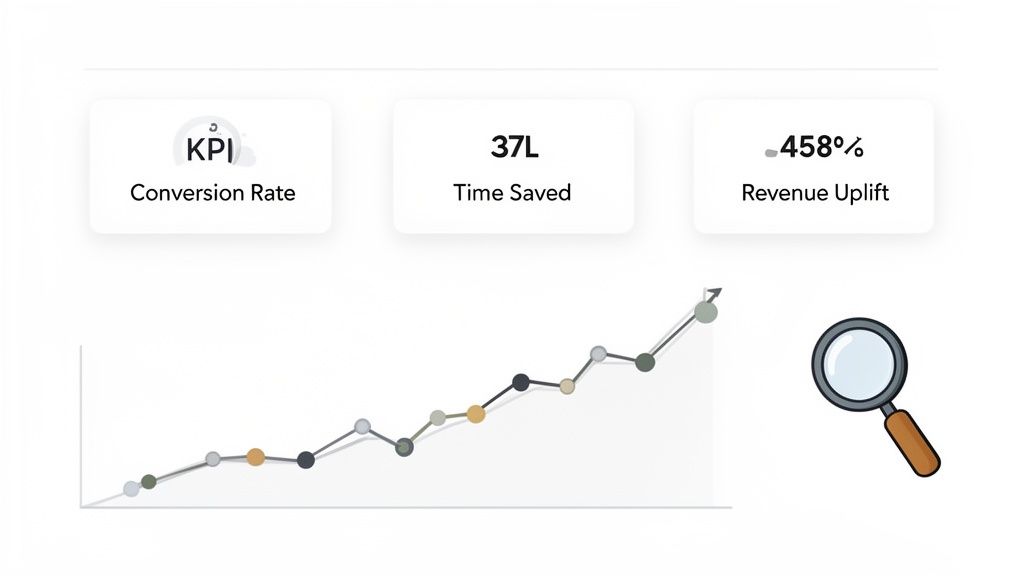
This type of visual reporting allows leadership to see the financial impact of the CRM instantly, connecting daily operational activities to overarching business growth and proving the system is a core strategic asset.
Putting Your CRM to Work with AI and Automation
The primary benefit of integrating AI and automation into a CRM is the transformation of the platform from a passive data repository into a proactive, revenue-generating engine. By leveraging features like predictive lead scoring and automated workflow triggers, a CRM can directly shorten sales cycles and improve conversion rates. This is achieved by systematically turning vast amounts of raw customer data into tangible, revenue-focused actions, such as prioritizing high-value leads and automating routine follow-up tasks.
The adoption of AI and big data within CRM platforms is projected to increase by 97% between 2025 and 2030, signaling a fundamental shift in how businesses manage customer relationships and forecast growth.
Shifting from Reactive to Predictive Operations
The most significant operational benefit of an AI-powered CRM is the shift from retrospective analysis to predictive forecasting. AI algorithms analyze historical data to anticipate future outcomes, empowering RevOps teams with forward-looking insights. Instead of sales representatives manually qualifying leads, an AI model can instantly analyze behavioral and firmographic data to assign a predictive lead score. This allows the team to focus its efforts on prospects with the highest probability of conversion. To learn more about refining this process, take a look at our guide on building an effective sales funnel.
An AI-powered CRM doesn’t just hold your data; it interprets it. It actively suggests the 'next best action' for your team—whether that’s sending a specific follow-up email, sharing a relevant case study, or prompting a well-timed phone call.
These AI-driven recommendations provide a guided selling path, increasing the efficiency and effectiveness of every sales interaction.
The image below illustrates an AI assistant analyzing customer data to provide a predictive score and recommend the next best action.
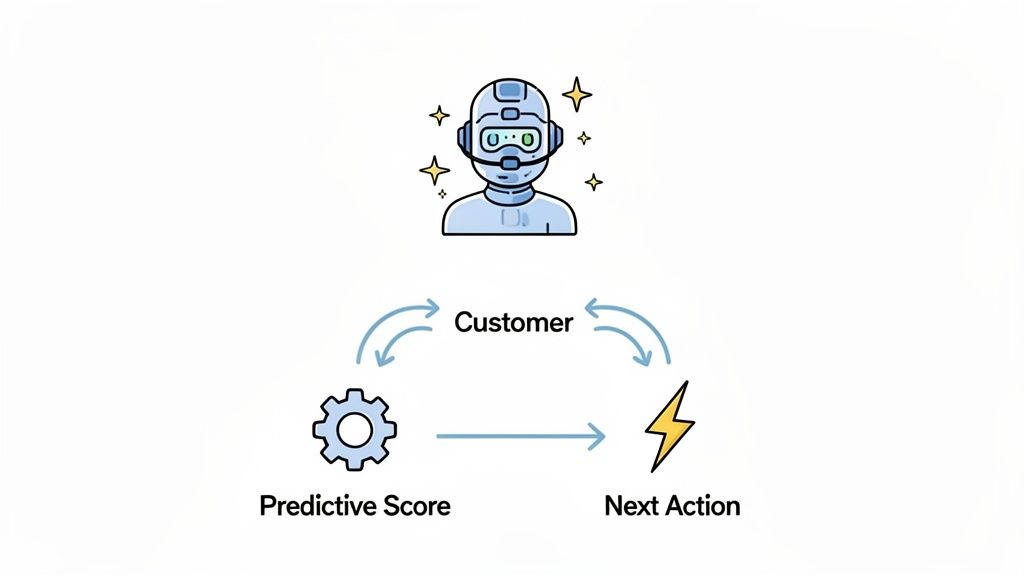
This demonstrates how AI becomes an active partner in the daily workflow, enabling smarter, faster decision-making.
Making Intelligent Workflow Automation a Reality
Beyond predictive insights, AI enables the automation of complex workflows that previously consumed significant manual effort. This intelligent automation builds a more efficient and consistent operational backbone for the business, ensuring critical follow-ups are never missed and every customer receives a timely, relevant experience.
Intelligent automation can:
- Trigger personalized email nurture sequences based on a prospect's real-time behavior.
- Automatically update a deal's pipeline stage when a key action, like opening a proposal, occurs.
- Draft initial quotes or follow-up communications for sales team review.
The table below compares key AI features available in modern CRM platforms.
| AI Feature | Primary Business Benefit | Implementation Complexity |
|---|---|---|
| Predictive Lead Scoring | Boosts sales efficiency by focusing your team on the most promising leads, directly improving conversion rates. | Moderate |
| Next-Best-Action Recommendations | Gives sales and service agents real-time guidance, leading to better decisions and happier customers. | Moderate |
| Automated Data Entry | Slashes administrative time by automatically logging emails, calls, and meeting notes into the CRM. | Low |
| Sentiment Analysis | Reads customer emotion in emails and support tickets, helping you proactively manage satisfaction and flag risks. | High |
By strategically selecting which features to implement, organizations can significantly reduce administrative overhead and empower teams to focus on strategic, revenue-driving work.
Real World Examples of B2B CRM Success
The most compelling arguments for CRM adoption are found in tangible business outcomes that directly tie the system's capabilities to measurable ROI. The following B2B case studies demonstrate how organizations transformed common operational challenges into financial gains by implementing CRM-driven solutions for data centralization, lead flow automation, and AI-powered analytics.
Tech Company Accelerates Its Sales Cycle
A mid-market software provider’s primary challenge was a slow average sales cycle of 75 days, which constrained cash flow and hampered growth. By implementing a CRM with automated lead management, the company was able to capture, qualify, and route every new lead to the appropriate sales representative in minutes. This single change reduced their sales cycle by 40%, resulting in a £1.2 million increase in annual bookings.
- Automated lead capture and de-duplication saved the team 60 hours per month on manual data cleansing.
- Workflow rules for lead qualification increased their lead-to-opportunity conversion rate by 18%.
- Sales representatives reclaimed 15% of their workweek for high-value activities like product demos and strategic client meetings.
Manufacturing Firm Improves Its Win Rates
A global manufacturing firm was losing approximately 30% of qualified inquiries due to slow and inconsistent follow-up, representing a significant loss of potential revenue. The solution was the integration of predictive lead scoring within their CRM, which ranked prospects based on historical buying patterns and real-time engagement data. This enabled the sales team to prioritize their efforts on the highest-potential leads, resulting in a 22% lift in their overall win rate within three quarters.
“Predictive scoring cut through the noise and aligned our team with the prospects most likely to convert,” says the VP of Sales.
Centralized dashboards provided real-time pipeline visibility, which also supported more effective sales coaching and reduced new hire ramp-up time by 25%.
SaaS Enterprise Slashes Administrative Costs
A large SaaS vendor faced operational inefficiencies due to fragmented RevOps workflows across marketing, sales, and support, leading to data silos and duplicate administrative effort. By consolidating these functions into a single CRM, they automated routine inter-departmental handoffs. This strategic move reduced administrative overhead by 35%, saving the company £250,000 annually and accelerating their campaign time-to-market.
The CRM’s workflow builder automated tasks such as:
- Creating post-demo follow-up tasks for the customer success team.
- Updating opportunity stages upon contract signature.
- Triggering renewal reminders six months prior to account expiration.
A Summary of Industry Outcomes
| Industry | Key Challenge | CRM Solution | Outcome |
|---|---|---|---|
| Tech | Long sales cycle | Automated lead routing | 40% faster deal closure |
| Manufacturing | Low conversion on enquiries | AI-driven predictive scoring | 22% higher win rate |
| SaaS | High administrative effort and costs | Unified RevOps integration | 35% reduction in overhead costs |
These examples demonstrate a repeatable formula for success: identify the most significant operational bottleneck, apply a targeted CRM capability to address it, and measure the impact on a key business metric.
How to Apply These Lessons to Your Business
Replicating this success requires a methodical, data-driven approach rather than just a software purchase.
- Benchmark Your Current Metrics: Document your current sales cycle length, win rates, and administrative hours to establish a clear baseline for measuring improvement.
- Configure the Right Features: Prioritize the implementation of CRM features that directly address your primary business challenges, such as lead routing, predictive scoring, or workflow automation.
- Track the Impact Relentlessly: Utilize CRM dashboards to continuously monitor the KPIs you identified. Conduct regular reviews to assess progress and refine your strategy.
This iterative cycle of adapting, measuring, and optimizing transforms a CRM from a simple database into a powerful engine for sustainable growth.
Executive Action Plan for CRM Implementation
The primary objective of a CRM implementation is to create a direct, measurable link between the technology's configuration and key financial outcomes, such as accelerated revenue growth and enhanced operational efficiency. To transition from high-level strategy to tangible results, B2B leaders must follow a structured, five-step roadmap. This plan ensures that the investment serves core business objectives from day one and establishes a framework for continuous improvement and sustainable growth.
Step 1: Align Stakeholders on Business Goals
The first action is to convene leaders from sales, marketing, and customer service to agree upon the primary business problem the CRM will solve. Define one primary objective (e.g., shorten the sales cycle) and two secondary objectives. This initial alignment is critical for ensuring the entire organization is focused on the same strategic outcomes.
- Key Deliverable: A signed-off document listing the top three business goals for the CRM, ranked by priority.
- Success Criterion: Every department head can articulate how the CRM will help them achieve their specific performance targets.
Step 2: Define Success Metrics and KPIs
Translate the agreed-upon goals into concrete, trackable Key Performance Indicators (KPIs). If the primary goal is to shorten the sales cycle, the core KPI is the average number of days from lead creation to a closed-won deal. It is imperative to establish baselines for these metrics before implementation to accurately measure impact.
The best CRM strategies are data-driven from the very beginning. By defining your KPIs before launch, you change the CRM from a simple contact database into a powerful performance management tool that keeps everyone accountable for results.
Step 3: Configure Core Workflows and Modules
With goals and metrics defined, configure the CRM's core components—such as lead management, opportunity tracking, and customer service cases—to reflect your ideal business processes. Use this as an opportunity to simplify and automate critical handoffs between teams, rather than replicating existing inefficient habits.
Step 4: Strategically Deploy High-Impact AI Features
Avoid the common mistake of enabling all AI features simultaneously. Instead, begin with a single, high-impact capability that directly supports your primary business goal. For example, if the top priority is improving lead quality, focus first on implementing and calibrating the predictive lead scoring model.
Step 5: Establish a Cycle of Continuous Improvement
CRM implementation is not a one-time project but an ongoing process. Schedule quarterly business reviews with key stakeholders to analyze performance dashboards, assess progress against KPIs, and identify new opportunities for workflow automation and optimization. This iterative approach ensures the CRM evolves with your business and continues to deliver long-term value.
Your CRM Questions, Answered
For B2B leaders considering a CRM investment, practical questions regarding impact, timing, and integration are paramount. The following answers provide the clarity needed to make an informed, strategic decision for your organization.
How Quickly Can We Expect to See a Return on Investment?
Initial ROI can be observed within the first six months, primarily through operational efficiency gains like reduced time spent on manual data entry and faster lead response times. More substantial financial returns, such as significant increases in sales conversion rates or a measurable reduction in the sales cycle length, typically materialize within the first year as the team achieves full adoption and the system accumulates sufficient data for predictive analytics to become effective.
Will a CRM Integrate with Our Existing Technology Stack?
Yes. Modern CRM platforms are designed for interoperability and seamless integration with existing business systems. Leading providers like Salesforce and HubSpot offer robust APIs and pre-built connectors for essential tools, including marketing automation platforms, ERP systems, and business intelligence software. This integration is non-negotiable for creating a single, authoritative view of the customer and dismantling information silos between departments.
A well-integrated CRM becomes the heart of your entire RevOps tech stack. It doesn't just hold data; it orchestrates it across every critical application, making sure every team is on the same page, all the time.
How Secure Is a CRM for Our Sensitive Customer Data?
Enterprise-grade CRM platforms are architected with security as a core principle. They employ multi-layered security measures, including end-to-end data encryption, granular role-based access controls, and regular third-party security audits to ensure compliance with standards like GDPR. By leveraging a reputable cloud-based CRM provider, you are entrusting your data to a security infrastructure that is often more robust and sophisticated than what most individual companies can maintain in-house.
At Vantage Advisory, we provide the strategic intelligence B2B leaders need to integrate AI and automation into their revenue operations. Discover how to build a more efficient, scalable business at https://vantageadvisory.co.uk.