Key Takeaways
- Answer-First Analysis: The optimal Account-Based Marketing (ABM) tool is determined by organisational maturity, existing technology stack, and specific go-to-market objectives. There is no single "best" platform; selection requires aligning platform capabilities with strategic business needs.
- Workflow Integration is Critical: The most significant ROI from ABM tools comes from their ability to integrate seamlessly with core CRM and Marketing Automation Platforms (MAPs). This alignment creates a unified data flow that enables actionable insights for both sales and marketing teams.
- Focus on ROI, Not Features: Evaluate tools based on their capacity to impact key business metrics such as pipeline velocity, deal size, and target account engagement. Enterprise platforms like Demandbase and 6sense offer comprehensive orchestration, while specialised tools like Dealfront or LinkedIn provide high-impact, focused capabilities.
- Implementation Requires a Plan: Successful ABM tool deployment is a strategic initiative, not just a software installation. It requires a cross-functional steering committee, a phased roll-out plan, and a commitment to continuous optimisation to ensure adoption and drive measurable results.
Selecting the right account based marketing tools is a critical decision for executing a sophisticated, revenue-driven strategy that scales. The primary solution is to choose a platform that directly aligns with your organisation's specific business model, existing tech stack, and strategic objectives, rather than seeking a generic, all-in-one solution. Misalignment in this area leads to inefficient spend, disjointed customer experiences, and a significant drain on RevOps resources. The core challenge is not a lack of options, but a lack of clarity on which platforms genuinely support defined B2B workflows and deliver measurable ROI.
This guide moves beyond surface-level feature comparisons to provide a detailed, practical analysis of the leading ABM platforms. We evaluate each solution against a consistent enterprise rubric, focusing on criteria that directly impact return on investment: security posture, scalability, workflow integration, and the practical application of AI. Our objective is to equip B2B leaders with the insights needed to make informed procurement decisions that drive measurable growth.
For each of the 12 account based marketing tools reviewed, you will find:
- A concise analysis of its core strengths and ideal use cases.
- An honest assessment of potential limitations and integration challenges.
- Strategic guidance on how it fits within a modern B2B technology stack.
- Direct links and screenshots to provide clear context and facilitate further exploration.
This resource is structured to help you quickly identify the platforms that best match your organisation’s strategic objectives, operational workflows, and revenue targets, ensuring your investment accelerates growth rather than creating administrative debt.
1. Demandbase One
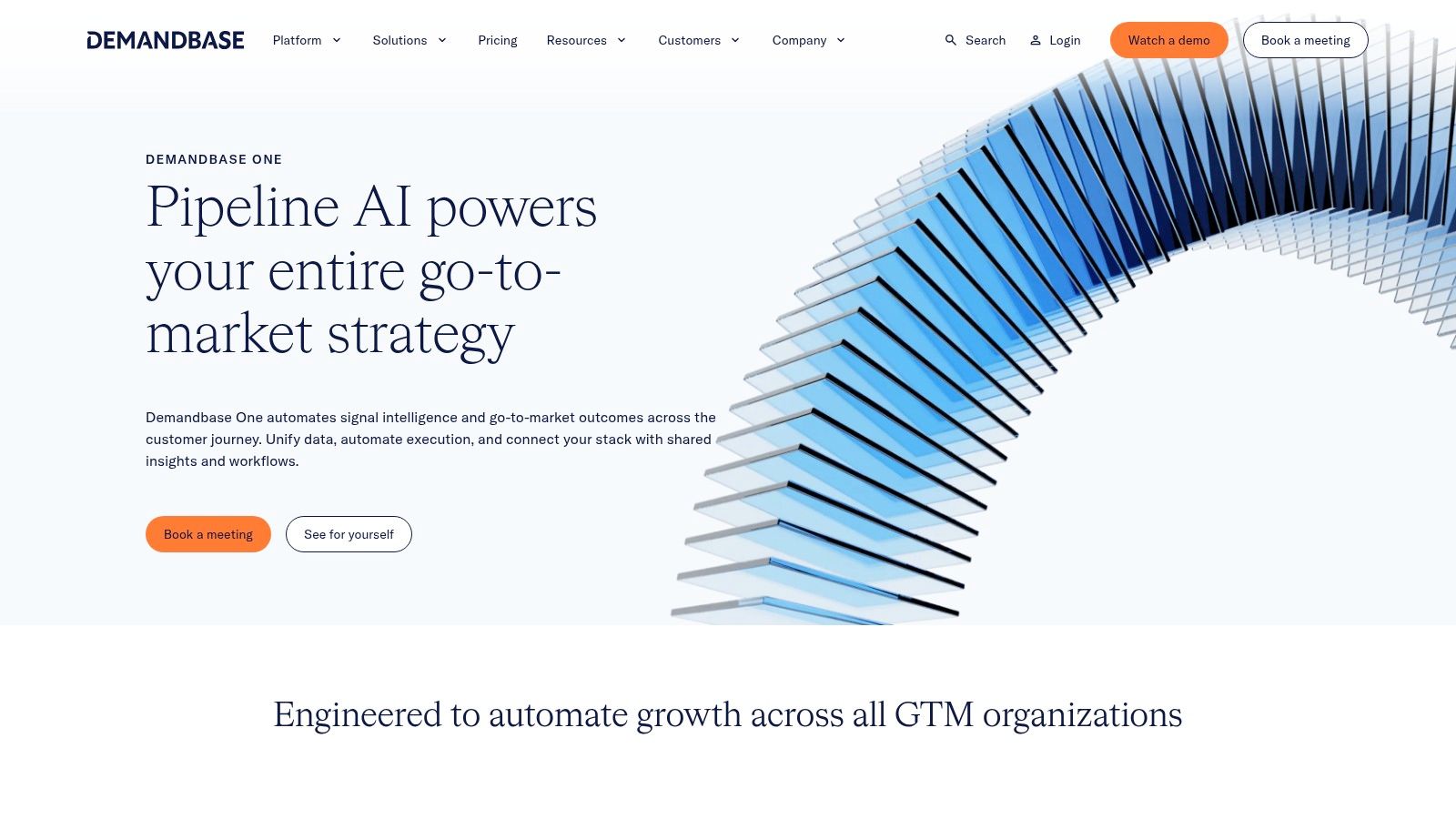
Demandbase One is a comprehensive, end-to-end Account-Based Marketing (ABM) platform designed for mid-market and enterprise organisations seeking to unify their Go-To-Market (GTM) strategy. The primary solution it provides is a centralised system for account intelligence, advertising, sales engagement, and measurement, making it one of the most powerful all-in-one account based marketing tools for mature revenue teams. It excels at orchestrating complex, multi-channel campaigns by combining first-party CRM data with its extensive third-party intent data and B2B-native advertising DSP.
Core B2B Workflow & ROI Focus
The primary workflow for Demandbase One involves establishing a standardised, data-driven GTM motion across marketing, sales, and customer success. Its strength lies in identifying in-market accounts using its proprietary intent data and AI-driven scoring, then activating personalised engagement through its integrated advertising and sales intelligence modules. From an ROI perspective, the platform delivers value by improving pipeline velocity and eliminating redundant point solutions. Deployment is best suited for organisations with a well-defined Ideal Customer Profile (ICP) and a mature RevOps function capable of managing deep integrations with core CRM (e.g., Salesforce) and Marketing Automation Platforms (e.g., Marketo, HubSpot).
Technical Comparison
| Feature | Description |
|---|---|
| Unified Data Core | Combines intent, firmographic, technographic, and contact data to create a holistic view of target accounts. |
| Pipeline AI | Utilises machine learning to predict which accounts are most likely to become pipeline opportunities. |
| B2B Advertising DSP | Enables precise, account-targeted display and connected TV advertising campaigns. |
| Sales Intelligence & Orchestration | Provides sellers with prioritised account lists and automated "Sales Plays" based on real-time buying signals. |
Procurement & Total Cost of Ownership
Pricing is available via custom quotes, and procurement cycles can be extensive, reflecting its enterprise focus. The total cost of ownership should factor in the platform subscription, integration costs, and the need for dedicated administrative resources. While the initial investment is significant, the platform offers substantial ROI potential by improving pipeline velocity and eliminating redundant point solutions.
Official Website: https://www.demandbase.com/products/
2. 6sense
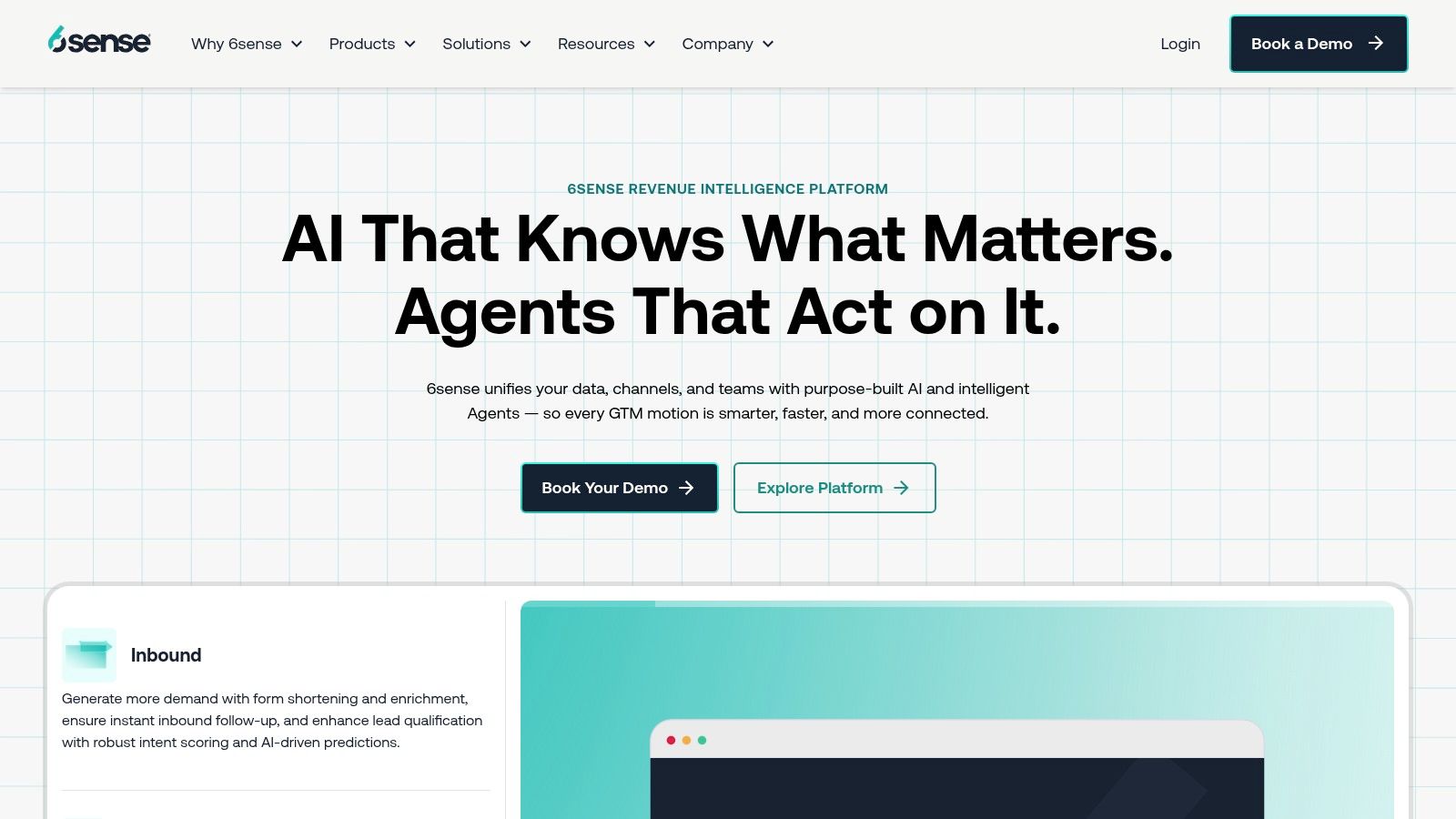
6sense is a market-leading Revenue AI platform that provides the solution for uncovering anonymous buying signals to help marketing and sales teams engage the right accounts at the right time. It is a powerful choice for B2B organisations looking to operationalise an ABM strategy built on predictive analytics and third-party intent data. The platform's core strength is its ability to identify in-market accounts before they formally engage, making it one of the most proactive account based marketing tools for building high-quality pipeline and accelerating revenue growth.
Core B2B Workflow & ROI Focus
The primary workflow within 6sense is identifying and prioritising accounts demonstrating purchase intent, then orchestrating multi-channel engagement based on AI-driven recommendations. It is ideal for mature GTM teams that need to move beyond traditional lead-based models and focus resources on accounts with the highest propensity to buy. Its ROI is realised by focusing marketing spend and sales effort on accounts most likely to convert, thereby increasing efficiency and pipeline quality. Deployment requires deep integration with a CRM like Salesforce and a Marketing Automation Platform, where 6sense data enriches account records and triggers automated workflows for marketing and sales outreach.
Technical Comparison
| Feature | Description |
|---|---|
| Predictive AI Models | Creates dynamic account segments based on buying stage and intent signals, with AI-recommended actions. |
| Revenue AI for Sales | Provides sellers with a Chrome extension, a Sales Copilot, and real-time alerts on account activity and engagement. |
| Comprehensive Data | Unifies company and contact data, technographics, web visitor identification (Deanonymization), and extensive third-party intent. |
| Free Sales Intelligence Tier | A credits-based free offering allows sales teams to pilot core data and intelligence features. |
Procurement & Total Cost of Ownership
The full enterprise ABM platform is available via custom quote, and the total cost can be significant, particularly with add-on modules. However, the introduction of a free Sales Intelligence tier has lowered the initial barrier to entry for sales teams wanting to test the data. The total cost of ownership should account for the subscription, implementation effort, and the necessary investment in change management to drive user adoption and operationalise the platform's insights effectively.
Official Website: https://6sense.com/
3. RollWorks
RollWorks provides an accessible yet powerful account-based platform, primarily offering a solution to help B2B organisations identify and engage target accounts through sophisticated advertising and data. It serves as a practical entry point for businesses scaling their ABM efforts, especially those heavily integrated with CRM and marketing automation platforms like HubSpot and Salesforce. By combining firmographic data with behavioural signals, RollWorks helps revenue teams coordinate digital advertising and sales outreach, making it one of the more focused account based marketing tools for paid media activation.
Core B2B Workflow & ROI Focus
The primary workflow for RollWorks is to operationalise an ABM advertising strategy by identifying in-market accounts and executing targeted digital ad campaigns. It excels at helping marketing and sales teams align on a target account list and then reaching key decision-makers within those accounts across multiple channels. The ROI focus is on maximising the efficiency of advertising spend by concentrating it on high-value accounts, thereby improving cost-per-acquisition and marketing-sourced pipeline. Deployment is well-suited for mid-market B2B companies that have a defined ICP and want a more direct, self-serve-oriented path to launching ABM ads.
Technical Comparison
| Feature | Description |
|---|---|
| Account and Contact Targeting | Utilises a proprietary data co-op and integrations to build precise audiences based on firmographic, technographic, and intent data. |
| Cross-Channel Ad Execution | Manages display, social, and native advertising campaigns to engage target accounts wherever they are online. |
| Measurement and Revenue Impact | Provides analytics that connect ad spend directly to pipeline generation and revenue, integrating with CRM data for a full-funnel view. |
| Salesforce & HubSpot Integration | Deep, bi-directional syncs push account-level engagement data directly to sales teams, enabling timely and relevant follow-up. |
Procurement & Total Cost of Ownership
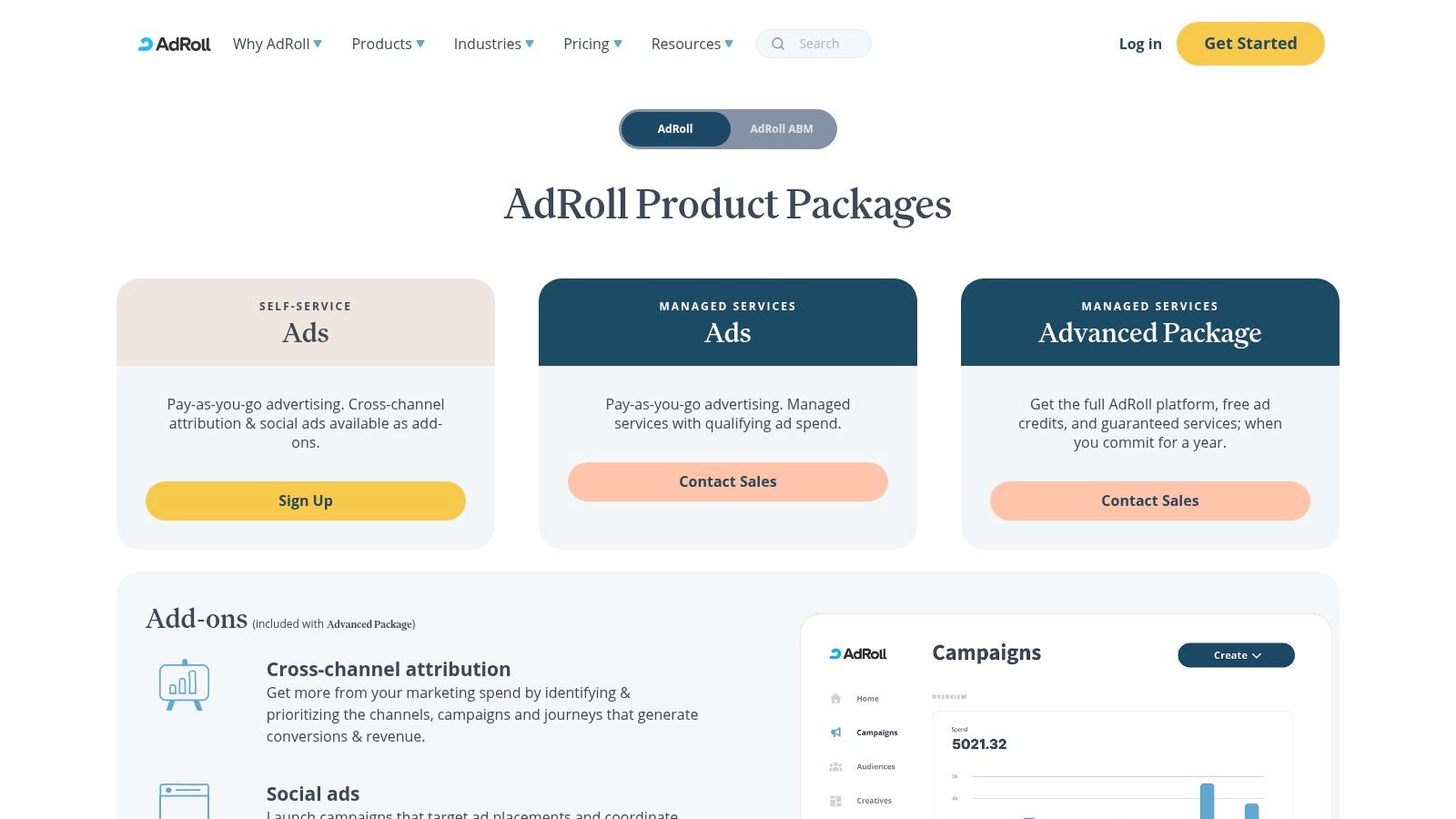
RollWorks offers tiered pricing packages, starting with a free tier and scaling up to custom enterprise plans. This transparent model makes procurement more straightforward than with some all-in-one suites. The total cost of ownership includes the platform subscription fee plus the managed advertising spend. While initial platform costs can be lower, organisations must carefully budget for media spend to achieve meaningful results.
Official Website: https://www.rollworks.com/pricing/
4. Terminus
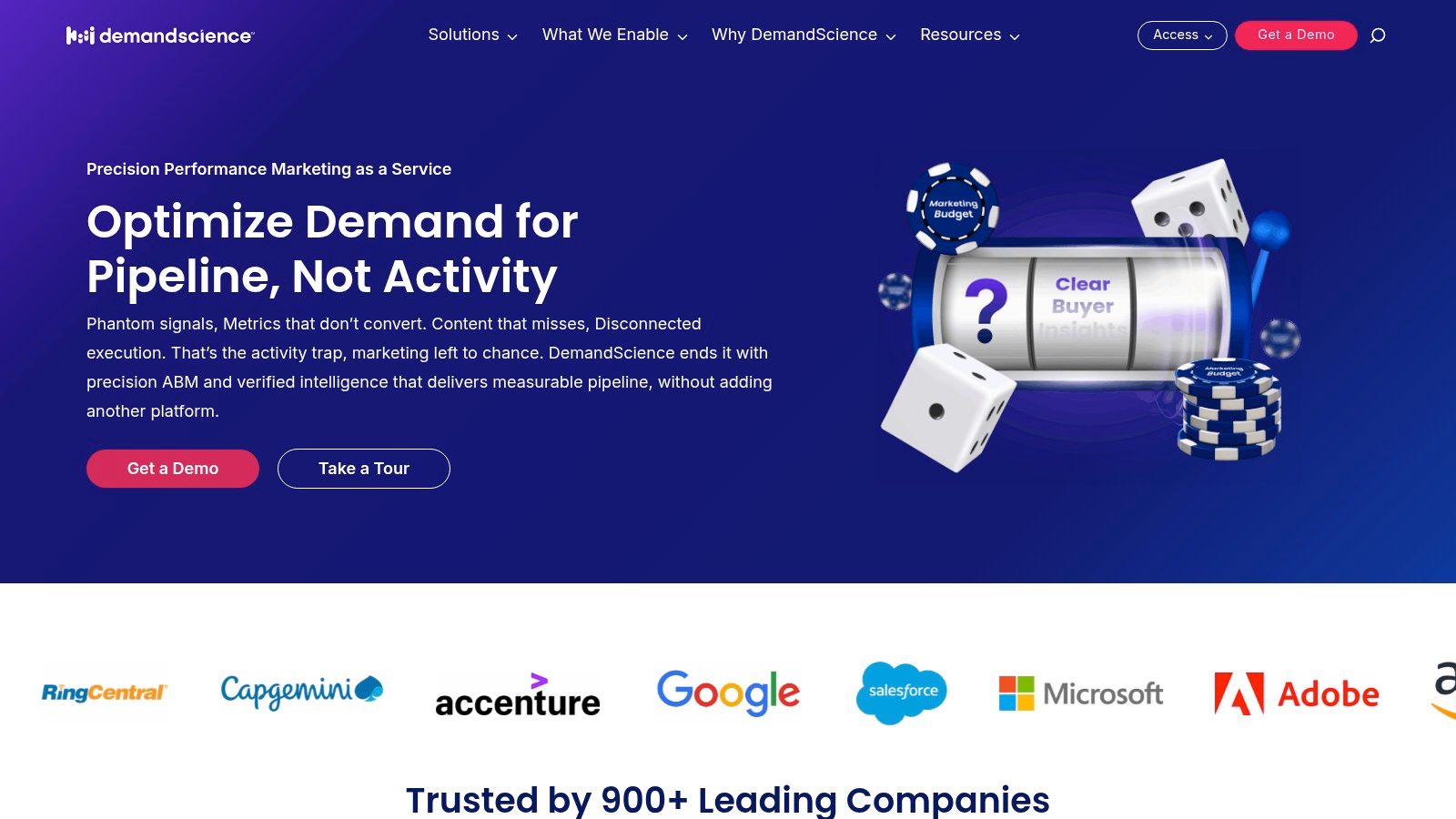
Terminus is a multi-channel ABM platform that provides a unified solution for advertising, chat, email, and web personalisation. It is engineered for revenue teams aiming to execute a cohesive full-funnel strategy by centralising both data and engagement channels under one roof. The platform excels at activating coordinated, account-centric campaigns across multiple touchpoints, making it one of the most versatile account based marketing tools for organisations that prioritise broad channel coverage and operational simplicity.
Core B2B Workflow & ROI Focus
The primary workflow for Terminus is the orchestration of synchronised, multi-channel engagement plays targeting specific accounts. Its strength lies in its Engagement Hub, which allows marketers to build and launch campaigns from a central command centre, ensuring consistent messaging. The ROI is driven by improving engagement rates and pipeline conversion by surrounding target accounts with a consistent message across all digital touchpoints. Deployment is ideal for mid-market B2B organisations that need an all-in-one platform but may lack the deep RevOps resources required by more complex enterprise systems.
Technical Comparison
| Feature | Description |
|---|---|
| Engagement Hub | Activates campaigns across advertising, chat, email, and website personalisation to surround target accounts. |
| Data Studio | Provides robust segmentation and audience-building capabilities, integrating first-party and third-party data sources. |
| Measurement Studio | Delivers program-level attribution and reporting to demonstrate marketing's impact on pipeline and revenue. |
| Native CRM & MAP Integrations | Connects seamlessly with core platforms like Salesforce, HubSpot, and Marketo to ensure data flow and workflow alignment. |
Procurement & Total Cost of Ownership
Terminus operates on a custom, quote-based pricing model, requiring direct engagement with their sales team. The total cost of ownership should account for the subscription fee and the internal resources needed for content creation and campaign management across multiple channels. While the platform consolidates several point solutions, organisations should plan for a phased enablement process to maximise adoption and ROI.
Official Website: https://terminus.com/
5. Triblio
Triblio is a specialised ABM orchestration platform that offers a solution for activating target account lists through personalised website experiences and account-based advertising. It excels at translating account intelligence into tailored digital journeys, dynamically altering website content, calls-to-action (CTAs), and messaging for specific audience segments. As one of the more focused account based marketing tools, Triblio is ideal for marketing teams aiming to increase engagement and conversion rates from known accounts visiting their primary web properties.
Core B2B Workflow & ROI Focus
The primary workflow for Triblio is to bridge the gap between account identification and digital engagement, transforming the corporate website into a dynamic ABM channel. It orchestrates personalised web content and runs coordinated advertising campaigns to surround target accounts with a consistent message. The ROI focus is on improving on-site conversion and sales alignment by delivering relevant experiences to high-value visitors, directly impacting website-sourced pipeline. Deployment is best suited for organisations that have already identified their target account lists and integrate with major CRM and MAPs to trigger sales alerts based on account web activity.
Technical Comparison
| Feature | Description |
|---|---|
| Account-Based Web Personalisation | Dynamically changes website content, headlines, and CTAs based on the visitor's industry, account, or buying stage. |
| ABM Advertising | Enables display and retargeting campaigns specifically for defined account lists, ensuring ad spend is highly targeted. |
| Content Hubs & Microsites | Allows for the creation of personalised content destinations for strategic accounts, supporting effective B2B lead nurturing best practices. |
| Sales Insights & Alerts | Notifies sales representatives in real-time when target accounts are active on the website, providing valuable engagement context. |
Procurement & Total Cost of Ownership
Triblio operates on a quote-only, sales-led pricing model. The total cost of ownership should account for the subscription fee and potentially the need for creative or technical resources to fully leverage the website personalisation capabilities. It offers a clear ROI by directly impacting website pipeline generation from target accounts.
Official Website: https://triblio.com/
6. Madison Logic (ML Platform)
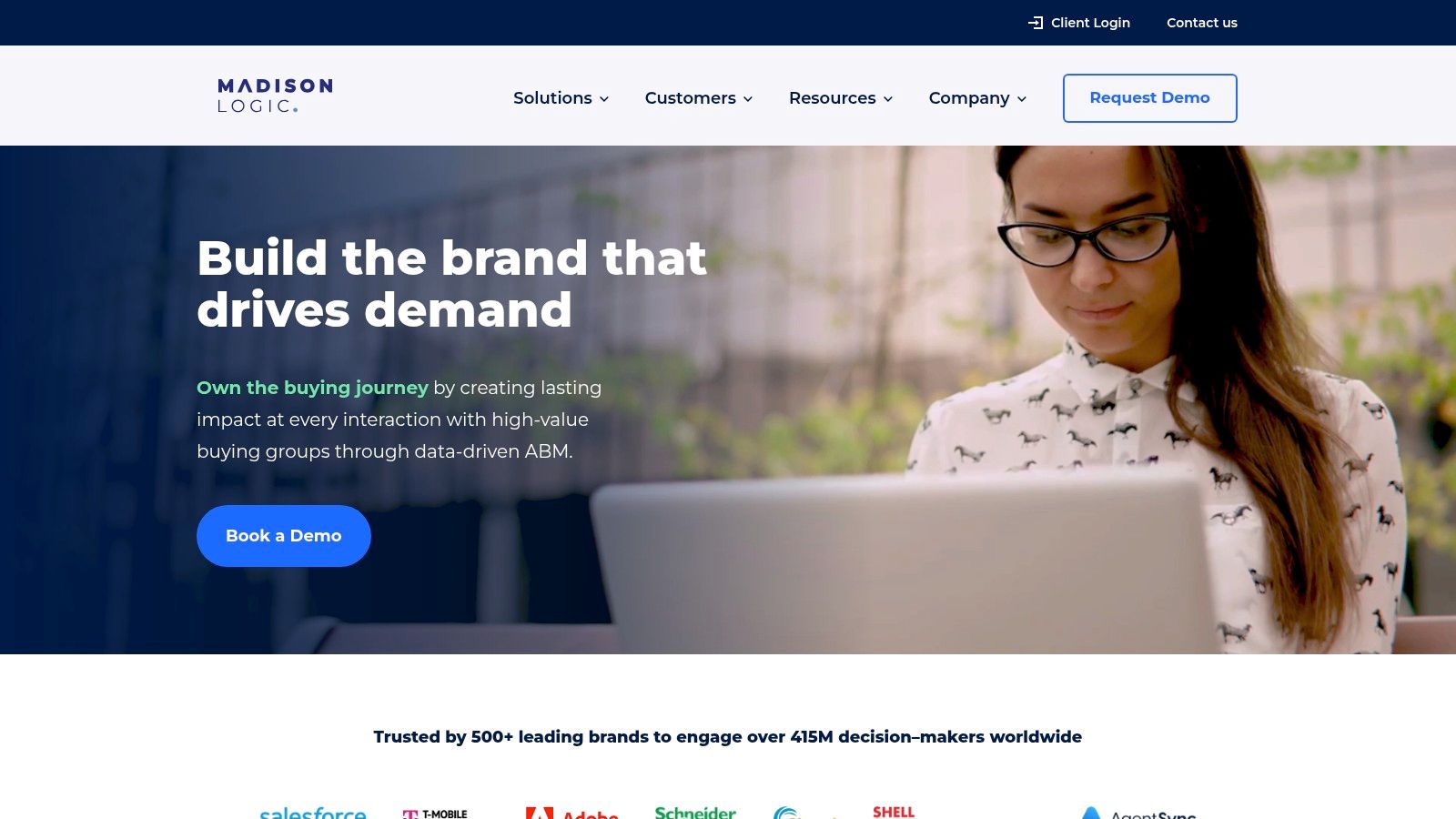
Madison Logic's ML Platform is an activation-focused ABM solution designed to identify and engage in-market accounts early in their buying journey. It provides a solution that combines third-party intent data with multi-channel activation, including content syndication, display, and connected TV advertising. For revenue teams, it serves as a key tool for de-anonymising website traffic and surfacing buying committee signals, making it one of the more specialised account based marketing tools for global demand generation.
Core B2B Workflow & ROI Focus
The primary workflow for Madison Logic is to drive top-of-funnel engagement and generate qualified leads from a target account list through data-driven content syndication and media campaigns. It is ideal for marketing teams with a strong content library who need to scale their reach and fill the pipeline with accounts showing active research behaviour. The ROI is measured by improvements in lead quality and pipeline creation from target accounts by focusing resources on those demonstrating early intent. Its strength lies in providing actionable account-level engagement data to fuel sales and marketing follow-up.
Technical Comparison
| Feature | Description |
|---|---|
| ML Intent Dashboard | Provides a unified view of account and buying-group signals, visualising topical interest and engagement across channels. |
| ABM Web Analytics | Identifies anonymous site visitors and maps them to known accounts, revealing previously hidden interest. |
| Multi-channel Activation | Executes coordinated campaigns across content syndication, programmatic display, social, and CTV to surround the buying committee. |
Procurement & Total Cost of Ownership
Pricing is typically provided via a custom quote and often involves a platform fee combined with media spend and lead generation costs. The procurement process is sales-led. Total cost of ownership should account for the ongoing media investment required to fuel the platform, as well as the internal resources needed to manage campaigns and supply a steady stream of content assets.
Official Website: https://www.madisonlogic.com/
7. Jabmo
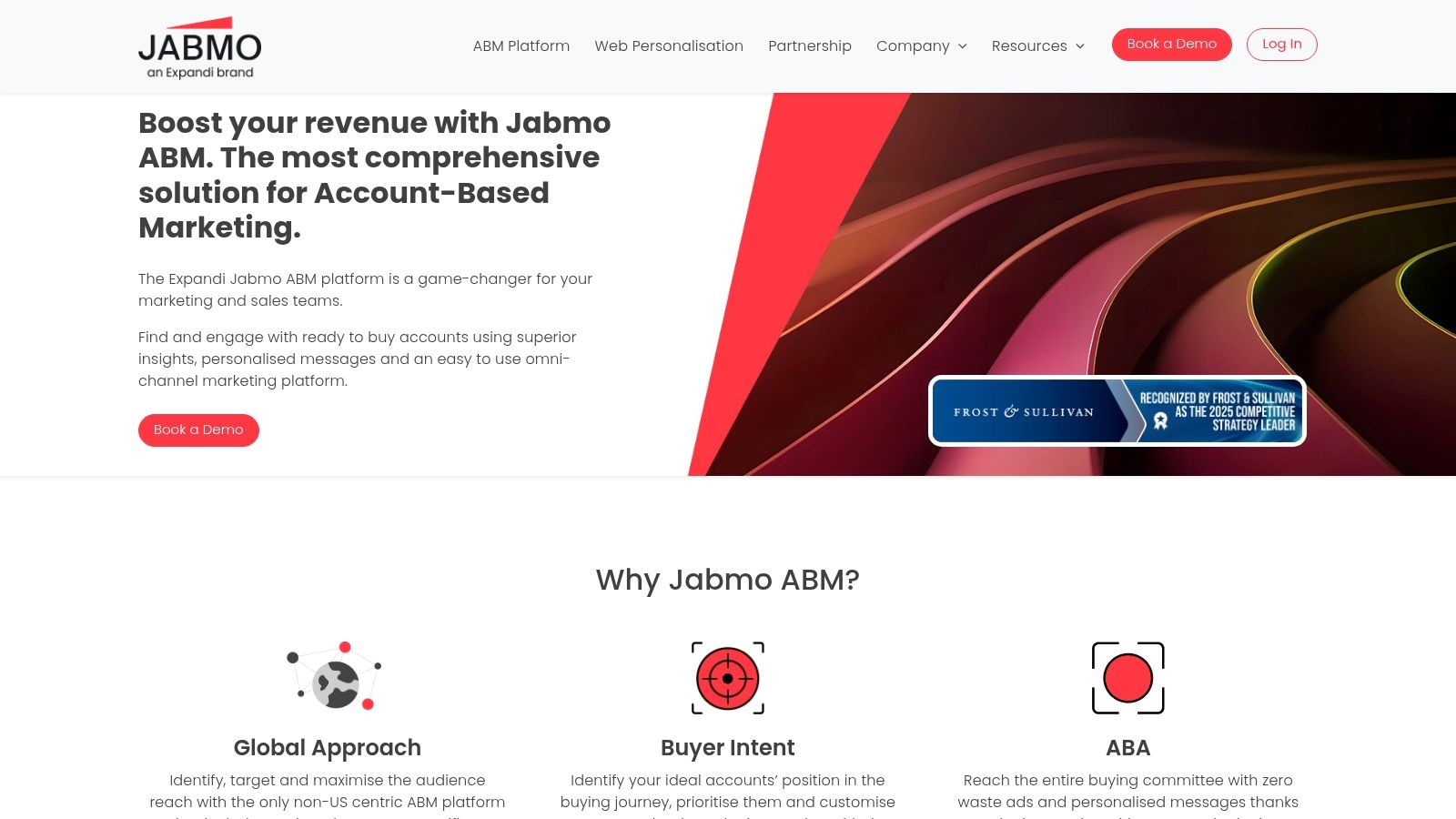
Jabmo is an omni-channel ABM platform engineered for global manufacturing and life sciences, providing a solution with a strong focus on EMEA and APAC markets. Its primary differentiator is robust multi-language intent data and country-specific IP tracking that provides deeper insights for organisations with significant non-US account lists. For revenue teams with a heavy EMEA focus, Jabmo provides a level of regional data granularity that makes it one of the most relevant account based marketing tools for international GTM strategies.
Core B2B Workflow & ROI Focus
The core workflow for Jabmo is to execute and measure account-based advertising and marketing campaigns for global enterprises targeting specific buying committees within named accounts. Its platform excels at identifying anonymous buying signals from target accounts across multiple languages and regions, then activating personalised digital advertising and sales alerts. The ROI is delivered by providing otherwise inaccessible international account intelligence and improving marketing effectiveness in non-US territories. Deployment is ideal for established global marketing teams that need to overcome the limitations of US-centric data providers.
Technical Comparison
| Feature | Description |
|---|---|
| Global IP-Based Analytics | Captures anonymous website engagement signals from target accounts worldwide, offering superior tracking in EMEA and APAC. |
| Multi-Language Intent | Processes and analyses intent signals in multiple languages, crucial for understanding buying behaviour in diverse international markets. |
| Buying Group Identification | Maps anonymous activity to specific buying groups within an account, enabling more precise targeting. |
| Omni-channel ABM Advertising | Delivers coordinated display, social, and video ads directly to prioritised buying committee members. |
Procurement & Total Cost of Ownership
Jabmo’s pricing is available through a custom quote and sales-led engagement, tailored to the scope of the global programme. The total cost of ownership should include the platform subscription and considerations for their managed services, which many clients leverage for campaign execution.
Official Website: https://jabmo.com/
8. MRP Prelytix
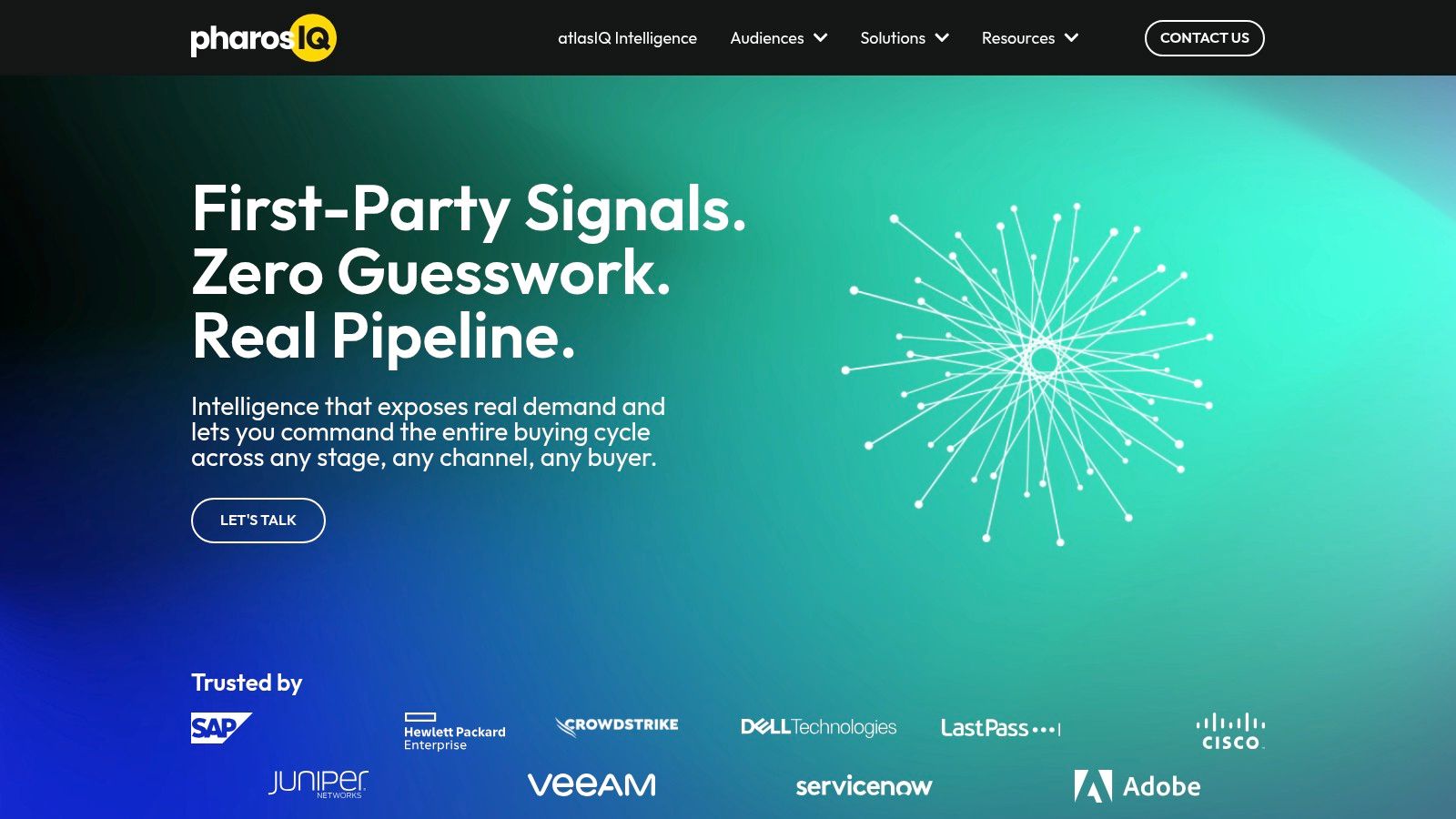
MRP Prelytix is an enterprise-grade ABM platform offering a solution for global organisations managing complex, multi-business-unit go-to-market strategies. It stands out for its ability to ingest and process vast, disparate data sets to deliver predictive insights and orchestrate omnichannel campaigns at scale. For large enterprises with distinct regional teams, Prelytix offers the multitenancy and robust data governance required to execute coordinated yet locally relevant ABM programmes, making it one of the top-tier account based marketing tools for global operations.
Core B2B Workflow & ROI Focus
The primary workflow for MRP Prelytix is enabling mature, data-driven ABM for global enterprises that require deep predictive analytics and multi-channel activation. It is best deployed in organisations with an established RevOps function and a need to coordinate marketing and sales efforts across multiple geographies, languages, and business units. The platform's ROI is delivered by improving marketing efficiency and sales effectiveness in highly complex GTM environments. Its architecture supports deep integrations with enterprise CRM and MAP systems, centralising intelligence to drive more effective campaigns.
Technical Comparison
| Feature | Description |
|---|---|
| Predictive Insights | Utilises AI to analyse intent signals and historical data to identify and prioritise accounts demonstrating buying behaviour. |
| Omnichannel ABM Activation | Orchestrates engagement across display advertising, email, social, direct mail, and sales outreach from a single platform. |
| Global & Multilingual Support | Designed for international deployments with features that support regional scaling and language-specific campaigns. |
| Managed Services Layer | Offers supplemental professional services for strategy, execution, and analytics, ideal for teams needing additional support. |
Procurement & Total Cost of Ownership
Pricing is provided via custom quote and is structured for enterprise-level contracts. The total cost of ownership should account for the subscription, integration complexity, and potential use of their managed services. While the investment is significant, the platform is built to deliver ROI in complex GTM environments.
Official Website: https://www.mrpfd.com/
9. HubSpot Marketing Hub (ABM features)
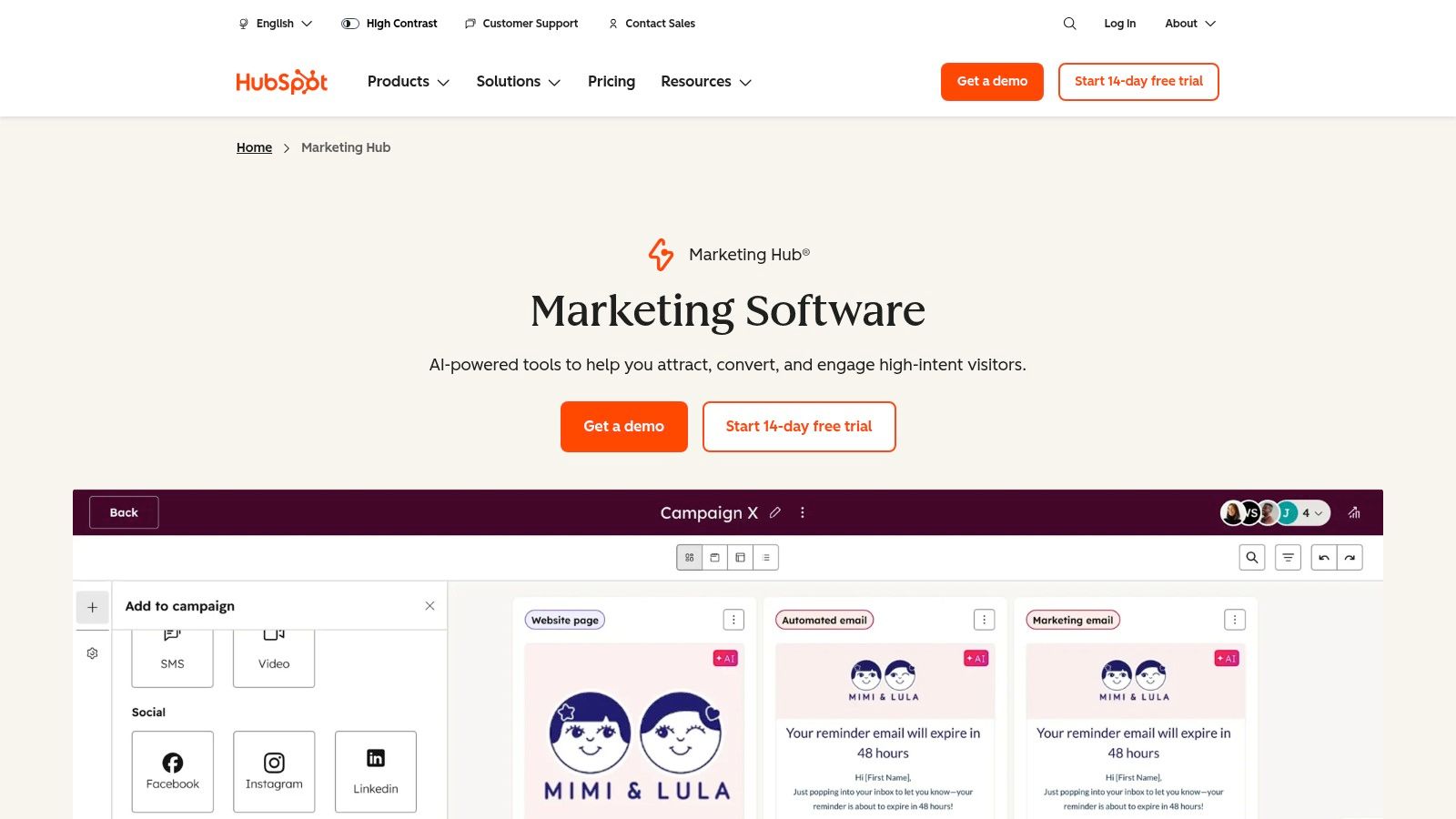
HubSpot Marketing Hub provides a native Account-Based Marketing solution directly within its widely adopted CRM and Marketing Automation Platform. It is an excellent choice for organisations already embedded in the HubSpot ecosystem, offering a unified system for marketing and sales without needing a separate suite. By activating its ABM features, teams can leverage existing data and workflows to target high-value accounts, making it one of the most integrated account based marketing tools for businesses prioritising simplicity.
Core B2B Workflow & ROI Focus
The primary workflow is for B2B teams to layer an ABM strategy onto their existing inbound marketing and sales processes within HubSpot. Its strength lies in its simplicity and native integration, allowing users to designate target accounts, score them based on engagement, and view ABM-specific analytics without leaving the platform. The ROI is achieved by improving focus on high-value accounts and increasing sales-marketing alignment without the cost and complexity of a separate platform. Deployment is ideal for mid-market companies that prefer a consolidated tech stack.
Technical Comparison
| Feature | Description |
|---|---|
| Target Account Properties | Natively identify and track your highest-priority accounts within the HubSpot CRM. |
| ABM Dashboards & Reporting | Pre-built reports offer a clear overview of target account engagement, pipeline influence, and overall programme performance. |
| Workflow Automation | Build account-based workflows to trigger personalised email sequences, ad targeting, or internal sales notifications based on account-level signals. |
| Company Scoring | Create custom scoring properties to automatically prioritise accounts based on firmographics and engagement data. |
Procurement & Total Cost of Ownership
HubSpot offers transparent, published pricing on its website, primarily based on the number of marketing contacts and the selected software tier (Professional or Enterprise). This simplifies budgeting. The total cost of ownership should account for the core subscription, mandatory professional onboarding for higher tiers, and potential costs for additional "Hubs" or user seats.
Official Website: https://www.hubspot.com/products/marketing
10. LinkedIn Marketing Solutions (Matched Audiences)
LinkedIn Marketing Solutions provides the primary solution for activating ABM lists through its powerful advertising channel. Its Matched Audiences feature allows B2B marketing teams to target specific companies and contacts directly, making it a cornerstone for paid media execution within a broader ABM strategy. By uploading target account lists or integrating with CRM and MAPs, organisations can deliver highly relevant ad creative to buying committee members on the professional network, turning it into one of the most critical account based marketing tools for air cover and direct engagement.
Core B2B Workflow & ROI Focus
The primary workflow is precise ad targeting and retargeting of known accounts and contacts identified through other ABM platforms or CRM data. The ROI is measured in terms of brand awareness within strategic accounts and the generation of marketing-qualified engagement from specific, high-value individuals. It is most effective when used to support sales outreach, promote high-value content, and build brand presence within a defined set of strategic accounts. Deployment is self-serve and straightforward for any team with digital advertising experience.
Technical Comparison
| Feature | Description |
|---|---|
| Company & Contact Targeting | Upload CSV lists of companies or email addresses to create bespoke advertising audiences. |
| Website Retargeting | Build audiences from website visitors, video viewers, or Lead Gen Form interactors to re-engage warm prospects. |
| Platform Integrations | Natively connects with major CRM/MAP systems and data platforms like HubSpot, Marketo, and Salesforce for dynamic audience syncing. |
| Lookalike Audiences | Expand reach by targeting professionals with similar profiles to existing high-value customers or prospects. |
Procurement & Total Cost of Ownership
Procurement is self-serve, with no platform subscription fees; costs are based entirely on ad spend (CPC/CPM). The total cost of ownership is directly tied to campaign budget, scale, and performance. While accessible, achieving meaningful impact within an enterprise ABM programme requires a significant and sustained media budget.
Official Website: https://business.linkedin.com/marketing-solutions/ads
11. ZoomInfo MarketingOS / SalesOS
ZoomInfo provides a foundational B2B data platform that is the solution for building and activating ABM campaigns, centring on its extensive contact and company intelligence. While not an end-to-end ABM platform, its MarketingOS and SalesOS bundles offer the critical data enrichment, audience segmentation, and intent signals that power other account based marketing tools. Its strength lies in furnishing marketing and sales teams with high-quality, actionable data to identify and engage target accounts with precision, making it an essential component of many GTM technology stacks.
Core B2B Workflow & ROI Focus
The primary workflow is data acquisition and audience intelligence for ABM initiatives. Teams leverage ZoomInfo to define their ICP, build hyper-targeted account lists, and identify key decision-makers. The ROI is driven by improving the accuracy of targeting, increasing sales efficiency through better data, and reducing wasted marketing spend on out-of-market accounts. Deployment integrates deeply with CRM and marketing automation systems to ensure data hygiene and power segmentation. Organisations targeting UK/EU markets must conduct a compliance review against GDPR requirements.
Technical Comparison
| Feature | Description |
|---|---|
| Advanced Audience Segmentation | Build precise audiences using hundreds of data points, including company size, industry, technology used, and real-time intent signals. |
| Website Visitor Tracking | Identify anonymous companies visiting your website, allowing for proactive outreach and personalised follow-up. |
| Form & Data Enrichment | Automatically enrich inbound leads and existing CRM records with complete and accurate contact and company information. |
| Extensive Integrations | Native connectors for major platforms like Salesforce, HubSpot, and Marketo ensure seamless data flow across the GTM stack. |
Procurement & Total Cost of Ownership
ZoomInfo operates on an annual subscription model with pricing available via custom quote. Contracts are often credit-based, with costs scaling based on data access and add-on modules. The total cost of ownership should account for the core subscription, any feature add-ons, and potential overage fees.
Official Website: https://www.zoominfo.com/solutions/marketingos
12. Dealfront (formerly Leadfeeder)
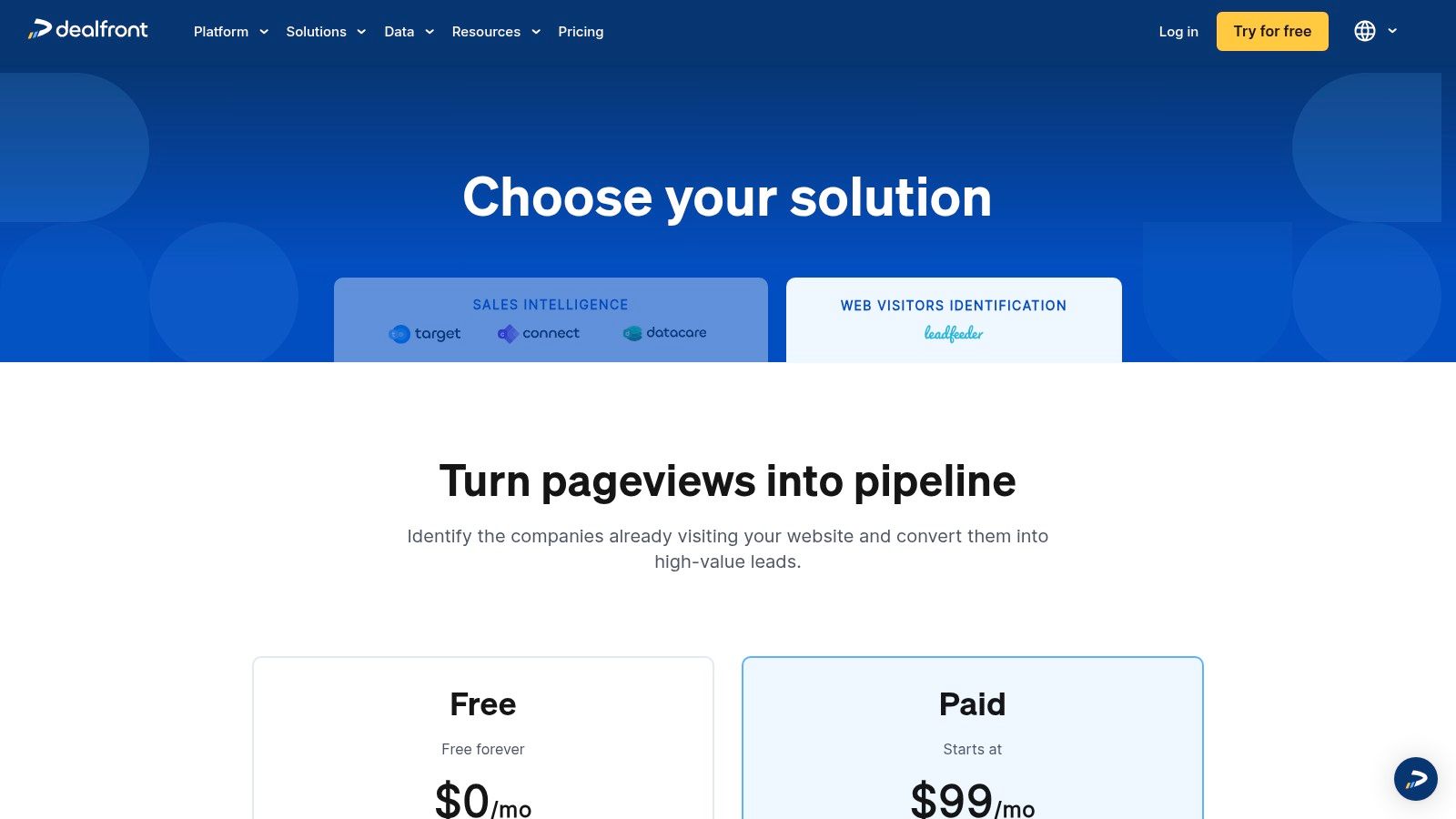
Dealfront, widely known by its former name Leadfeeder, serves as a powerful website visitor identification platform, providing a direct solution for teams to uncover which of their target accounts are demonstrating intent by visiting their website. The platform de-anonymises web traffic, revealing the companies behind the visits and providing rich firmographic and contact data to fuel timely sales and marketing outreach. It is one of the most accessible account based marketing tools for this specific use case.
Core B2B Workflow & ROI Focus
The primary workflow for Dealfront is to generate a high-intent list of accounts for sales and marketing follow-up based on website activity. It bridges the gap between anonymous traffic and actionable sales opportunities. The platform offers a very fast path to ROI by surfacing otherwise hidden pipeline opportunities with a low total cost of ownership. Deployment is straightforward, requiring a simple tracking script, and it integrates intelligence directly into CRM or MAP for automated alerting and campaign enrolment.
Technical Comparison
| Feature | Description |
|---|---|
| Website Visitor Identification | Pinpoints the companies visiting your website, what pages they viewed, and how long they stayed. |
| Data Enrichment | Provides firmographic details and contact information for key decision-makers within identified accounts. |
| CRM & MAP Integration | Natively syncs identified companies and their browsing behaviour to major platforms, creating new leads or updating existing records. |
| GDPR-First Data Posture | Built with a focus on European data compliance, making it a reliable choice for organisations operating in or targeting the EU/UK. |
Procurement & Total Cost of Ownership
Dealfront offers transparent and accessible pricing, including a free-forever tier. Paid plans scale based on the volume of unique companies identified, starting from £89 per month when billed annually. The total cost of ownership is low, as the platform is easy to implement and manage without dedicated administrative resources.
Official Website: https://www.dealfront.com/pricing-web-visitors/
Top 12 ABM Tools Comparison
| Product | Core features | UX & enablement | Ideal fit (target audience) | Unique selling point | Pricing model |
|---|---|---|---|---|---|
| Demandbase One | Unified 1st/2nd/3rd‑party data, intent scoring, B2B DSP, sales playbooks, CRM/MAP integrations | Enterprise-grade enablement, role-based training & certifications | Mid-market & enterprise with mature RevOps | End-to-end ABM + advertising + orchestration in one suite | Quote-based, modular; long procurement cycles |
| 6sense | Predictive AI models, intent signals, Sales Copilot, web visitor ID | AI-recommended actions, seller alerts, strong enterprise adoption | Data-driven marketing & sales teams at enterprise scale | Predictive intent + operational recommendations; free Sales Intelligence tier | Quote-based for ABM; free sales tier available |
| RollWorks | Account/contact audiences, B2B ad execution, HubSpot & GTM integrations, retargeting | Self-serve onboarding, faster time-to-value for paid ABM | SMBs to mid-market seeking paid-media ABM on-ramp | Accessible self-serve paid ABM with clear entry packages | Platform fees + ad spend; tiered starting packages |
| Terminus | Engagement Hub (ads, chat, email, web, sales), Data & Measurement Studios | Full-funnel playbooks, professional services and rollout support | Revenue teams needing multi‑channel ABM under one platform | Broad channel coverage with integrated measurement | Quote-based (sales-led) |
| Triblio | Website personalization, dynamic CTAs, display/retargeting, content hubs | Strong product walkthroughs; web-first ABM UX | Teams prioritizing site personalization & account web experiences | Web-personalization and content hubs tied to ABM lists | Quote-only; services/creative often required |
| Madison Logic (ML Platform) | Intent dashboard, ABM web analytics, content syndication, display/CTV | Buyer-intent visibility across channels; earlier-stage detection | Programs needing global reach and early account detection | Content syndication + intent-driven activation across channels | Platform fees + media costs; quote-based |
| Jabmo | Country IP tracking, multi-language intent, account advertising | Regional office/engagement, localized signals for EMEA/UK | UK/EMEA-heavy lists and global programs needing local coverage | Strong non‑US coverage and multilingual targeting | Quote-based, demo-led |
| MRP Prelytix | Predictive insights, omnichannel activation, multitenancy, services | Enterprise-class for complex multi‑BU rollouts; services available | Large enterprises with multi-BU/global scaling needs | Designed for complex, multitenant global ABM deployments | Enterprise quote-based contracts |
| HubSpot Marketing Hub (ABM) | Native ABM properties, dashboards, workflows, contact hierarchies | Single system of record, published onboarding, predictable UX | Organizations already on HubSpot preferring integrated ABM | Integrated ABM inside CRM/MAP for simpler operations | Published tiers (Pro+/Enterprise); costs scale with contacts/hubs |
| LinkedIn Marketing Solutions (Matched Audiences) | Company/contact uploads, retargeting, integrations, self-serve ads | Precise B2B targeting at scale; regional billing & currency support | ABM teams activating paid lists at scale globally | Essential paid-media channel for ABM list activation | Self-serve ad spend; min. audience (~300) and higher CPC/CPM |
| ZoomInfo MarketingOS / SalesOS | Contact/company data, intent, site visitor tracking, enrichment | Deep dataset, broad integrations; requires compliance review for EU/UK | Teams relying on rich data for list building and enrichment | Comprehensive B2B data backbone for ABM & outreach | Annual, credit-based contracts; add-ons increase TCO |
| Dealfront (formerly Leadfeeder) | Website visitor ID, firmographic enrichment, CRM sync, GDPR-first | Fast time-to-value, transparent plans, free tier available | UK/EU teams wanting site‑visitor ID and quick wins | EU/UK-first data posture with transparent pricing | Free plan + paid Web Visitors from ~$99/month (annual) |
Executive Action Plan: Deploying Your ABM Stack for Maximum Impact
Moving from evaluation to execution requires a structured, cross-functional approach. The most successful ABM technology deployments are business-led initiatives, not IT projects. Your primary objective is to align technology with a clear go-to-market strategy that Sales, Marketing, and Customer Success have all co-authored. Use the following phased plan to guide your implementation and ensure long-term adoption and value realisation.
This comprehensive review has demonstrated that the market for account based marketing tools is diverse, catering to a wide spectrum of organisational needs, from the all-in-one platforms like Demandbase One and 6sense to more specialised solutions like Dealfront and LinkedIn Marketing Solutions. The critical takeaway is that no single tool is universally "best"; the optimal choice is entirely dependent on your organisation’s maturity, existing technology stack, strategic objectives, and budget. For mid-market firms, a platform like RollWorks or HubSpot’s ABM features offers a pragmatic entry point. In contrast, large enterprises with complex GTM motions will find the deep data and orchestration capabilities of platforms like Terminus or MRP Prelytix essential for scaling their efforts.
Phase 1: Strategic Alignment and Scoping (Weeks 1-4)
Before a single licence is purchased, your first step is to achieve internal consensus on the "why" behind your ABM initiative. Technology is an enabler, not a strategy.
- Form a Cross-Functional Steering Committee: Involve key stakeholders from Executive Leadership, Sales, Marketing, and Revenue Operations. This group will define the ABM charter, establish key performance indicators (KPIs), and select your Ideal Customer Profile (ICP) and initial target account lists (TALs).
- Define Your ABM "Play": Are you running a one-to-one, one-to-few, or one-to-many ABM model? Your chosen approach will heavily influence which account based marketing tools are a priority. A one-to-one strategy demands deep personalisation capabilities, whereas a one-to-many approach requires robust advertising and automation features.
- Audit Your Existing Tech Stack: Map out your current CRM, Marketing Automation Platform (MAP), and data sources. Identify integration points and potential data-hygiene issues that must be addressed before implementing a new platform. This audit prevents costly redundancies and ensures seamless data flow.
Phase 2: Vendor Selection and Pilot Programme (Weeks 5-12)
With a clear strategy, you can now engage with vendors from a position of strength. Focus on how each tool specifically addresses the use cases defined in Phase 1.
- Develop a Detailed Request for Proposal (RFP): Use the evaluation rubric from this article (security, scalability, integration, AI features, data posture, TCO) as a framework. Provide vendors with your specific use cases and ask for a tailored demonstration, not a generic product tour.
- Conduct a Paid Pilot or Proof of Concept (PoC): Select your top two vendors for a limited-scope pilot. Focus the PoC on a single, measurable objective, such as increasing engagement within a specific list of 20 target accounts or improving pipeline velocity for a particular sales team.
- Verify Integration and Data Integrity: The pilot is your opportunity to pressure-test the integration with your CRM and MAP. Ensure that intent data, engagement scores, and campaign analytics are syncing correctly and are genuinely actionable for your sales development representatives (SDRs).
Phase 3: Phased Roll-out and Continuous Optimisation (Weeks 13+)
A successful ABM programme is not a "set it and forget it" project. It requires ongoing refinement, training, and a commitment to data-driven decision-making.
- Establish a Centre of Excellence: Designate an internal team or individual responsible for platform governance, user training, and optimising ABM plays. This ensures consistent usage and prevents the platform from becoming underutilised.
- Launch with an Internal Communications Plan: Treat the roll-out like a product launch. Build excitement, clearly articulate the benefits for each team (e.g., "better leads for Sales," "higher ROI for Marketing"), and provide comprehensive training and documentation.
- Iterate Based on Performance: Regularly review your agreed-upon KPIs. Are you seeing an increase in target account pipeline? Has your deal size or sales cycle improved? Use these insights to refine your account lists, adjust your messaging, and optimise your campaign tactics.
Ultimately, the power of these account based marketing tools is unlocked not by their features, but by the strategic discipline and cross-functional alignment your organisation brings to the table. By following this phased approach, you transform a technology purchase into a strategic GTM transformation that drives sustainable revenue growth.
Selecting and implementing the right ABM stack is a high-stakes decision that defines your GTM effectiveness. If you require expert, independent guidance to navigate this complex landscape and ensure your technology investment delivers measurable ROI, Vantage Advisory specialises in architecting and optimising enterprise B2B tech stacks. Visit us at Vantage Advisory to learn how we can help you build a revenue engine that scales.