Key Takeaways
- Prioritize Data-Driven Automation: The most effective B2B lead generation best practices are rooted in AI-powered systems for scoring, routing, and personalizing outreach, which increases efficiency and conversion rates.
- Adopt an Account-Centric Model: Shift from individual lead capture to an Account-Based Marketing (ABM) framework fueled by third-party intent data to target entire buying committees at companies actively in a buying cycle.
- Unify the Revenue Engine: True scalability requires breaking down data silos. A unified lead database and a cohesive RevOps strategy are essential for orchestrating multi-channel campaigns and providing a consistent customer experience.
- Focus on the Full Funnel: Lead generation extends beyond initial acquisition. Best practices include leveraging conversation intelligence to improve sales effectiveness and using predictive scoring to drive expansion revenue from existing customers.
In the modern B2B landscape, a fragmented, manual approach to lead generation is no longer a viable strategy; it's an operational liability. The most effective b2b lead generation best practices are now rooted in a unified, AI-driven framework that aligns Revenue Operations (RevOps) with scalable technology. This guide provides a prioritised, enterprise-focused roundup of actionable strategies that deliver measurable ROI.
We will dissect ten core practices, from AI-powered lead scoring and intent-driven Account-Based Marketing (ABM) to automated personalisation and predictive routing. Each section offers precise implementation notes, key performance indicators (KPIs), and practical guidance for integrating these strategies into your existing technology stack. You will learn how to leverage conversation intelligence, orchestrate multi-channel campaigns with unified data, and gather critical buying committee insights.
This article is designed for B2B leaders, RevOps managers, and MarTech professionals who need to build a predictable, efficient, and scalable revenue engine. By focusing on data governance, RevOps alignment, and intelligent automation, this framework enables organisations to scale their impact without linearly increasing headcount. The goal is to transform lead generation from a resource-intensive cost centre into a strategic and predictable driver of business growth, providing the structure needed to consistently identify, engage, and convert high-value accounts. This is a direct playbook for implementation and measurement, focusing on workflows that produce tangible results.
1. AI-Powered Lead Scoring and Qualification
The primary solution for scaling lead qualification is to implement machine learning algorithms that automatically score and qualify leads based on a composite of behavioural, firmographic, and third-party intent data. This data-driven process, managed by Revenue Operations (RevOps), replaces subjective manual review by Sales Development Representatives (SDRs). By connecting AI models to your CRM and marketing automation platforms, the system continuously learns from historical win/loss data to refine its predictive accuracy. The immediate ROI is realized through reduced sales cycle lengths and a measurable increase in lead-to-opportunity conversion rates, as sales teams consistently prioritize their efforts on opportunities with the highest statistical probability of closing.
Implementation and Key Performance Indicators (KPIs)
To successfully implement AI-powered scoring, your RevOps team must first ensure data hygiene within your CRM, as the model's effectiveness is entirely dependent on the quality of the input data.
- Actionable Workflow:
- Data Integration: Connect your CRM (e.g., Salesforce), marketing automation platform (e.g., HubSpot), and intent data providers (e.g., 6sense) to a central AI scoring engine.
- Model Training: Feed the model at least 12-18 months of historical data, including deals that were won, lost, and disqualified, to identify the shared attributes of successful customers.
- Threshold Configuration: Establish clear score thresholds for routing. For instance, leads scoring 90-100 are automatically routed to Account Executives, while those scoring 70-89 are sent to SDRs for further nurturing.
ROI-Focused Insight: The goal is not just to score new leads but to continuously re-score your entire database. An AI model can surface a dormant contact showing sudden high buying intent, creating a qualified opportunity long before a competitor does.
| KPI to Measure | Expected Outcome |
|---|---|
| Lead-to-Opportunity Conversion Rate | An increase as sales focuses on better-qualified leads. |
| Sales Velocity | A decrease in the time from lead creation to deal closure. |
| SDR Productivity | An increase in qualified meetings booked per representative. |
2. Intent Data Integration and Account-Based Marketing (ABM)
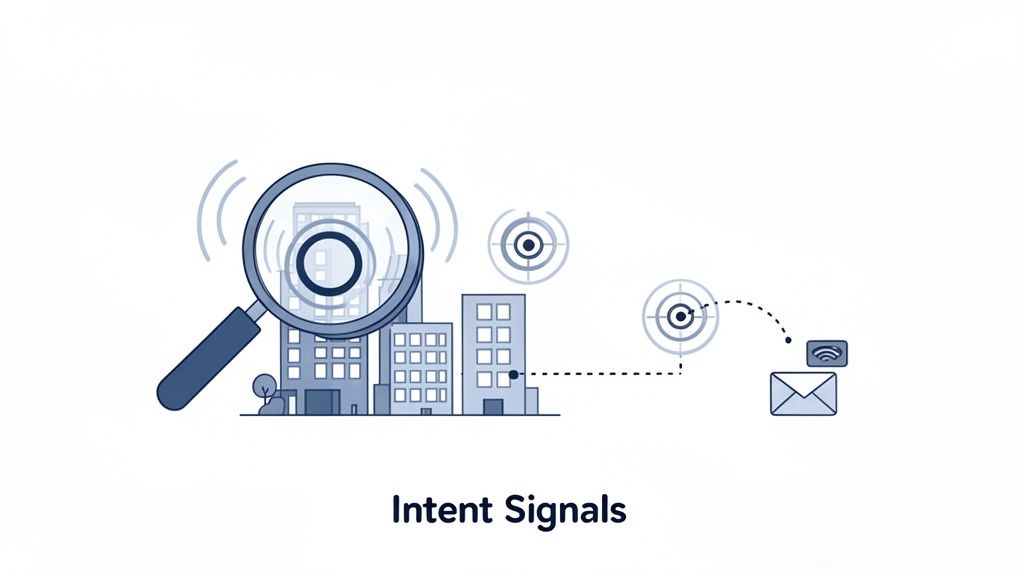
The most effective method for targeting in-market buyers is to integrate third-party intent data into an Account-Based Marketing (ABM) strategy. This approach shifts focus from broad, individual lead capture to a precise, account-centric model. By leveraging platforms that identify companies actively researching relevant solutions, competitors, or keywords, marketing and sales teams can surgically engage entire buying committees at the exact moment they enter a buying cycle. This transforms demand generation from a reactive process into a proactive one, concentrating resources exclusively on accounts with a validated, immediate need. The result is a significant reduction in wasted marketing spend and a higher-quality pipeline.
Implementation and Key Performance Indicators (KPIs)
Successful ABM execution requires tight alignment between sales, marketing, and RevOps, with intent data serving as the single source of truth for account prioritisation. Your tech stack must be integrated to orchestrate multi-channel campaigns based on real-time signals.
- Actionable Workflow:
- Data Integration: Connect your intent data provider (e.g., Bombora, 6sense) to your CRM and marketing automation platform to create dynamic account lists based on intent topics.
- Tiered ABM Programs: Develop distinct engagement strategies for account tiers. Tier 1 (top 50-100 accounts) receives highly personalised, multi-touch campaigns, while Tier 2 receives a more programmatic approach.
- Orchestrated Plays: Use intent spikes to trigger automated "plays," such as a targeted LinkedIn ad campaign and an SDR outreach sequence for an account showing high intent for a competitor's name.
ROI-Focused Insight: The power of intent data is not just identifying who is in-market, but understanding what they care about. Use topic-level intent signals to personalize ad creative, email copy, and sales talk tracks for maximum resonance.
| KPI to Measure | Expected Outcome |
|---|---|
| Target Account Pipeline | Increased value of new sales pipeline from your defined target accounts. |
| Account Engagement Score | A higher composite score reflecting multi-touchpoint engagement. |
| Sales Cycle Length | A reduction, as you are engaging accounts already in a buying journey. |
3. Automated Outbound Personalization at Scale
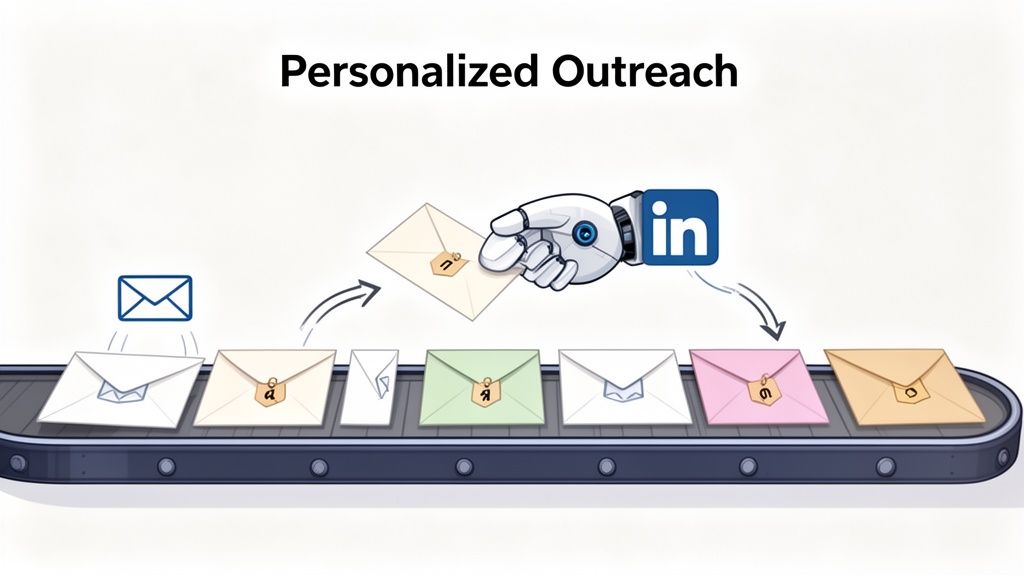
To scale outbound efforts effectively, the primary solution is to leverage artificial intelligence that dynamically generates hyper-personalized cold outreach messages. This technique moves beyond simple [First Name] mail merges by using AI to analyse data points like a prospect’s LinkedIn activity, their company’s recent news, or specific job description details. It then crafts unique, contextually relevant emails and sequences that feel bespoke yet are deployed with the efficiency of automation. This process, managed by Sales or Revenue Operations, allows SDR teams to scale high-touch outreach without a linear increase in headcount, directly leading to a higher number of qualified meetings booked from cold outreach.
Implementation and Key Performance Indicators (KPIs)
Successful implementation requires a structured approach to data inputs and continuous testing. The quality of the AI’s output is directly proportional to the quality and specificity of the personalisation variables provided.
- Actionable Workflow:
- Variable Selection: Define 3-5 core personalisation variables, such as a prospect’s recent LinkedIn post, a company funding announcement, or a newly implemented technology.
- Platform Integration: Connect an AI-powered outbound platform (e.g., Instantly.ai, SalesLoft) to your lead sources and CRM, ensuring clean data flows.
- Sequence Logic: Develop multi-step cadences with variable delays. Configure rules using sentiment analysis to automatically route positive replies to an Account Executive’s calendar.
ROI-Focused Insight: Combine broad-scale AI personalisation with manual, high-touch follow-ups for top-tier accounts. Use automation to initiate the conversation and identify interest, then deploy human expertise to nurture the most promising opportunities.
| KPI to Measure | Expected Outcome |
|---|---|
| Email Reply Rate | An increase in the percentage of positive responses. |
| Meeting Booked Rate | A higher number of qualified meetings set per 1,000 emails sent. |
| Domain Health Score | Maintained or improved deliverability by monitoring bounce rates. |
4. Predictive Lead Routing and Assignment
The most efficient way to assign leads is through a predictive routing system that uses machine learning to assign each lead to the sales representative most likely to close that specific deal. This approach analyses historical performance data against lead characteristics (e.g., industry, company size) to identify which reps have the highest win rates with similar prospects. The system then automatically routes new leads to the optimal rep, eliminating manual assignment delays and maximizing conversion potential from the first touchpoint. This data-driven strategy, managed by RevOps, directly impacts revenue by matching opportunity to skill.
Implementation and Key Performance Indicators (KPIs)
Successful implementation requires a clean and robust dataset of past sales activities and outcomes. The predictive model's accuracy is directly correlated with the quality and volume of historical win-loss data it can analyse.
- Actionable Workflow:
- Establish a Routing Hierarchy: Define a clear rules-based hierarchy (e.g., geography, industry) before applying the predictive layer to select the best rep within that qualified group.
- Integrate Performance Data: Connect your routing tool (e.g., LeanData) to your CRM's opportunity and account data, providing the model with at least 12-24 months of deal outcomes.
- Build Trust through Transparency: Configure the system to provide reps with a brief explanation for why they received a specific lead (e.g., "Assigned based on your high win rate with FinTech companies").
ROI-Focused Insight: Predictive routing is not a "set-it-and-forget-it" system. RevOps must regularly re-evaluate model performance and re-weight historical data quarterly to account for rep development, team changes, and shifts in market focus.
| KPI to Measure | Expected Outcome |
|---|---|
| Lead-to-Opportunity Conversion Rate (by Rep) | Higher conversion rates for predictively matched leads. |
| Average Sales Cycle Length | A decrease in deal velocity due to optimal matching. |
| Quota Attainment Variance | A reduction in performance gaps across the sales team. |
5. Behavioural Email Marketing with Dynamic Segmentation
To improve email engagement, the best practice is to transition from static, list-based campaigns to behaviour-triggered email marketing. This approach uses marketing automation platforms to create dynamic audience segments that are continuously updated based on real-time prospect actions, such as visiting a pricing page or downloading a case study. Instead of generic "batch-and-blast" sends, automated workflows trigger highly contextual messages precisely when a prospect exhibits buying intent. This directly connects marketing activity to sales readiness by aligning messaging with the prospect's position in the buying journey, which in turn accelerates pipeline velocity and improves lead conversion rates.
Implementation and Key Performance Indicators (KPIs)
Successful implementation requires a tight integration between your website, CRM, and marketing automation platform (e.g., HubSpot, Pardot) to ensure behavioural data is captured and used to trigger workflows accurately.
- Actionable Workflow:
- Define Core Triggers: Identify 3-5 high-value behavioural triggers, such as form submissions for specific content, multiple visits to a key solution page, or webinar engagement.
- Build Dynamic Lists: Create segments in your automation platform based on these triggers, such as a list of "Highly Engaged MQLs" who have met specific criteria in the last 30 days.
- Develop Nurture Workflows: Map out automated email sequences for each segment. A workflow triggered by a pricing page visit might send a follow-up email with a relevant case study.
ROI-Focused Insight: This approach's power lies in its ability to automatically re-segment contacts. A previously cold lead can instantly enter a "hot" nurture track the moment they re-engage, ensuring sales is alerted at the peak of buyer interest.
| KPI to Measure | Expected Outcome |
|---|---|
| Email Click-Through Rate (CTR) | A significant increase as content becomes more relevant. |
| MQL to SQL Conversion Rate | An improvement as leads are better nurtured and qualified. |
| Unsubscribe Rate | A lower rate, indicating your messaging is well-targeted and valuable. |
6. Conversation Intelligence and AI-Powered Sales Call Analysis
To scale sales coaching and improve performance, the primary solution is to leverage conversation intelligence platforms. These AI-driven systems record, transcribe, and analyse sales calls and meetings to pinpoint winning behaviours and identify coaching opportunities. This transforms sales management from a reactive, anecdotal process into a proactive, data-informed discipline. By integrating with your CRM, these platforms automatically surface key moments like competitor mentions, pricing objections, and agreed next steps. The main benefit is the ability to scale sales coaching effectively and increase win rates by replicating successful interaction patterns across the entire team.
Implementation and Key Performance Indicators (KPIs)
Successful adoption requires positioning the tool as a coaching and development asset for the sales team, focusing on insights over surveillance.
- Actionable Workflow:
- Platform Integration: Connect a conversation intelligence tool (e.g., Gong, Chorus.ai) to your CRM, calendar, and video conferencing software to automate call recording.
- Win/Loss Analysis: Begin by analysing a set of recently won and lost deal conversations to identify differences in talk-to-listen ratios, topics discussed, and objection handling.
- Create a "Best Practice" Library: Isolate recordings of exceptional calls for different scenarios (e.g., initial discovery, demo) to use as tangible training assets for new hires.
ROI-Focused Insight: The most valuable data comes from analysing trends across hundreds of calls, not just one. Focus on identifying systemic patterns, such as a recurring objection to a new feature, which can provide crucial feedback to product and marketing teams.
| KPI to Measure | Expected Outcome |
|---|---|
| Deal Win Rate | An uplift as reps adopt proven talk tracks and objection-handling methods. |
| Sales Cycle Length | A decrease as reps become more effective at moving deals forward. |
| Ramp Time for New Hires | A reduction in the time it takes for new reps to achieve their first quota. |
7. Predictive Customer Success Scoring for Net Revenue Retention
The most efficient way to generate revenue is to expand from your existing customer base, a practice best enabled by predictive customer health scoring. This is achieved by using machine learning models that analyse product usage patterns, feature adoption rates, and support ticket volume to create a dynamic health score for every account. This transforms Customer Success from a reactive, problem-solving function into a proactive, revenue-generating engine. By integrating these tools with your product analytics and CRM, your CS team receives automated alerts highlighting both churn risks needing intervention and prime accounts ready for an upsell or cross-sell conversation, maximizing Net Revenue Retention (NRR).
Implementation and Key Performance Indicators (KPIs)
Successful implementation requires tight alignment between Customer Success, Product, and RevOps to define the key behaviours that drive long-term value.
- Actionable Workflow:
- Data Instrumentation: Ensure your product is instrumented to track crucial engagement metrics (e.g., daily active users, feature adoption) that serve as the foundation of your model.
- Model Configuration: Work with Product to define the leading indicators of both customer health and potential churn, then configure your CS platform to weigh these signals appropriately.
- Workflow Automation: Map specific CS actions to health score triggers. A "red" score (at-risk) could automatically create a high-priority task, while a "green" score could trigger an upsell sequence.
ROI-Focused Insight: The primary goal is not just to prevent churn, but to systematically identify expansion signals. An account showing a sudden increase in usage or nearing a data limit is a high-quality, pre-qualified lead for your expansion team.
| KPI to Measure | Expected Outcome |
|---|---|
| Net Revenue Retention (NRR) | An increase in revenue retained and expanded from existing customers. |
| Customer Churn Rate | A decrease in both logo churn and revenue churn. |
| Expansion MRR | An increase in new monthly recurring revenue from upsells and cross-sells. |
8. Content-Based Lead Generation with Topic Clustering and Distribution
The most effective way to establish domain authority and generate sustainable inbound leads is to shift from disparate blog posts to an organised topic cluster model. This strategy involves creating a central "pillar" page covering a broad topic, which then links out to multiple in-depth "cluster" articles addressing specific sub-topics. This structured approach transforms your website into a comprehensive resource that captures significant organic search traffic and provides numerous conversion points. The direct business impact is a scalable engine for inbound lead generation, reduced reliance on paid media, and a stronger brand reputation as an industry thought leader.
Implementation and Key Performance Indicators (KPIs)
Successful implementation requires a strategic shift from a volume-based content calendar to a topic-centric plan aligned with core business objectives.
- Actionable Workflow:
- Pillar Topic Identification: Define 3-5 core pillar topics that align directly with your primary product value propositions, using SEO tools to validate search volume.
- Cluster Content Mapping: For each pillar, plan 10-15 cluster articles, mapping each to a specific stage of the buyer's journey and a long-tail keyword.
- Content Optimisation and Linking: Use AI writing assistants to ensure content is optimised for search intent. Critically, ensure every cluster page links back to the central pillar page.
ROI-Focused Insight: The power of topic clustering is its compounding effect. As individual cluster pages begin to rank, they pass authority back to the pillar page, lifting the organic visibility of the entire topic ecosystem and creating a durable competitive advantage.
| KPI to Measure | Expected Outcome |
|---|---|
| Organic Traffic Growth | An increase in non-paid traffic to the pillar and cluster pages. |
| Keyword Rankings | Improved SERP positions for both broad and long-tail keywords. |
| Content-Sourced Leads | A higher number of MQLs generated through forms within the topic cluster. |
9. Multi-Channel Orchestration with Unified Lead Databases
To enable consistent and effective multi-channel engagement, the primary solution is to consolidate all prospect and customer data into a single, unified database, such as a Customer Data Platform (CDP). This approach centralises information from disparate sources like your website, social media, and advertising platforms, creating a single source of truth for every interaction. By breaking down data silos between marketing, sales, and service, you enable context-aware messaging across every touchpoint. This provides a complete historical record of engagement, allowing your automation systems to coordinate outreach seamlessly and prevent disjointed customer experiences.
Implementation and Key Performance Indicators (KPIs)
Successful unification requires a strong data governance framework managed by RevOps to establish clear ownership and standards before merging any data sources.
- Actionable Workflow:
- Data Governance: Define clear data ownership and establish a single ‘source of truth’ for key data points (e.g., Salesforce for firmographics, your marketing platform for engagement).
- Deduplication Logic: Implement a graduated deduplication strategy, starting with unique identifiers like email addresses and layering in rules for phone numbers and company domains.
- Platform Integration: Use a CDP like Segment to ingest and normalise data from all sources before feeding it into your central CRM, ensuring data is clean and consistently formatted.
ROI-Focused Insight: The goal of a unified database is to enable account-centric intelligence. Seeing that three different contacts from the same target account have engaged with your content across three different channels is a powerful buying signal that siloed systems would completely miss.
| KPI to Measure | Expected Outcome |
|---|---|
| Account Engagement Score | A more accurate composite metric reflecting an entire account's interactions. |
| Data Quality Score | Improved metrics like fill rates for key fields and a lower percentage of duplicates. |
| Cross-Channel Conversion Rates | Better attribution and understanding of how channel sequences contribute to pipeline. |
10. Executive Insights and Buying Committee Intelligence
The most effective way to navigate complex B2B sales cycles is to automate the identification and mapping of key decision-makers and influencers within target accounts. This strategy uses AI-powered intelligence platforms to analyse data from professional networks and company news to pinpoint who holds veto power, who influences technical evaluation, and who controls the budget. This allows for a multi-threaded outreach strategy where messaging is tailored to each stakeholder’s specific priorities. This intelligence transforms generic, single-contact outreach into a sophisticated, account-based engagement model that significantly accelerates the sales cycle by pre-emptively addressing objections from the entire buying committee.
Implementation and Key Performance Indicators (KPIs)
To effectively implement buying committee intelligence, your RevOps team must integrate a B2B data provider directly into your CRM and sales engagement platforms.
- Actionable Workflow:
- Data Platform Integration: Connect a B2B intelligence platform like ZoomInfo or LinkedIn Sales Navigator to your CRM to automatically build and visualise buying committee maps for target accounts.
- Role-Specific Personalisation: Create distinct value proposition messaging and content tracks for key personas (e.g., Economic Buyer, Technical Evaluator).
- Trigger-Based Outreach: Set up alerts for significant personnel changes within target accounts, such as a new CFO, and prioritise outreach to these new executives.
ROI-Focused Insight: Shift focus from tracking individual lead engagement to monitoring account-level engagement. A high level of activity across multiple members of a buying committee is a far stronger buying signal than a single contact downloading a whitepaper.
| KPI to Measure | Expected Outcome |
|---|---|
| Multi-Threaded Engagement Rate | An increase in the percentage of opportunities with active engagement from 3+ contacts. |
| Account-to-Opportunity Conversion Rate | An improvement, indicating you are successfully engaging the right people. |
| Sales Cycle Length | A decrease as you navigate internal buying processes more efficiently. |
10-Point Comparison: B2B Lead Gen Best Practices
| Solution | Implementation complexity | Resource requirements | Expected outcomes | Ideal use cases | Key advantages |
|---|---|---|---|---|---|
| AI-Powered Lead Scoring and Qualification | High — ML models, CRM integration, data pipelines | Historical sales/outcome data, ML/RevOps, model hosting | Faster qualification, higher conversion, prioritized pipeline | B2B with sufficient historical data and lead volume | Scales qualification, reduces bias, improves win rates |
| Intent Data Integration and Account-Based Marketing (ABM) | High — vendor integrations and campaign orchestration | Intent data provider, ABM tools, coordinated sales & marketing | Targeted high-propensity accounts, larger deals, shorter cycles | Enterprise or targeted account strategies | Timely account targeting, reduced wasted spend, higher deal size |
| Automated Outbound Personalization at Scale | Medium — personalization engine, sequence automation | Personalization AI, clean prospect data, ESP/engagement tools | Higher response rates, scalable outreach, faster contact | SDR teams scaling cold outreach across lists | Scales hand-written-feel messaging, boosts replies |
| Predictive Lead Routing and Assignment | Medium — routing logic + performance models | Rep performance data, CRM integration, RevOps rules | Near-instant assignment, improved close rates, balanced workload | High-volume inbound teams with varied rep skills | Matches leads to best reps, reduces assignment latency |
| Behavioral Email Marketing with Dynamic Segmentation | Medium — trigger/workflow configuration in ESPs | ESP/marketing automation, tracking, content assets | Higher open/click rates, faster funnel progression | Nurture-focused programs and inbound marketing | Timely, context-driven messaging; automated lifecycle moves |
| Conversation Intelligence and Sales Call Analysis | High — NLP, transcription, consent & compliance | Call recording/transcription platform, storage, analytics, legal controls | Rep coaching at scale, replicated winning behaviors, better objection handling | Teams with heavy call activity seeking coaching insights | Extracts best-practice patterns, objective performance metrics |
| Predictive Customer Success Scoring for NRR | High — product instrumentation and ML models | Product event tracking, CS tools, data science, playbooks | Early churn detection, prioritized expansion, improved NRR | SaaS/product-led firms with measurable usage data | Proactive retention, prioritized upsell opportunities |
| Content-Based Lead Generation with Topic Clustering | Medium — strategic content planning and SEO execution | Content team, SEO/content tools, distribution channels | Lower CAC over time, sustained inbound leads, domain authority | Companies investing in long-term inbound growth | Compounding organic traffic, thought leadership authority |
| Multi-Channel Orchestration with Unified Lead Databases | Very high — extensive data engineering and governance | CDP/CRM, integration middleware, engineers, governance | Single source of truth, better attribution, coordinated campaigns | Organizations with fragmented stacks and cross-channel needs | Eliminates silos, improves data quality and campaign coordination |
| Executive Insights and Buying Committee Intelligence | Medium — enrichment and mapping workflows | Third-party data providers, CRM enrichment, analyst/tooling | Faster identification of decision-makers, larger deals, targeted outreach | Complex sales with multiple stakeholders and long cycles | Identifies key stakeholders, enables stakeholder-specific outreach |
Executive Action Plan
To operationalize these B2B lead generation best practices, focus on a phased implementation that prioritizes foundational elements before moving to advanced optimization. This approach ensures early wins and builds momentum for a complete transformation of your revenue engine.
Phase 1: Foundational Data and Prioritization (Months 1-3)
- Action: Conduct a comprehensive data governance audit of your CRM. Cleanse data, merge duplicates, and establish a single source of truth.
- Action: Implement AI-powered lead scoring to provide an immediate lift in sales efficiency by focusing efforts on the highest-propensity leads.
- ROI Goal: Improve lead-to-opportunity conversion rate and establish a baseline for data quality.
Phase 2: Scaled Outreach and Nurturing (Months 4-6)
- Action: Deploy intent data-driven ABM for a select list of target accounts.
- Action: Launch automated, behaviour-triggered email nurture sequences to replace static campaigns.
- ROI Goal: Increase engagement within target accounts and accelerate MQL-to-SQL conversion velocity.
Phase 3: Full-Funnel Optimization and Intelligence (Months 7-12)
- Action: Integrate conversation intelligence to create a data-driven sales coaching program.
- Action: Implement predictive customer success scoring to identify churn risks and expansion opportunities.
- ROI Goal: Increase deal win rates and boost Net Revenue Retention (NRR).
By following this structured roadmap, your organization can methodically build a resilient and effective B2B revenue engine, transforming lead generation from a cost centre into a strategic and predictable driver of growth.
Navigating the complexities of integrating AI, data, and automation requires specialised expertise. Vantage Advisory provides the strategic guidance and hands-on implementation support B2B enterprises need to build a high-performance revenue engine. To accelerate your transformation and ensure your technology investments deliver measurable ROI, explore how our advisory services can help at Vantage Advisory.