Business process automation (BPA) is a strategic method for executing high-volume, repeatable tasks with minimal human intervention, enabling scalable growth by increasing operational output without a proportional rise in costs. For B2B companies, this means systematically converting manual workflows in areas like Revenue Operations and Finance into efficient, automated systems. By doing so, you can reduce administrative overhead, improve data accuracy, and free up skilled professionals to focus on revenue-generating activities.
Key Takeaways
- Answer-First Automation: BPA uses technology to automate multi-step workflows across departments, directly improving efficiency and consistency.
- Focus on ROI: The primary value of BPA lies in measurable outcomes: reduced operational costs, increased team productivity, and fewer errors.
- Strategic Deployment: The most effective automation initiatives target high-volume, rules-based tasks in Revenue Operations (e.g., lead routing) and Finance (e.g., invoice processing).
- Implementation Framework: A successful BPA rollout follows a clear, four-phase plan: identify and prioritise processes, design the new workflow, select the right tools, and then deploy and optimise based on performance data.
Understanding Business Process Automation
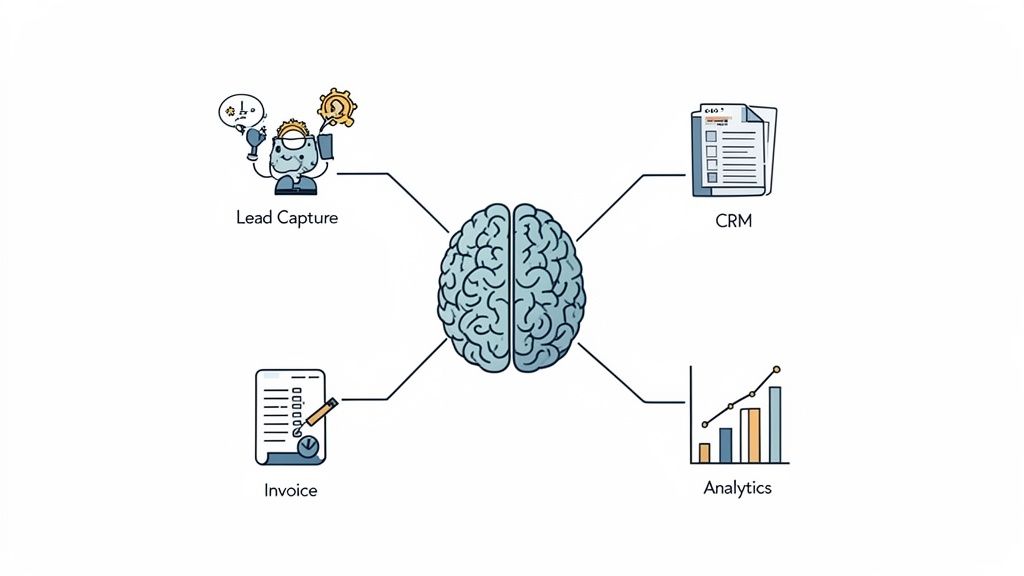
Business process automation is the strategic use of technology to orchestrate complex, end-to-end workflows that span multiple departments, requiring minimal human input. Distinct from basic task automation, which handles single actions, BPA manages entire multi-step journeys—from lead capture to final payment reconciliation. For B2B leaders, implementing BPA is about transforming manual, error-prone processes into intelligent, data-driven operations that create a sustainable competitive advantage by freeing up strategic talent to focus on growth.
Core Components of Modern Automation
Modern BPA solutions are built on a suite of integrated technologies, with artificial intelligence at their core, enabling systems to learn, adapt, and make decisions. This AI-driven approach moves beyond simple "if this, then that" rules, using machine learning to interpret documents, classify content, and manage exceptions without rigid templates. This capability is driving significant market growth; the UK's business process management market trends on imarcgroup.com show that 39% of companies plan to focus on AI-dependent automation, reflecting a broad shift toward intelligent operational models.
Manual vs. Automated Workflows: A Technical Comparison
The operational and financial impact of shifting from manual processes to automated workflows is significant, providing a clear business case for investment in BPA. This transition directly affects key metrics such as accuracy, speed, and scalability, as detailed in the comparison below. For further examples, you can explore our analysis of AI in business operations.
| Metric | Manual Process | Automated Workflow | ROI Impact |
|---|---|---|---|
| Data Entry | Prone to human error; inconsistent formats. | Automated data capture ensures 99%+ accuracy. | Reduced costs from error correction. |
| Lead Routing | Slow; based on static rules or availability. | AI-driven; instant routing based on lead score. | Shortened sales cycles. |
| Invoice Processing | Days or weeks; high labour costs. | Minutes; minimal human touchpoints required. | Improved cash flow; lower overhead. |
| Reporting | Time-consuming; data is often outdated. | Real-time dashboards with predictive insights. | Faster, more accurate decision-making. |
| Scalability | Limited; requires adding more staff. | High; handles volume spikes without extra headcount. | Enables growth without proportional cost increases. |
Why Automation Is a Strategic Imperative
For any B2B company, business process automation is the most reliable way to achieve scalable growth—the ability to expand revenue without proportionally inflating operational costs. By automating high-effort, low-reward tasks like lead qualification, client onboarding, or financial reconciliation, you embed operational excellence into your business model. This directly confronts "administrative debt": the cumulative cost of inefficient manual tasks that divert your most valuable people from revenue-generating work.
Liberating Strategic Talent
The primary ROI of BPA is not replacing skilled professionals but augmenting them by liberating them from monotonous, low-value work. Every hour your Head of Sales spends manually compiling a report is an hour not spent on market strategy. By automating reporting, data reconciliation, and compliance checks, you return time to your best minds, enabling them to focus on high-impact activities such as market expansion, product innovation, or competitive analysis.
Establishing a Single Source of Truth
A core benefit of a well-executed automation strategy is enhanced data integrity. When data is manually transferred between systems like a CRM and an ERP, errors are inevitable, leading to flawed reports and poor business decisions. Automation creates a synchronised ecosystem where data flows cleanly and instantly between platforms. This establishes a single, reliable source of truth—an essential asset for any leadership team that depends on accurate data for strategic planning.
The Accelerating Pace of Adoption
The adoption of intelligent automation is creating a clear competitive divide. In the UK, SMEs are projected to invest over £3.1 billion in automation technologies by the end of 2025, moving beyond simple scripts to sophisticated workflows combining robotic process automation (RPA) with AI. You can explore the top BPA trends in the UK for 2025 to see where the market is headed. The results are already measurable: sales teams report 3x better response rates using AI agents for initial outreach. Companies that delay automation are choosing to fall behind competitors who are already operating with greater speed, leaner costs, and higher accuracy.
Where to Start: High-Impact Automation Use Cases
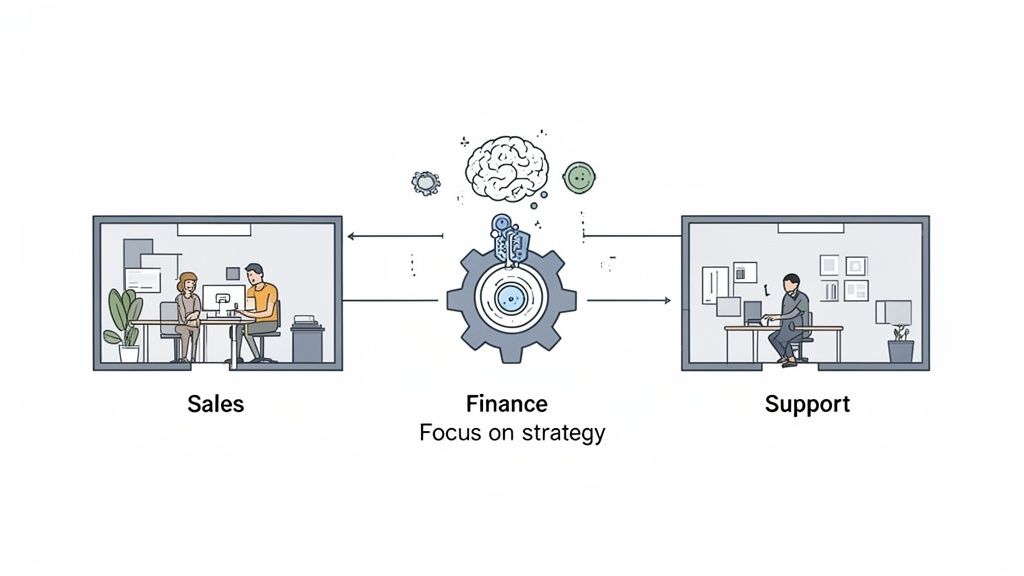
To achieve the most significant immediate returns, focus your initial business process automation efforts on high-volume, rules-based tasks within your Revenue Operations and Finance departments. Automating lead scoring and routing will accelerate your sales cycle, while AI-driven outbound campaigns can substantially increase engagement. Concurrently, automating administrative processes like invoice processing and financial reporting frees up hundreds of expert hours, providing immediate operational leverage. This approach aligns with a broader strategy of business process improvement.
Supercharge Your Revenue Operations
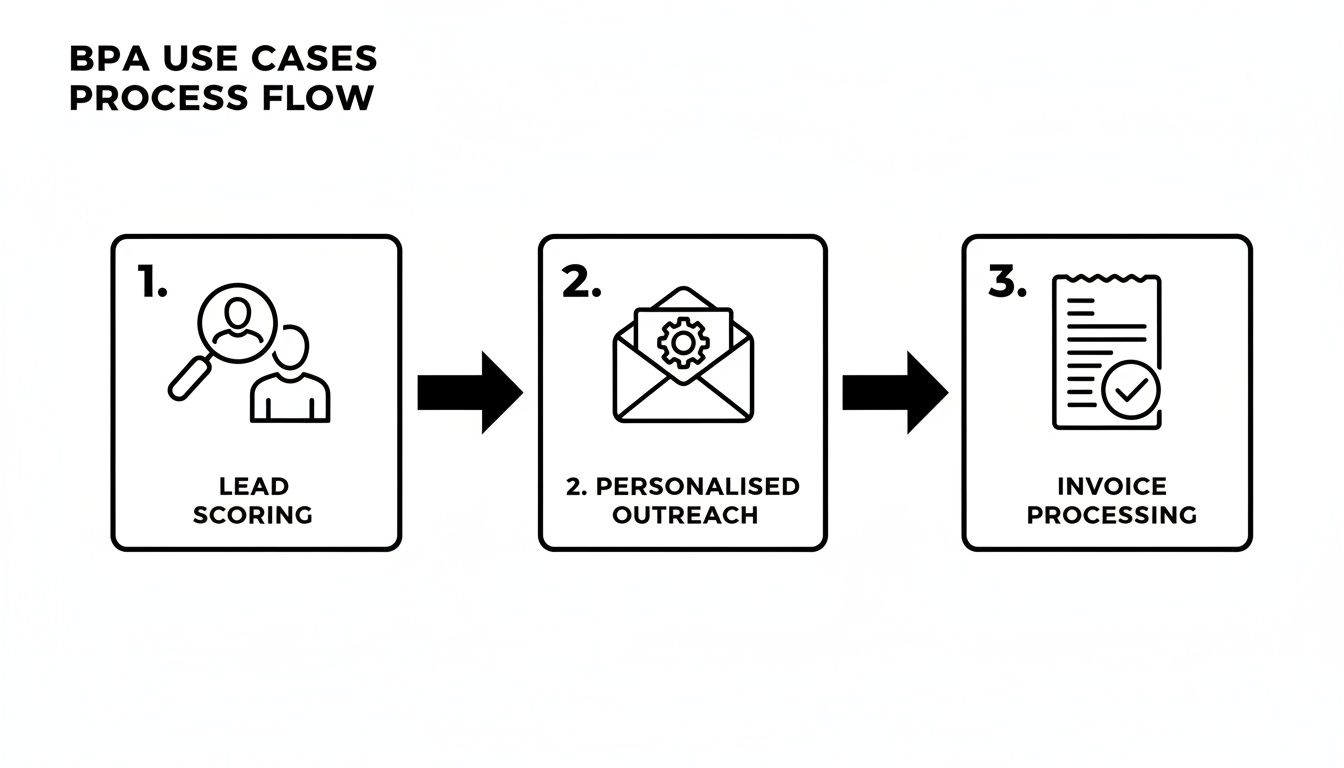
The primary goal in Revenue Operations is to shorten sales cycles and increase conversion rates, areas where AI-driven automation delivers exceptional value. Implementing automated lead scoring and routing allows an AI model to analyze dozens of real-time data points—including behavioural signals and firmographic details—to predict which leads are sales-ready. The system then instantly routes high-value prospects to the appropriate salesperson, ensuring that top opportunities receive immediate attention. Another high-impact application is creating personalised outbound campaigns at scale. Using AI, you can generate customized emails and social media messages by integrating data from your CRM and public sources like LinkedIn, shifting from generic outreach to highly relevant, one-to-one conversations executed automatically.
BPA Use Case Analysis for B2B RevOps
The following table provides a technical breakdown of key automation opportunities within Revenue Operations, outlining the process, the enabling technology, and the expected ROI.
| Use Case | Core Process Automated | Key Technology | Measurable ROI |
|---|---|---|---|
| Lead Scoring & Routing | Analysis of lead data and assignment to the correct sales representative. | AI/Machine Learning, CRM Integration | Reduction in lead response time by over 80%; improved lead conversion rates. |
| Personalised Outreach | Generation of customised sales emails and follow-up sequences. | Generative AI, Natural Language Processing (NLP) | Increased open and reply rates; higher volume of qualified meetings booked. |
| Customer Health Scoring | Real-time analysis of product usage and support tickets to predict churn risk. | Predictive Analytics, Customer Success Platforms | Reduction in customer churn; increased opportunities for proactive upselling. |
| Sales Forecasting | Aggregation and analysis of pipeline data to predict future revenue. | AI-driven Analytics, BI Tools | Improved forecast accuracy; better resource allocation and strategic planning. |
Eliminate Administrative Debt
Beyond revenue generation, BPA is a powerful tool for reducing the "administrative debt" that drains company resources, particularly within the finance department. A prime example is invoice processing. AI-powered tools can intelligently extract data from invoices regardless of format, match them against purchase orders, and route them for approval with minimal human intervention. This single automation can save a finance team hundreds of hours per month and reduce payment errors. Similarly, financial reporting can be automated to pull data from disparate systems in real-time, generating standardised reports on a schedule. This not only saves time but also ensures leadership makes decisions based on the most current and accurate information.
Your Framework for Implementing Automation
Successful business process automation is achieved through a structured, four-phase framework, not by chance. The approach begins with a thorough analysis of current operations to identify bottlenecks and repetitive tasks. Once a target process is selected, the new automated workflow is meticulously mapped. With this blueprint, the appropriate technology is selected based on integration, security, and scalability requirements. Finally, the solution is deployed in a controlled manner, monitored against KPIs, and continuously optimised for performance.
Phase 1: Identify and Prioritise
This initial analysis phase is critical for ensuring a strong return on investment. Conduct a comprehensive audit of existing workflows to identify processes best suited for automation. Prime candidates typically exhibit the following characteristics:
- High Volume and Frequency: Tasks that are performed repeatedly, consuming significant team hours.
- Rules-Based Logic: Processes that follow a clear, predictable "if-this-then-that" sequence.
- Prone to Human Error: Workflows where manual mistakes in data entry or calculations are common and costly.
- Multiple System Touchpoints: Processes requiring manual data transfer between applications, such as a CRM and an ERP.
Phase 2: Design and Map
Before selecting any technology, meticulously map the new automated workflow by creating a visual flowchart that details every action, decision point, and data transfer. This blueprint ensures stakeholder alignment on the ideal process before development begins and serves as a technical specification for evaluating potential automation platforms. A common failure is attempting to automate a flawed process; always streamline and optimise the workflow on paper first.
Phase 3: Select and Integrate
With a clear process map, you can begin evaluating automation tools. The primary consideration must be integration capability. The platform must have robust, pre-built connectors to your core business systems. Security and scalability are equally vital. Verify that any vendor meets enterprise-grade compliance standards and can handle significant increases in transaction volume without performance degradation.
Phase 4: Deploy, Monitor, and Optimise
The final phase involves a controlled rollout and a commitment to continuous improvement. Launch the automation in a limited environment first to identify and resolve any initial issues. From day one, track clear Key Performance Indicators (KPIs) tied to the pain points identified in Phase 1, such as:
- Process Cycle Time: The total time from process start to finish.
- Error Rate Reduction: The percentage decrease in manual errors.
- Cost Per Transaction: The new, lower labour cost for each completed process.
This data-driven approach is essential. UK businesses using AI automation report significant improvements, with 80% of companies accelerating their processes and 92% reporting direct revenue growth. You can discover more research on the UK process automation market for more data. Continuously monitor your KPIs to refine and enhance the workflow, treating BPA as an ongoing cycle of optimisation.
How to Measure Your Automation ROI
To secure ongoing investment for business process automation, you must demonstrate its value using ROI-focused metrics that leadership understands. The business case should be built on four core pillars: cost reduction, productivity gains, accelerated process cycles, and error reduction. These metrics translate operational improvements into clear financial impact, justifying further investment.
Measuring Cost Reduction and Productivity Gains
The most direct metric is Cost Reduction, calculated by quantifying the decrease in employee hours spent on a newly automated task. If automating invoice processing frees up 20 hours of a finance professional's time per week, that is a direct and defensible labour saving. Beyond cost savings, Productivity Gain measures the increase in output per employee. For example, an automated lead qualification system might enable a sales development representative to manage 30% more leads effectively, demonstrating a tangible increase in team capacity.
Demonstrating Speed and Quality Improvements
Another critical metric is Process Cycle Time—the end-to-end duration of a workflow. Reducing the time it takes to onboard a new client not only improves the customer experience but also accelerates revenue recognition. This metric is a clear indicator of a more agile business. Finally, Error Rate Reduction provides concrete proof of improved quality control and risk management. A documented decrease in mistakes in data entry or order fulfillment builds a compelling case for automation, especially in regulated industries where compliance is critical. To explore this further, read our guide on achieving operational excellence.
ROI Measurement Framework
| Metric | How to Calculate | B2B Application Example |
|---|---|---|
| Cost Reduction | (Hours Saved × Employee Cost) + Material Savings | Automating AP invoice processing saves the finance team 80 hours per month. |
| Productivity Gain | (New Output per Employee ÷ Old Output per Employee) – 1 | AI-powered outreach allows each SDR to book 15% more meetings. |
| Process Cycle Time | Time at Process End – Time at Process Start | New client onboarding time is cut from 10 business days to 2. |
| Error Rate Reduction | 1 – (New Error Rate ÷ Old Error Rate) | Automated data entry reduces CRM record errors by 95%. |
Your Top Questions About BPA, Answered
When evaluating business process automation, senior leaders consistently raise the same questions regarding scope, technology selection, and implementation risks. Here are direct answers to help you form a practical and effective automation strategy.
What is the difference between Task Automation and Process Automation?
The primary distinction is scope. Task automation focuses on a single, repetitive action, such as creating a new contact in a CRM from a web form. It is a point solution that optimizes one step. Business process automation (BPA) orchestrates an entire end-to-end workflow connecting multiple steps across different systems. For example, a BPA workflow for a new lead would not just create the contact but also enrich it with third-party data, score it with an AI model, assign it to the correct sales representative based on territory rules, and trigger a personalized welcome email sequence. BPA manages the entire journey, not just an isolated action.
How do I choose the right automation tools?
Selecting the right software depends on three practical criteria: integration, scalability, and security. First, prioritize platforms with robust, pre-built connectors to your existing core systems, such as Salesforce or NetSuite, to avoid costly and fragile custom integrations. Second, verify the platform’s ability to scale with your transaction volume without performance degradation. Finally, ensure any vendor meets enterprise-grade security and compliance standards, a non-negotiable requirement when handling sensitive customer or financial data.
What are the common pitfalls to avoid?
The most common failure is automating a broken process. Automation will only accelerate existing flaws, so you must first analyze, simplify, and optimize the underlying workflow. Another frequent mistake is failing to secure buy-in from the teams who will use the system. Involve them early in the design process to ensure the solution addresses their real-world challenges and is viewed as a tool to help them, not replace them. Lastly, many projects fail due to a lack of clear success metrics. Before you begin, define specific KPIs, such as a target reduction in cycle time or a specific cost-saving goal. Without these metrics, you cannot prove ROI and will struggle to secure budget for future automation initiatives.
Executive Action Plan
- Audit High-Volume Tasks: Identify three repetitive, manual processes in your Revenue Operations or Finance teams as prime candidates for an initial automation project.
- Define Baseline KPIs: Before implementation, measure the current time, cost, and error rate associated with the target process to establish a clear baseline for proving ROI.
- Form a Pilot Team: Assemble a cross-functional team with members from RevOps, Finance, and IT to lead the initial process audit and pilot project, ensuring diverse perspectives and early buy-in.
- Schedule ROI Reviews: Establish a quarterly meeting with leadership to review the performance dashboard, demonstrate value, and propose the next set of high-impact automation projects.
At Vantage Advisory, we provide the strategic intelligence B2B leaders need to implement AI-driven automation effectively. Our focus is on delivering measurable ROI by optimising your Revenue Operations and eliminating administrative debt. Discover how to build a more scalable and efficient organisation at https://vantageadvisory.co.uk.