Key Takeaways
- Answer-First Approach: CRM automation tools deliver maximum ROI when they streamline core B2B workflows like lead management, sales execution, and customer retention. The primary goal is to increase operational efficiency, which directly translates to revenue growth and improved profit margins.
- Evaluation Framework: Assess platforms based on four pillars: scalability to handle growth, enterprise-grade security (including UK GDPR), flexible integration architecture, and a clear, quantifiable Return on Investment (ROI).
- Core Capabilities: Effective tools automate the entire lead-to-revenue lifecycle. This includes AI-driven lead scoring, intelligent routing, quote-to-cash process automation, and personalised marketing campaigns.
- B2B Workflow Focus: Prioritise implementing high-impact workflows such as predictive customer health scoring to reduce churn and fully automated lead management to shorten sales cycles. These provide the most immediate and measurable financial returns.
At the enterprise level, the right CRM automation tools are strategic assets for enabling scalable growth without a proportional increase in headcount. The primary function of these platforms is to eliminate administrative overhead and automate the complex sales, marketing, and service workflows that directly impact revenue. This guide provides a strategic framework for RevOps leaders to evaluate and implement these tools with a clear focus on B2B performance and financial return.
A Strategic Framework for CRM Automation
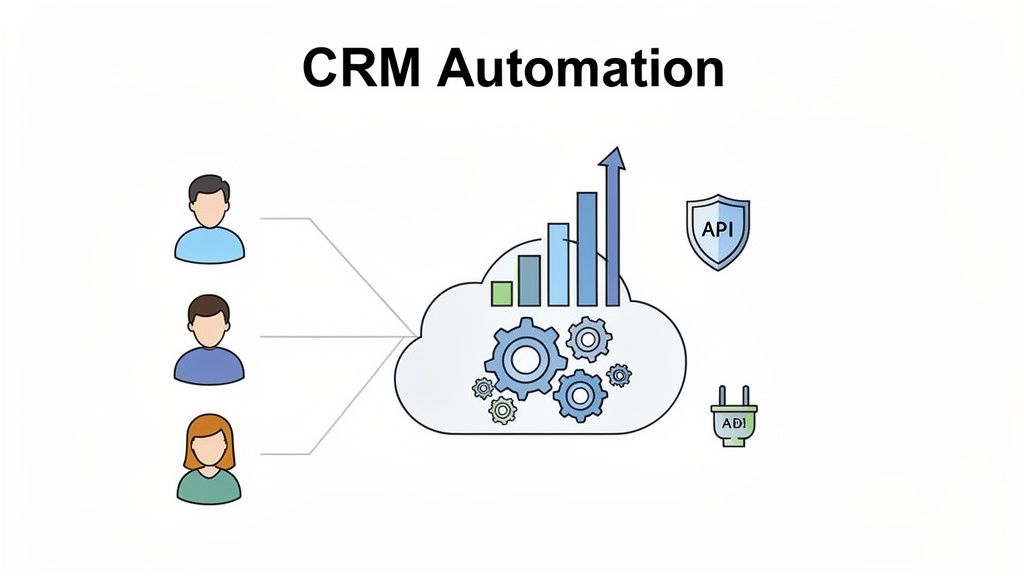
A robust evaluation framework is the first step to selecting a CRM automation tool that aligns with long-term business objectives. For B2B leaders, this requires assessing platforms against four essential criteria: scalability, security, integration architecture, and Return on Investment (ROI). A rigorous analysis of these pillars ensures your technology investment can support enterprise-level demands and deliver measurable value.
The Four Pillars of Evaluation
The selection process must extend beyond a surface-level feature comparison to assess foundational capabilities. These four pillars provide a structured approach to determine if a platform can meet the operational demands of a scaling B2B organisation.
- Scalability: The platform must handle significant increases in data volume, user count, and workflow complexity without performance degradation.
- Security: The system must adhere to critical data protection regulations like UK GDPR, offering advanced security protocols and granular access controls to protect sensitive customer information.
- Integration Architecture: The tool must connect seamlessly with your existing technology stack, either through native connectors or a flexible, well-documented API, to avoid costly custom development.
- Return on Investment (ROI): A clear financial model is required to calculate the platform's impact on both cost reduction and revenue acceleration.
The following table translates these pillars into actionable questions for B2B decision-makers, guiding internal evaluation discussions.
| Evaluation Pillar | Key Consideration for B2B Leaders |
|---|---|
| Scalability | Can the system handle a 10x increase in lead volume and user activity over the next three years? |
| Security | Does the platform offer granular user permissions and comply with UK GDPR data residency requirements? |
| Integration | Will it natively connect to our ERP and marketing automation platform, or are we looking at costly custom development? |
| ROI | What is the projected impact on sales team productivity and customer lifetime value within the first 18 months? |
Looking at the Core CRM Automation Capabilities
The most effective CRM automation tools are defined by their ability to manage three core business functions: lead management, sales process execution, and marketing campaign delivery. The primary solution these platforms offer is the systematisation of these functions to drive operational efficiency and predictable revenue growth. The sophistication of these capabilities, particularly the use of AI for predictive scoring and dynamic workflows, separates enterprise-grade solutions from simpler, rule-based systems.
Automated Lead Management
Effective lead management automation provides a predictable, efficient sales pipeline by systematising the entire lead journey from capture to qualification. The primary solution is to eliminate manual lead handling, which reduces speed-to-lead times and increases conversion rates. This ensures sales teams consistently focus on the most valuable prospects.
- Automated Lead Scoring: Look for AI-driven predictive scoring that analyses historical win data to identify the characteristics of a high-value lead, moving beyond basic demographic and behavioural point assignments.
- Intelligent Lead Routing: The system should offer flexible, rule-based routing that assigns leads based on criteria like territory, industry, or company size, and can even account for sales representative workload to ensure prompt follow-up.
Sales Process and Quote-to-Cash Automation
Automating the sales process is designed to remove administrative tasks so that sales professionals can focus on selling. The solution involves automating the entire cycle, from opportunity creation to final invoicing. This standardises best practices, reduces manual data entry, and provides clear visibility into pipeline health. A key capability is the automation of entire sales stages, such as generating proposals, managing discount approval workflows, and triggering follow-up sequences based on deal progression.
Marketing Campaign Automation
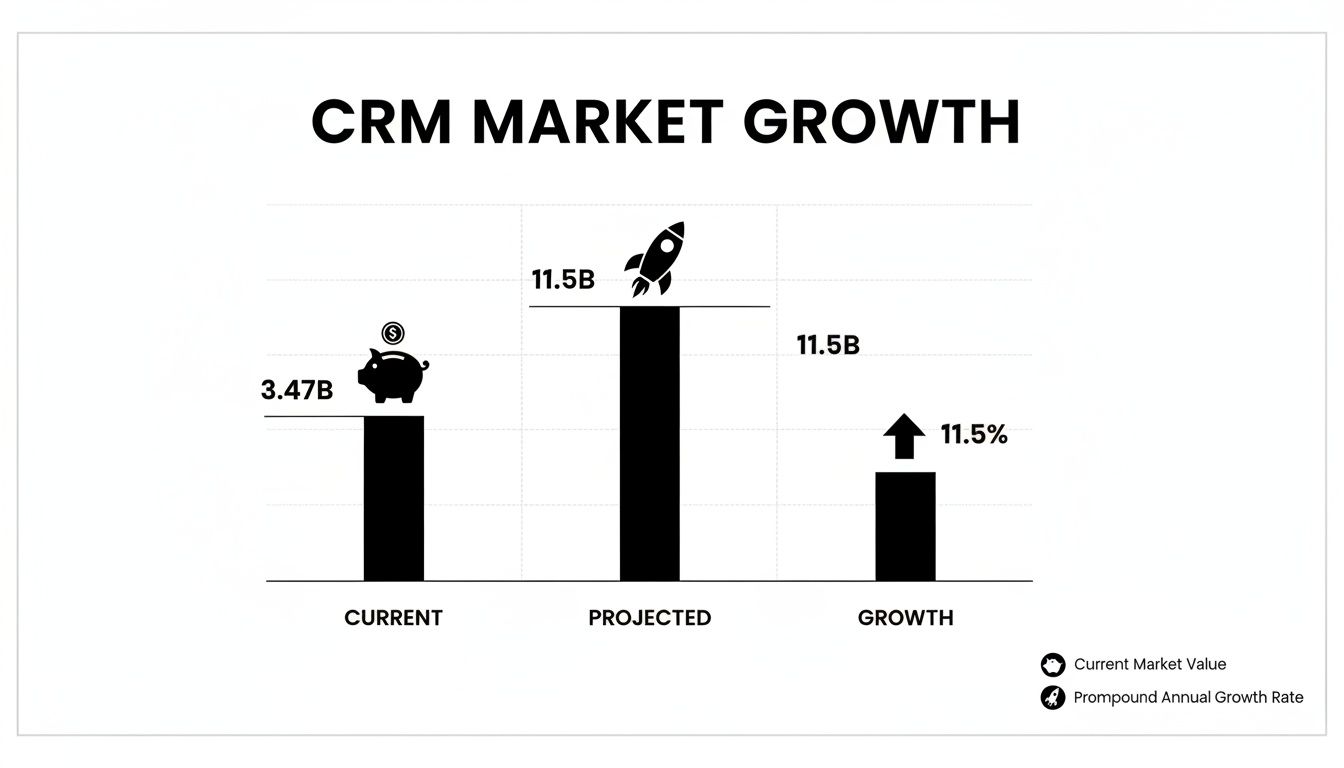
Modern marketing automation within a CRM provides the ability to execute highly segmented, personalised campaigns that guide prospects through complex B2B buying journeys. The core function is to move beyond simple email broadcasts to deliver targeted communication at scale, directly improving marketing ROI. The value of these platforms is increasingly tied to advanced AI and data handling, which are driving significant market growth. In the UK, the CRM software market was valued at USD 3,472.5 million and is projected to reach USD 11,500.25 million by 2035, fueled by these automation capabilities. You can explore more data on the UK CRM market growth.
A Comparative Look at Enterprise CRM Platforms
Selecting an enterprise CRM automation platform is a strategic decision that requires a clear evaluation of how leading solutions handle AI-driven insights, integration, and compliance. The primary solutions in the market—Salesforce Sales Cloud, HubSpot Operations Hub, and Microsoft Dynamics 365—each offer distinct architectural philosophies. Your choice should be determined by your existing technology stack, operational maturity, and long-term strategic goals.
AI and Predictive Capabilities
The shift from rule-based automation to predictive intelligence is the primary differentiator among modern CRMs.
- Salesforce Sales Cloud utilises its Einstein AI to analyse historical data for predictive lead scoring, opportunity insights, and sales forecasting. It can, for example, identify at-risk deals by analysing communication sentiment.
- HubSpot's Operations Hub focuses its AI on ensuring data quality through automated formatting and deduplication, providing a reliable foundation for all automation efforts.
- Microsoft Dynamics 365 integrates with the Azure AI infrastructure to deliver relationship analytics and leverages tools like Copilot to assist with tasks directly within the CRM.
Integration Architecture and Ecosystem
A CRM’s value is directly tied to its ability to integrate with other business-critical systems.
- Salesforce offers an extensive ecosystem via its AppExchange, a marketplace of third-party applications with pre-built connectors that provides immense flexibility.
- HubSpot is designed as an all-in-one platform where its native Marketing, Sales, and Service Hubs are seamlessly integrated, ensuring effortless data flow between departments.
- Dynamics 365 provides unparalleled native integration with the Microsoft ecosystem, including Office 365, Teams, and Power BI, often eliminating the need for third-party tools.
Security and UK Compliance
Compliance with UK GDPR and other data protection regulations is non-negotiable for any enterprise operating in the UK.
- Salesforce provides a robust security model, including advanced encryption with its Shield add-on, and operates UK-based data centres to help meet data residency requirements.
- HubSpot offers strong security controls and gives enterprise clients the option to host data in the EU to align with UK GDPR principles.
- Microsoft Dynamics 365 leverages the comprehensive security and compliance framework of Azure, offering dedicated UK data centres and transparent adherence to global standards.
Enterprise CRM Automation Feature and Compliance Matrix
This table provides a comparative analysis of the leading platforms across key criteria for B2B RevOps leaders, focusing on AI capabilities, integration architecture, and UK compliance.
| Evaluation Criterion | Salesforce Ecosystem | HubSpot Enterprise | Microsoft Dynamics 365 |
|---|---|---|---|
| Primary Automation Strength | Highly customisable, complex workflows via Flow Builder and Apex code for enterprise-scale operations. | User-friendly, code-free automation focused on data quality and inter-departmental process alignment. | Deep integration with the Microsoft stack for automating cross-application business processes. |
| AI Predictive Feature | Einstein AI for predictive lead scoring, forecasting, and opportunity insights. | AI-powered data cleansing, duplicate management, and foundational predictive analytics. | Azure AI for relationship analytics, predictive scoring, and integration with Copilot assistants. |
| Integration Model | API-first with the extensive AppExchange marketplace for third-party connectors. | Natively integrated suite (Sales, Marketing, Service Hubs) with a growing app marketplace. | Native integration with Microsoft 365, Teams, and Power BI; API for custom connections. |
| UK GDPR & Data Residency | Strong compliance features with UK-based data centres available. | EU data hosting options available for enterprise customers to support GDPR alignment. | Comprehensive compliance via Azure, with dedicated UK data centres. |
High-Impact B2B Automation Workflows
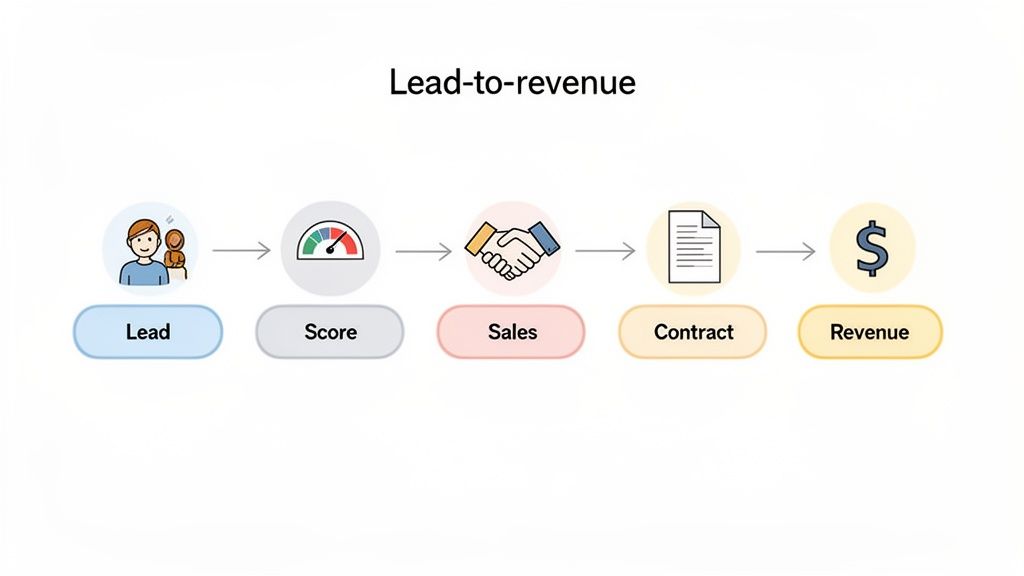
The primary solution offered by CRM automation is the ability to systematise entire operational functions, not just individual tasks. By implementing strategic workflows, B2B organisations can solve high-value business challenges, such as shortening sales cycles or reducing customer churn. These automated playbooks are designed to build repeatable, scalable processes that generate measurable gains in both productivity and revenue.
Automating the Lead-to-Revenue Lifecycle
The core solution here is to create an automated, end-to-end journey from lead acquisition to a closed deal. This workflow eliminates the manual handoffs and data entry that slow down the sales process and introduce errors.
- The Problem: Disjointed lead management processes cause slow follow-up, inconsistent qualification, and poor pipeline visibility, leading to lost opportunities.
- The Automated Solution: When a lead is captured, the CRM automation tool instantly enriches the contact data, scores the lead based on predictive criteria, and routes it to the appropriate sales representative with an automated task for follow-up. As the deal progresses, the system automatically updates its status and generates proposals from templates.
- Expected ROI: Businesses that implement this workflow typically see a 15-20% reduction in their average sales cycle and a significant lift in lead conversion rates due to faster response times.
Predictive Customer Health Scoring for Churn Reduction
This workflow provides a proactive solution to customer churn by using data to identify at-risk accounts before they disengage. It enables a shift from reactive problem-solving to proactive relationship management, directly impacting customer lifetime value.
- The Problem: Customer success teams often lack the data to identify declining engagement early, forcing them into a reactive stance when it is often too late to salvage the relationship.
- The Automated Solution: The CRM aggregates customer data points like product usage, support ticket volume, and communication frequency to calculate a real-time health score. If a score falls below a predefined threshold, the system automatically creates a high-priority task for the account manager, providing a summary of the issues and an intervention playbook.
- Expected ROI: A predictive health scoring system can reduce customer churn by up to 30% by enabling targeted, proactive interventions and improving the efficiency of the customer success team.
For further guidance on structuring these workflows, consult our guide on business process automation. Applying these structured approaches allows B2B leaders to convert the potential of CRM automation tools into tangible financial results.
Calculating the ROI of Your CRM Investment
A credible financial justification is the primary solution for securing executive buy-in for a CRM automation project. This begins with a comprehensive calculation of the Total Cost of Ownership (TCO), which must account for all direct and indirect expenses beyond the subscription fee. By establishing a thorough TCO, RevOps leaders can build a defensible Return on Investment (ROI) model that frames the project as a long-term value creator rather than a short-term cost.
Identifying Total Cost of Ownership
The true cost of a CRM platform is the sum of several key components that must be quantified for an accurate TCO analysis.
- Licensing and Subscription Fees: These are typically billed per user, per month. Scrutinise pricing tiers, as advanced automation features are often reserved for premium plans.
- Implementation and Setup: Include costs for data migration, system configuration, and initial workflow development, which may require professional services.
- Integration Maintenance: Account for the ongoing costs of building and maintaining integrations with other core systems like ERP or marketing platforms.
- Training and Adoption: Budget for initial and continuous user training. Low adoption is a primary cause of CRM project failure and negative ROI.
Quantifying the Financial Gains
With a clear TCO established, the next step is to quantify the financial returns. The primary solution is to connect automation directly to key business performance indicators. Gains are most often realised through increased sales productivity, improved marketing efficiency, and higher customer retention.
The UK small business market for CRM automation is projected to hit US$5.2 billion by 2025, with AI-powered features like predictive lead scoring reportedly increasing close rates by up to 25%. More CRM adoption statistics for UK businesses show the impact of this trend. The table below provides a framework for linking automated workflows to measurable financial outcomes.
| ROI Driver | Key Metric | Example Calculation |
|---|---|---|
| Increased Sales Productivity | Time Saved per Sales Rep | 5 hours/week saved on admin x 20 reps x £40/hour wage = £4,000/week |
| Improved Marketing Efficiency | Lead Conversion Rate Increase | 2% increase in conversion rate on 5,000 leads/month = 100 extra deals |
| Enhanced Customer Retention | Reduction in Customer Churn | 5% reduction in churn on a £2M customer base = £100,000 in retained revenue |
This structured approach presents a data-backed business case that demonstrates the strategic value of investing in the right CRM automation tools. For more on the broader advantages, review the key benefits of CRM for business growth.
Your Executive Action Plan for Implementation
The primary solution for a successful CRM automation rollout is a structured implementation plan. The process must begin with a thorough audit of current processes and technology to establish a baseline. This enables the definition of clear, measurable goals tied directly to business KPIs, ensuring that the investment in CRM automation tools is targeted at solving high-value operational problems. This methodical roadmap reduces project risk and ensures the final solution delivers a tangible return on investment.
Phase 1: Initial Audit and Goal Definition
Before evaluating vendors, you must first understand your current operational state. Conduct a comprehensive audit of existing technology and manual workflows to identify key bottlenecks and opportunities for automation.
- Map Critical Processes: Document the entire lead-to-revenue lifecycle as it currently operates, pinpointing all manual handoffs, data entry points, and process gaps.
- Define Measurable Goals: Translate identified pain points into specific, quantifiable objectives. For example, a goal could be to "reduce time spent on administrative tasks by five hours per sales rep per week within six months."
- Establish Success Metrics: Select the primary KPIs that will be used to measure success, including a mix of operational metrics (e.g., lead response time) and financial outcomes (e.g., customer lifetime value).
Phase 2: Vendor Selection and Migration Planning
With clear goals defined, you can initiate a structured vendor selection process using the evaluation criteria outlined in this guide. Once a vendor is selected, the focus shifts to data migration and user adoption.
- Prioritise Architectural Fit: Select a tool that integrates seamlessly with your existing ERP and marketing platforms to avoid costly custom development.
- Develop a Migration Plan: Create a detailed plan for data migration that includes stages for data cleansing and validation to ensure data quality in the new system.
- Build an Adoption Strategy: Formulate a user adoption plan that includes role-specific training and identifies internal champions to drive engagement and support colleagues.
Common Questions on CRM Automation
The single most critical first step before implementing CRM automation tools is to establish strong data governance. The primary solution for a successful rollout is to build your automation on a foundation of clean, standardised, and de-duplicated data. This requires a full audit of current data sources, clear data ownership, and automated cleansing rules within the CRM to maintain data hygiene long-term. Building on a poor data foundation will undermine every automation, leading to inaccurate reporting and a loss of user trust in the system.
How Do We Get Our Team to Actually Use It?
The primary solution for driving user adoption is to demonstrate clear value to end-users. Involve sales and service teams in the workflow design process to ensure the automation solves their most pressing administrative challenges. Provide role-specific training and identify internal champions who can advocate for the platform and provide peer support.
What Are the Key Metrics for Measuring Success?
Success must be measured against the financial and operational goals defined at the project's outset. The primary metrics should link automation directly to business outcomes.
- Sales Productivity: Track the reduction in time spent on administrative tasks versus time spent on core selling activities.
- Pipeline Velocity: Measure the time it takes for a lead to progress from initial contact to a closed deal.
- Customer Lifetime Value (CLV): Monitor CLV and net revenue retention as indicators of reduced customer churn.
- Lead Conversion Rate: Analyse the percentage of marketing-qualified leads that convert to sales opportunities.
How Much Customisation Is Too Much?
The right level of customisation aligns the platform with your core business processes without creating excessive technical debt. The recommended solution is to prioritise out-of-the-box features and native integrations. Reserve heavy customisation or custom code for situations where a standard feature cannot meet a critical, revenue-impacting requirement. Over-customisation increases maintenance costs, complicates future upgrades, and can undermine the scalability of your CRM automation tools.
At Vantage Advisory, we provide the strategic intelligence B2B leaders need to implement AI-driven automation effectively. Our focus is on scalable strategies that reduce administrative debt and deliver a measurable ROI. Discover how we help firms scale their impact.
Executive Action Plan
- Conduct an Internal Audit: Before evaluating any vendors, map your current lead-to-revenue process. Identify the top three bottlenecks that cause administrative friction or revenue leakage.
- Define Quantifiable Goals: Translate the identified bottlenecks into specific, measurable objectives. For example, "Reduce lead response time from 4 hours to under 30 minutes" or "Decrease customer churn by 15% within 12 months."
- Evaluate Platforms on Core Pillars: Use the Scalability, Security, Integration, and ROI framework to create a shortlist of 2-3 vendors that align with your technical and business requirements. Request demos focused specifically on your defined use cases.
- Model the TCO and ROI: Build a comprehensive Total Cost of Ownership model that includes licensing, implementation, training, and internal resource costs. Juxtapose this against a conservative ROI projection based on your quantified goals.
- Develop a Phased Rollout: Plan a phased implementation, starting with a single high-impact workflow (e.g., automated lead routing or customer health scoring). Use the success of this initial phase to build momentum and secure buy-in for broader adoption.