
Key Takeaways
- Prioritise Data Architecture: Effective AI-driven lead generation is contingent upon a unified data model. The primary solution is to establish a single source of truth by integrating your CRM and Marketing Automation Platform (MAP), governed by a strict data dictionary.
- Implement Predictive Scoring: Transition from static, rule-based lead scoring to a dynamic, AI-powered model. This approach leverages historical sales data to identify prospects with the highest probability of conversion, directly improving sales efficiency and ROI.
- Automate Key Workflows: Develop trigger-based automation for critical funnel stages. This includes automated lead capture and enrichment at the top, precise nurturing sequences in the middle, and rapid routing and scheduling at the bottom of the funnel.
- Measure Revenue-Centric KPIs: Focus on metrics that demonstrate financial impact, such as Customer Acquisition Cost (CAC), lead-to-opportunity conversion rates, and the LTV:CAC ratio. Use these KPIs to identify bottlenecks and justify operational investments.
From Theory to Revenue: An Executive Summary
The primary solution for improving sales funnel lead generation is to integrate AI-driven automation with a robust Revenue Operations (RevOps) framework. This guide provides a framework for B2B executives and RevOps leaders to deploy AI in a way that generates predictable revenue by moving beyond siloed data and inefficient, manual processes. The approach centres on creating a seamless pipeline from marketing's first touch to sales' final close, ensuring no opportunities are lost due to operational friction.
This guide provides a practical playbook for unifying data, implementing predictive lead scoring, and automating workflows across the B2B buyer journey.
Here's what we will cover:
- Architecting a Scalable Data Foundation: Establishing a unified data model across your CRM and MAP is the non-negotiable first step for any effective AI strategy.
- Implementing AI-Powered Lead Scoring: Qualifying leads based on predictive buying signals that indicate genuine intent, moving beyond outdated demographic scoring.
- Automating Critical Funnel Workflows: Designing and deploying intelligent, automated sequences to nurture leads effectively and eliminate administrative overhead for sales teams.
- Measuring ROI-Centric KPIs: Focusing on metrics that matter to executive leadership, such as Customer Acquisition Cost (CAC) and lead-to-opportunity conversion rates, to demonstrate clear business value.
By the end of this guide, you will have a clear framework to build and measure a lead generation system that provides a significant competitive advantage.
Architecting Your Data Foundation for AI Success
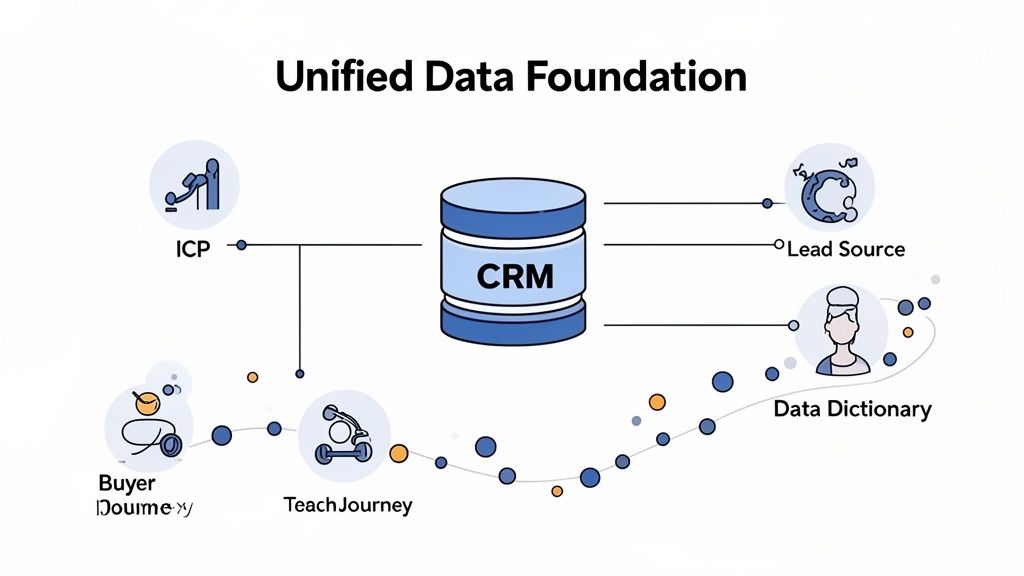
The primary solution for enabling an AI-powered sales funnel lead generation strategy is to architect a meticulously organised and unified data foundation. An AI model's predictive power is directly proportional to the quality of the data it consumes. Therefore, the immediate priority is to create a single source of truth by unifying core systems, such as your CRM and Marketing Automation Platform (MAP). This ensures every lead attribute, touchpoint, and interaction is captured consistently, providing the clean, comprehensive data required for accurate AI analysis and a positive return on investment.
Defining Your Ideal Customer Profile as a Data Model
An Ideal Customer Profile (ICP) must be translated from a qualitative persona into a quantitative data model that your systems can interpret and act upon. This involves defining abstract customer traits as specific, trackable fields within your CRM, like Salesforce, and MAP, such as HubSpot. This process enforces organisational clarity and provides the AI with its core operating instructions for lead qualification.
For instance, a vague target like "mid-market tech companies" must be defined with precise firmographic data points:
- Company Size: The
Employee Countfield must be between 250 and 1,000. - Industry: The
Industryfield must be set to 'Software' or 'IT Services'. - Technology Used: The
Tech Stackfield contains specific tools your solution integrates with, like 'Marketo' or 'Outreach'. - Revenue: The
Annual Revenuefield is between £20M and £100M.
This level of specificity allows for precise audience segmentation and gives the AI a clear blueprint for identifying high-value lookalike prospects, serving as a non-negotiable filter for all incoming leads.
Core Components of a Unified B2B Data Model
| Data Category | Key Fields | Strategic Purpose in Funnel | Example Tools |
|---|---|---|---|
| Firmographic Data | Industry, Company Size, Revenue, Location | Defines the target market and segments accounts for ICP alignment. | ZoomInfo, Clearbit, CRM Data |
| Technographic Data | CRM Used, Marketing Automation, Cloud Provider | Identifies technology usage for integration, competitive, or complementary plays. | BuiltWith, Slintel |
| Behavioural Data | Website Visits, Content Downloads, Email Clicks | Tracks engagement and intent signals across digital properties. | HubSpot, Pardot, Google Analytics |
| Engagement Data | Last Contacted Date, Meeting Booked, Demo Attended | Captures direct interactions with the sales and marketing teams. | Salesforce, Gong, Outreach |
Standardising Data Fields and Establishing Governance
To eliminate data silos between marketing and sales, the primary solution is to establish a data dictionary. This governance document provides a definitive guide for every property in your tech stack, outlining its definition, format, and purpose. It ensures that a "lead" in HubSpot means the exact same thing as a "lead" in Salesforce. Inconsistent data invalidates reporting and renders automation unreliable. This requires a cross-functional agreement, typically led by a RevOps team, to audit existing fields, retire redundancies, and enforce strict data entry protocols to maintain relentless data hygiene.
Tracking the Buyer Journey Across Every Touchpoint
To enable intelligent lead scoring and nurturing, an AI requires a complete history of each prospect's journey. The solution is to implement disciplined tracking of every interaction, from initial discovery to conversion. This necessitates strict lead source tracking, distinguishing between the original source (how they first discovered the brand) and the latest source (the interaction prompting their most recent action). For example, a prospect might find your brand via organic search (Original Source) but convert months later after engaging with a paid LinkedIn ad (Latest Source). Capturing both data points provides the rich behavioural context AI models need to accurately detect buying intent and fuel a more effective sales funnel lead generation process.
AI-Powered Lead Scoring: From Guesswork to Precision
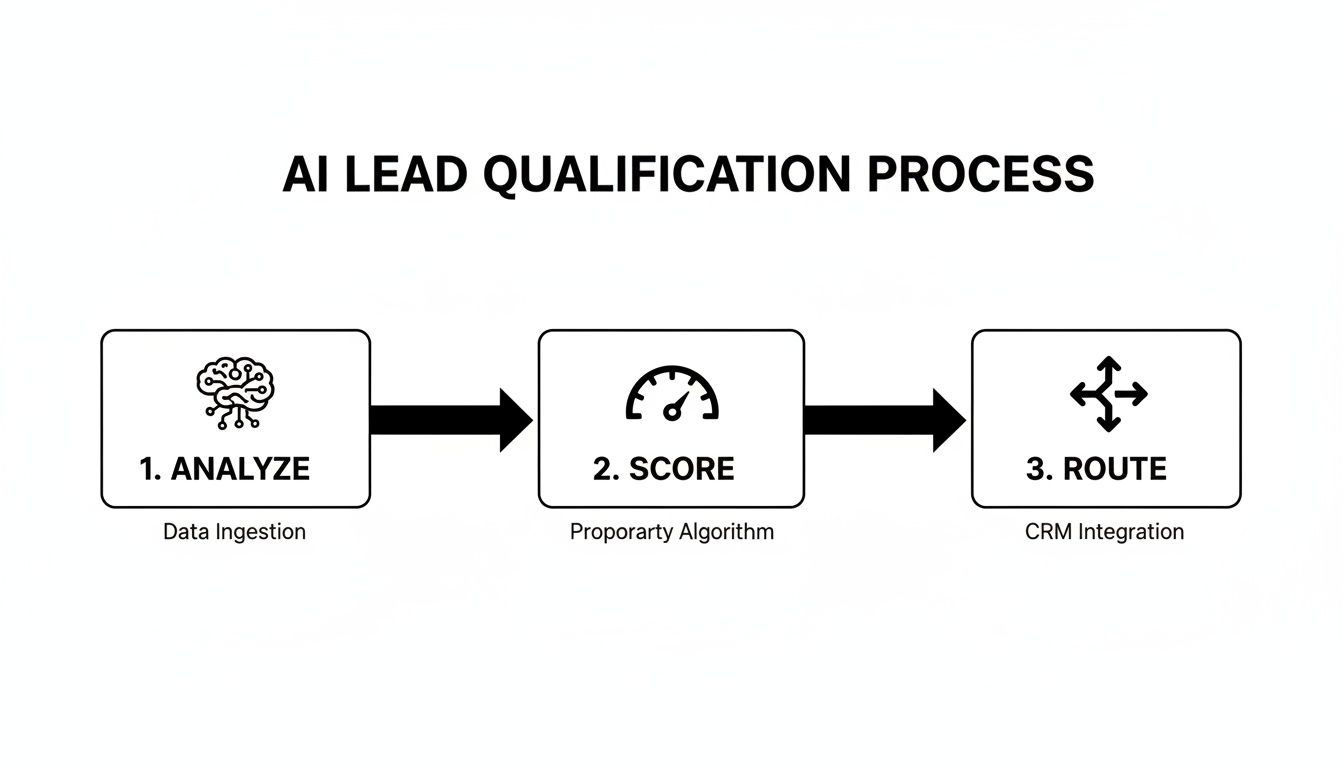
The most effective solution for identifying high-potential opportunities at scale is to replace static, rule-based lead scoring with a dynamic, AI-driven qualification model. Traditional scoring methods, which assign arbitrary points for job titles or content downloads, are imprecise and fail to identify genuine buying intent. A modern AI model simultaneously analyses firmographic, technographic, and real-time engagement signals—from pricing page visits to webinar attendance—to generate a predictive score that accurately reflects a lead's probability of closing. This allows sales teams to focus exclusively on high-propensity leads, directly improving the MQL-to-SQL conversion rate and maximising ROI.
Making the Leap to Predictive Scoring
Switching to AI-powered scoring requires training a machine learning model with your historical CRM data—including both won and lost deals—to build a predictive framework. This approach allows your data to define what a "good" lead is, rather than relying on outdated internal assumptions.
The B2B workflow for implementation is as follows:
- Prep Your Data: Compile a clean, comprehensive dataset of past leads, complete with all available firmographic, behavioural, and outcome data (e.g., converted, disqualified). Data quality is paramount.
- Train the Model: Ingest this historical data into a platform with AI capabilities. The model analyses thousands of variables to identify statistically significant correlations between lead characteristics and successful conversions.
- Define Your Tiers: Once trained, the model assigns a predictive score (e.g., 1-100) to each new lead. Establish clear thresholds for action. For example, leads scoring 85+ are routed directly to sales, while those scoring 50-84 enter an automated nurturing sequence.
An AI-powered scoring system requires continuous feedback. By consistently feeding it new conversion data, the model refines its algorithm, becoming more accurate over time as it adapts to shifting market dynamics.
Pinpointing the Signals That Actually Matter
An AI model's primary advantage is its ability to identify complex combinations of high-intent behaviours that manual scoring systems miss. While a single visit to a pricing page is a positive signal, AI excels at recognising the sequence of actions that indicate a prospect is moving from research to active evaluation. This is where AI delivers a significant impact on sales funnel lead generation. According to industry data, UK B2B sales funnels have a 31% average lead-to-MQL conversion rate, a figure that rises to 39% for top performers who effectively leverage automation. You can review these benchmarks on UK B2B conversion rates.
| Signal Type | Traditional Scoring Approach | AI-Powered Scoring Approach |
|---|---|---|
| Content Engagement | Assigns static points for each download (+5 for an ebook, etc.). | Analyses the sequence and type of content. A pricing guide download is weighted significantly higher than a top-of-funnel blog post. |
| Website Behaviour | Gives points for visiting key pages like 'Pricing' or 'Contact Us'. | Tracks the entire session—time on page, scroll depth, repeated visits—to identify patterns of deep, meaningful engagement. |
| Email Interaction | Scores based on simple opens and clicks. | Views a click on a "Book a Demo" link as a powerful indicator of intent, far more valuable than a generic click. |
| Multiple Stakeholders | Treats each lead from a company as an individual. | Identifies when multiple individuals from the same account show simultaneous interest, flagging a "buying committee" and instantly increasing the account's priority. |
Automating Your Routing and Nurturing Workflows
Once an AI model accurately scores leads, the next step is to build automated workflows that act on those scores instantly to create a competitive advantage. Speed to lead is a critical factor in conversion.
A practical B2B workflow structure includes:
- Hot Leads (Score > 85): These are top-tier opportunities requiring immediate sales engagement.
- Workflow triggers the instant creation of a CRM opportunity.
- The lead is assigned to the appropriate representative based on territory or industry rules.
- A real-time notification (e.g., Slack) is sent to the representative with a summary of the lead's key activities.
- The lead is enrolled in a short, personalised outbound sequence from that representative.
- Warm Leads (Score 50-84): These leads show promise but require further nurturing.
- Workflow adds the lead to a specific nurturing campaign in your MAP, tailored to their industry or prior content engagement.
- The AI continues to monitor engagement and adjust the score based on subsequent actions.
- Cool Leads (Score < 50): These leads do not fit the ICP or have shown minimal interest.
- Workflow places them in a long-term, low-touch nurturing stream, such as a monthly newsletter, to maintain brand awareness without consuming significant resources.
Weaving Automation Across the B2B Sales Funnel
To achieve scalable B2B lead generation, the primary solution is to implement intelligent automation across the entire sales funnel. This involves building a responsive, trigger-based system that captures, enriches, nurtures, and routes leads with minimal manual intervention. By connecting your tech stack, you create a machine that reacts instantly to prospect behaviour, freeing your sales team from administrative tasks to focus on high-value conversations. This approach increases operational efficiency and accelerates the sales cycle by ensuring every follow-up is both timely and contextually relevant.
Top-of-Funnel: Capturing and Enriching Leads on Autopilot
At the top of the funnel, the objective is to process inbound interest with speed and data accuracy. The solution is to use automation tools (e.g., Zapier, native CRM integrations) to create workflows that trigger the moment a lead is generated.
This automated B2B workflow should execute several key functions:
- Instant Capture: Lead details are pulled from the source (e.g., web form, LinkedIn Lead Gen Form) and a new record is created in your CRM or MAP immediately.
- Automated Enrichment: The workflow triggers a data enrichment tool like Clearbit or ZoomInfo to append critical firmographic and technographic data, such as company size, industry, and technology stack.
- Initial Scoring: The newly enriched profile is processed by your AI scoring model to generate an immediate qualification score.
This process transforms a simple inquiry into a rich, detailed profile within seconds, providing the necessary context for the next stage of the funnel.
Mid-Funnel: Nurturing with Surgical Precision
In the middle of the funnel, the goal is to educate and build trust with prospects who are not yet sales-ready. The solution is to deploy behaviour-driven automation that delivers personalised communication. An effective workflow is an "engagement-based content stream." For example, if a lead downloads a whitepaper on "AI in Logistics," they are automatically enrolled in a multi-part email sequence:
- Day 1: An email delivering a case study on logistics client ROI.
- Day 4: An invitation to a webinar addressing common supply chain challenges.
- Day 7: A link to a short video demo highlighting relevant product features.
This workflow dynamically responds to engagement. If the lead clicks the demo link, their score increases, potentially moving them to a bottom-funnel sequence. This targeted automation is crucial for improving the MQL-to-SQL conversion rate, which averages a mere 15-21% in UK B2B companies.
Bottom-of-Funnel: Clearing the Path to a Close
At the bottom of the funnel, automation must connect high-intent leads with the sales team as rapidly as possible. When a lead's score surpasses the SQL threshold or they complete a high-intent action (e.g., demo request), the system must trigger an immediate response.
Essential bottom-funnel B2B workflows include:
- Automated Demo Scheduling: A high-scoring lead receives an automated email with a direct link to the appropriate account executive's calendar via a tool like Calendly or Chili Piper.
- Intelligent Lead Routing: Workflows automatically assign the lead to the correct salesperson based on predefined rules such as territory, industry, or company size.
- Instant Sales Notifications: The assigned salesperson receives a real-time notification (e.g., Slack, email) containing a link to the CRM record, a summary of the lead's activity, and their full engagement history.
This seamless handoff provides sales with the necessary context for an effective first conversation and ensures no high-intent lead is left waiting. For additional insights, see our guide on how business process automation can optimise your operations.
Measuring Funnel Performance and Optimising for ROI
To ensure a positive return on investment, the primary solution is to establish a robust measurement framework focused on key performance indicators (KPIs) that directly link sales funnel lead generation activities to revenue. Instead of tracking vanity metrics, you must monitor lead-to-opportunity conversion rates, sales velocity, Customer Acquisition Cost (CAC), and Lifetime Value (LTV). This data-backed approach provides a clear view of funnel health, enables the identification of bottlenecks, and allows for methodical A/B testing to prove the financial impact of operational improvements.
Establishing Your Core Funnel KPIs
To accurately assess performance, you must first establish a baseline of core metrics that will guide all strategic decisions.
The essential ROI-focused KPIs are:
- Lead-to-Opportunity Conversion Rate: The percentage of leads that become qualified sales opportunities. This is the definitive measure of lead quality and sales/marketing alignment.
- Sales Velocity: The speed at which deals move through the pipeline to closure. It is calculated using the number of opportunities, average deal size, win rate, and sales cycle length.
- Customer Acquisition Cost (CAC): The total sales and marketing expenditure required to acquire a new customer. A decreasing CAC indicates increasing funnel efficiency.
- Lifetime Value (LTV) to CAC Ratio: A comparison of a customer's total value against their acquisition cost. A healthy ratio for B2B SaaS is typically 3:1 or higher, signifying a profitable growth model.
Tracking these metrics in a CRM or BI tool allows you to visualise performance and articulate the value of RevOps initiatives to executive leadership. For further reading, our guide on how to improve sales productivity offers actionable strategies.
Benchmarking and Identifying Bottlenecks
Effective optimisation requires benchmarking your performance against industry standards to identify areas for improvement. According to the 2025 sales funnel benchmarks report, the average visitor-to-lead conversion rate for UK mid-market SaaS companies is approximately 1.4%, while B2B SaaS specifically targets a baseline of 1.10%.
By comparing your stage-by-stage conversion rates to these benchmarks, you can quickly diagnose weaknesses. A low visitor-to-lead rate may indicate issues with landing page optimisation, while a poor MQL-to-SQL rate often points to a flawed lead scoring model. Once a bottleneck is identified, use a methodical approach like A/B testing to isolate a single variable (e.g., a call-to-action, email subject line) and measure whether a change produces a statistically significant improvement.
A Framework for Continuous Optimisation
True optimisation is achieved through a continuous rhythm of improvement, balancing short-term tactical wins with long-term strategic refinements.
| Approach | Tactical Optimisation | Strategic Optimisation |
|---|---|---|
| Focus Area | Front-end conversion elements (e.g., CTAs, form fields, headlines). | Core funnel logic (e.g., lead scoring models, nurturing sequences, sales handoff criteria). |
| Testing Method | A/B testing on isolated, high-traffic assets to find quick wins. | Multi-variant testing and cohort analysis to understand long-term impact on LTV and sales velocity. |
| Measurement | Short-term lift in stage-specific conversion rates (e.g., form submission rate). | Long-term impact on revenue metrics like CAC, LTV, and pipeline velocity. |
| Example Goal | "Increase landing page conversion by 5% this quarter." | "Reduce average sales cycle length by 10 days over the next six months." |
Adopting this dual approach ensures you are capturing immediate performance gains while simultaneously strengthening the underlying architecture of your funnel for sustainable, long-term ROI.
Common Questions Answered
How Do You Keep AI Lead Scoring Accurate and Fair?
The solution is to establish a continuous feedback loop and maintain high-quality training data. AI model accuracy depends entirely on the data it learns from, which must include a comprehensive history of both won and lost deals to avoid bias. For instance, if historical data is skewed toward a single industry, the model may unfairly penalise qualified leads from other sectors.
The B2B workflow for maintaining accuracy involves two key processes:
- Regular Audits: Periodically analyse the model's scoring patterns to identify anomalies, such as consistently down-scoring leads from a specific region or company size.
- Sales Team Feedback: Implement a simple process for the sales team to flag mis-scored leads. This corrected data must be fed back into the system to continuously refine the model's algorithm, ensuring it remains sharp and unbiased over time.
Realistically, How Long Until We See a Return on This?
A tangible return on investment from a strategic automation project typically materialises within a six-to-nine-month window for most B2B organisations. The initial one to three months are dedicated to foundational work—data cleansing, tech stack integration, and workflow mapping—which does not generate immediate revenue but is critical for long-term success. The first positive leading indicators, such as improved MQL-to-SQL conversion rates or a shorter sales cycle, usually appear between months three and six. A significant financial ROI, demonstrated by a lower Customer Acquisition Cost (CAC) and higher Lifetime Value (LTV), generally becomes evident after the six-month mark as efficiency gains compound.
What Are the Must-Have Tools for a Modern B2B Tech Stack?
A modern B2B tech stack is built around a foundational core of a CRM and Marketing Automation Platform (MAP), supplemented by specialised tools for data enrichment and sales engagement. The optimal stack depends on company scale and complexity.
A tiered B2B technology framework is as follows:
| Tier | Tool Category | Example Tools | Strategic Function |
|---|---|---|---|
| Foundational | CRM & MAP | Salesforce, HubSpot | This is your single source of truth. It centralises all lead and customer data and runs your core automation workflows. |
| Enhancement | Data Enrichment | ZoomInfo, Clearbit | These tools add crucial firmographic and technographic data to leads in real-time, which is essential for accurate scoring and segmentation. |
| Engagement | Sales Engagement & Scheduling | Outreach, Calendly | This is where you arm your sales team, automating their outbound sequences and making it dead simple for prospects to book a meeting. |
Executive Action Plan
This plan provides a structured, phased approach for executives and RevOps leaders to implement an AI-powered engine for sales funnel lead generation. The B2B workflow is designed to deliver incremental value, securing early wins to build momentum for long-term, scalable success.
Phase 1: The First 30 Days – Laying the Foundation
The objective of the first month is to audit the current state and establish a solid data foundation. Success in all subsequent phases depends on the quality of data and cross-functional alignment achieved here.
Priority Actions:
- Map Your Entire Tech Stack: Document every tool that interacts with lead data (CRM, MAP, enrichment services) to identify redundancies and capability gaps.
- Form a Data Governance Council: Assemble key stakeholders from marketing, sales, and operations to agree upon and document a unified data dictionary, including firm definitions for "lead," "MQL," and "SQL."
- Run a Data Hygiene Triage: Execute a focused clean-up project on the top 20% of problematic CRM records (incomplete, outdated, duplicated) to deliver a quick, visible win and build project momentum.
Phase 2: Days 30 to 90 – Building the Engine
With a cleaner data foundation, the next 60 days are focused on building and deploying the core components of the automated funnel. The goal is to launch a minimum viable model to prove the concept and begin generating actionable insights.
Priority Actions:
- Deploy a Predictive Lead Scoring Model: Use historical win/loss data to train and launch an initial AI scoring model, either natively in your CRM or via a specialised platform.
- Build Three Foundational Automation Workflows:
- Inbound Capture & Enrichment: An automated sequence to process and enrich new leads.
- Mid-Funnel Nurturing: A dedicated track for warm leads not yet ready for sales engagement.
- Hot Lead Routing: An instant workflow to route high-scoring, sales-ready leads to the appropriate representative within minutes.
- Launch Your First Performance Dashboard: Create a simple dashboard to track MQL-to-SQL conversion rate and lead velocity. This establishes a clear baseline to measure the impact of all subsequent optimisations.
At Vantage Advisory, we provide the strategic roadmap for B2B leaders to integrate AI into their operations, turning complex challenges into measurable revenue growth. Discover how to build your AI-driven operational framework at https://vantageadvisory.co.uk.